







The Persistence of Paper Reading Answers, IELTS Passage
 Porishmita .18 Mar, 2025
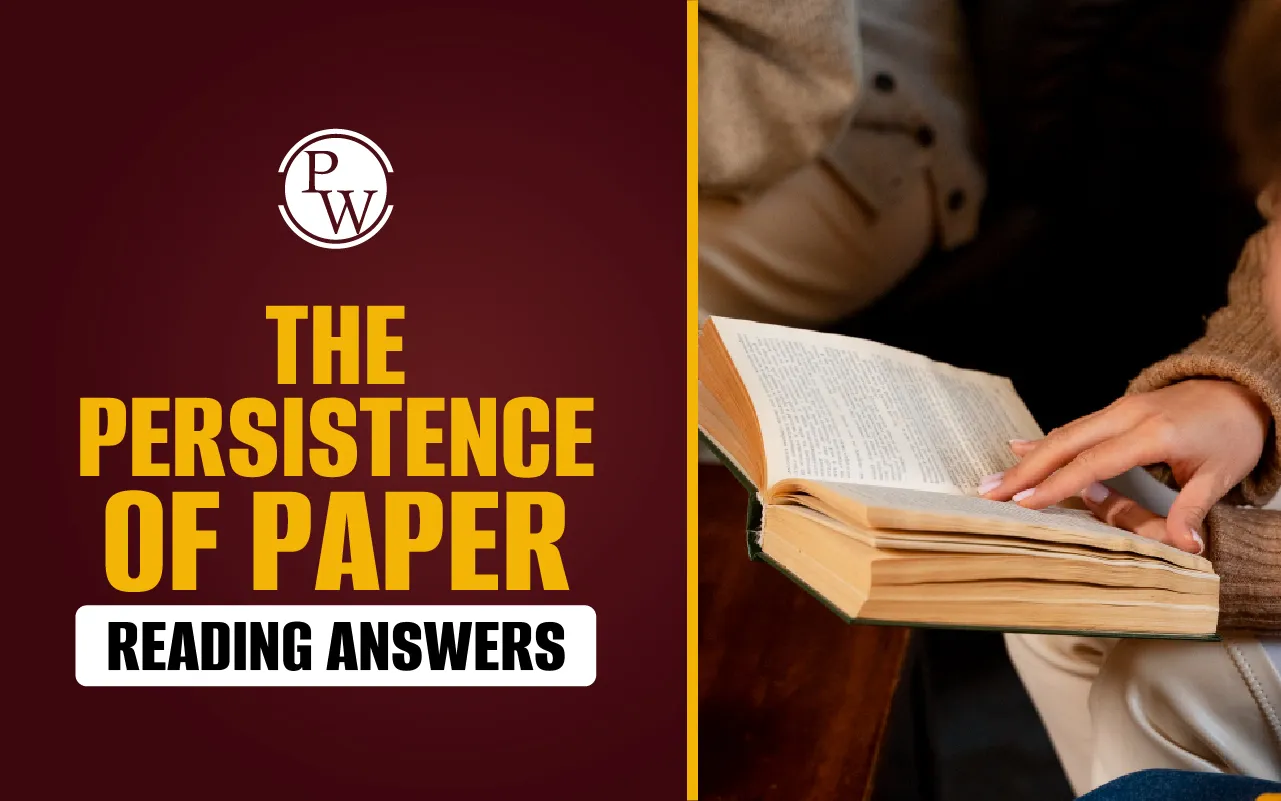
The Persistence of Paper Reading Answers: The Persistence of Paper IELTS Reading Answers explores the enduring relevance of paper despite the rise of digital technology. This guide examines why paper continues to play a crucial role in work and cognitive processes, highlighting its unique advantages over digital alternatives. It includes a sample passage with answers to question types like Matching Headings, Summary Completion, and Multiple Choice Questions, helping IELTS 2025 candidates strengthen their reading skills. By practicing with this passage, test-takers will improve their ability to analyze complex information and accurately answer related questions. Read on to uncover why paper remains indispensable in the modern world.
The Persistence of Paper Reading Answers Passage
The Persistence of Paper
A. Computer technology was supposed to replace paper. But that hasn’t happened. Every country in the Western world uses more paper today, on a per- capita basis, than it did ten years ago. The consumption of uncoated free-sheet paper, for instance the most common kind of office paper — rose almost fifteen per cent in the United States between 1995 and 2000. This is generally taken as evidence of how hard it is to eradicate old, wasteful habits and of how stubbornly resistant we are to the efficiencies offered by computerization. A number of cognitive psychologists and ergonomics experts, however, don’t agree. Paper has persisted, they argue, for very good reasons: when it comes to performing certain kinds of cognitive tasks, paper has many advantages over computers. The dismay people feel at the sight of a messy desk — or the spectacle of air-traffic controllers tracking flights through notes scribbled on paper strips – arises from a fundamental confusion about the role that paper plays in our lives.
B. The case for paper is made most eloquently in “The Myth of the Paperless Office”, by two social scientists, Abigail Sellen and Richard Harper. They begin their book with an account of a study they conducted at the International Monetary Fund, in Washington, D.C. Economists at the I.M.F. spend most of their time writing reports on complicated economic questions, work that would seem to be perfectly suited to sitting in front of a computer. Nonetheless, the I.M.F. is awash in paper, and Sellen and Harper wanted to find out why. Their answer is that the business of writing reports – at least at the I.M.F. is an intensely collaborative process, involving the professional judgments and contributions of many people. The economists bring drafts of reports to conference rooms, spread out the relevant pages, and negotiate changes with one other. They go back to their offices and jot down comments in the margin, taking advantage of the freedom offered by the informality of the handwritten note. Then they deliver the annotated draft to the author in person, taking him, page by page, through the suggested changes. At the end of the process, the author spreads out all the pages with comments on his desk and starts to enter them on the computer — moving the pages around as he works, organizing and reorganizing, saving and discarding.
C. Without paper, this kind of collaborative and iterative work process would be much more difficult. According to Sellen and Harper, paper has a unique set of “affordances” — that is, qualities that permit specific kinds of uses. Paper is tangible: we can pick up a document, flip through it, read little bits here and there, and quickly get a sense of it. Paper is spatially flexible, meaning that we can spread it out and arrange it in the way that suits the US best. And it’s tailorable: we can easily annotate it, and scribble on it as we read, without altering the original text. Digital documents, of course, have their own affordances. They can be easily searched, shared, stored, accessed remotely, and linked to other relevant material. But they lack the affordances that really matter to a group of people working together on a report. Sellen and Harper write:
D. Paper enables a certain kind of thinking. Picture, for instance, the top of your desk. Chances are that you have a keyboard and a computer screen off to one side, and a clear space roughly eighteen inches square in front of your chair. What covers the rest of the desktop is probably piles- piles of papers, journals, magazines, binders, postcards, videotapes, and all the other artefacts of the knowledge economy. The piles look like a mess, but they aren’t. When a group at Apple Computer studied piling behaviour several years ago, they found that even the most disorderly piles usually make perfect sense to the piler, and that office workers could hold forth in great detail about the precise history and meaning of their piles. The pile closest to the cleared, eighteen-inch-square working area, for example, generally represents the most urgent business, and within that pile the most important document of all is likely to be at the top. Piles are living, breathing archives. Over time, they get broken down and resorted, sometimes chronologically and sometimes thematically and sometimes chronologically and thematically; clues about certain documents may be physically embedded in the file by, say, stacking a certain piece of paper at an angle or inserting dividers into the stack.
E. But why do we pile documents instead of filing them? Because piles represent the process of active, ongoing thinking. The psychologist Alison Kidd, whose research Sellen and Harper refer to extensively, argues that “knowledge workers” use the physical space of the desktop to hold “ideas which they cannot yet categorize or even decide how they might use.” The messy desk is not necessarily a sign of disorganization. It may be a sign of complexity: those who deal with many unresolved ideas simultaneously cannot sort and file the papers on their desks, because they haven’t yet sorted and filed the ideas in their head. Kidd writes that many of the people she talked to use the papers on their desks as contextual cues to’’ recover a complex set of threads without difficulty and delay” when they come in on a Monday morning, or after their work has been interrupted by a phone call. What we see when we look at the piles on our desks is, in a sense, the contents of our brains.
F. This idea that paper facilitates a highly specialized cognitive and social process is a far cry from the way we have historically thought about the stuff. Paper first began to proliferate in the workplace in the late nineteenth century as part of the move toward “systematic management.” To cope with the complexity of the industrial economy, managers were instituting company-wide policies and demanding monthly, weekly, or even daily updates from their subordinates. Thus was born the monthly sales report, and the office manual and the internal company newsletter. The typewriter took off in the eighteen-eighties, making it possible to create documents in a fraction of the time it had previously taken, and that was followed closely by the advent of carbon paper, which meant that a typist could create ten copies of that document simultaneously. Paper was important not to facilitate creative collaboration and thought but as an instrument of control.
| IELTS Exam Important Links | |
|---|---|
| IELTS Reading Band Score | IELTS Listening Band Score |
| IELTS Speaking Band Score | IELTS Writing Band Score |
The Persistence of Paper Reading Answers Sample Questions
Questions 1-6
(Headings Matching)
The reading passage has six paragraphs, A–F.
Choose the correct heading for paragraphs A–F from the list below.
Write the correct option, I–IX, in boxes 1–6 on your answer sheet.
List of Headings:
I. The advantages of paper in cognitive tasks
II. Historical reasons for the rise of paper use in workplaces
III. Why paper still dominates despite technological advances
IV. The psychology behind desk organization
V. The role of paper in decision-making and collaboration
VI. Technological limitations compared to paper
VII. The symbolism of paper clutter in workspaces
VIII. How paper enables effective teamwork
IX. The environmental impact of paper use
-
Paragraph A -
-
Paragraph B -
-
Paragraph C -
-
Paragraph D -
-
Paragraph E -
-
Paragraph F -
Questions 7–10
(Summary Completion)
Complete the following summary of the paragraphs of the reading passage, using no more than three words from the reading passage for each answer.
Write your answers in boxes 7–10 on your answer sheet.
The continued use of paper despite the rise of (7) __________ reflects its unique cognitive benefits. Studies have shown that paper allows greater flexibility in tasks requiring (8) __________ and teamwork. The ability to annotate and rearrange paper documents makes it highly effective for collaborative work. Researchers have also discovered that organized (9) __________ on desks help people retain and structure complex ideas. This suggests that paper serves not only a practical purpose but also supports the brain's process of handling (10) __________.
Questions 11–14
(Multiple Choice)
Choose the correct letter, A, B, C or D.
Write your answers in boxes 11–14 on your answer sheet.
-
What was one key finding from the study conducted at the IMF?
A. Paper was only used for informal communication.
B. Paper was primarily used for preparing reports.
C. Paper facilitated collaborative decision-making.
D. Paper use decreased due to technological improvements. -
What is meant by the term "affordances" in the passage?
A. Qualities that make paper more expensive than digital formats.
B. Characteristics that make paper suitable for specific uses.
C. Benefits of reducing paper use in offices.
D. Factors influencing environmental impact of paper. -
Why do people often pile papers on their desks instead of filing them?
A. To make their workspaces more organized.
B. To avoid losing important documents.
C. To use them as mental cues for ongoing ideas.
D. To minimize paper consumption. -
What was the original role of paper in the workplace according to the passage?
A. To support creative thinking.
B. To increase efficiency in communication.
C. To facilitate employee training.
D. To maintain managerial control.
The Persistence of Paper Reading Answers with Explanations
-
Paragraph A – III. Why paper still dominates despite technological advances
-
Answer: III
-
Location: Paragraph A
-
Reference: "Computer technology was supposed to replace paper. But that hasn’t happened."
-
Explanation: Paragraph A discusses how, despite technological advances, paper remains widely used because it offers advantages that technology cannot fully replace.
-
Paragraph B – V. The role of paper in decision-making and collaboration
-
Answer: V
-
Location: Paragraph B
-
Reference: "The business of writing reports – at least at the I.M.F. – is an intensely collaborative process."
-
Explanation: The paragraph explains how paper plays a critical role in collaborative decision-making and communication within the IMF.
-
Paragraph C – I. The advantages of paper in cognitive tasks
-
Answer: I
-
Location: Paragraph C
-
Reference: "Paper has a unique set of 'affordances' — that is, qualities that permit specific kinds of uses."
-
Explanation: The paragraph highlights the cognitive benefits of paper, such as its flexibility and the ability to annotate.
-
Paragraph D – IV. The psychology behind desk organization
-
Answer: IV
-
Location: Paragraph D
-
Reference: "The piles look like a mess, but they aren’t. When a group at Apple Computer studied piling behaviour... workers could hold forth in great detail about the precise history and meaning of their piles."
-
Explanation: The paragraph explores how the organization of paper on desks reflects mental organization and cognitive processes.
-
Paragraph E – VII. The symbolism of paper clutter in workspaces
-
Answer: VII
-
Location: Paragraph E
-
Reference: "The messy desk is not necessarily a sign of disorganization. It may be a sign of complexity."
-
Explanation: The paragraph explains how paper piles symbolize ongoing thinking and problem-solving rather than simple clutter.
-
Paragraph F – II. Historical reasons for the rise of paper use in workplaces
-
Answer: II
-
Location: Paragraph F
-
Reference: "Paper first began to proliferate in the workplace in the late nineteenth century as part of the move toward 'systematic management.'"
-
Explanation: The paragraph discusses the historical reasons behind the rise of paper use in workspaces, including managerial control and efficiency.
-
(Technology)
-
Answer: technology
-
Location: Paragraph A
-
Reference: "Computer technology was supposed to replace paper. But that hasn’t happened."
-
Explanation: The passage mentions that despite technological advances, paper usage remains high because of its cognitive benefits.
-
(Collaboration and teamwork)
-
Answer: collaboration and teamwork
-
Location: Paragraph B
-
Reference: "The business of writing reports... is an intensely collaborative process."
-
Explanation: The passage emphasizes how paper facilitates collaborative work in a way that digital formats cannot match.
-
(Piles of paper)
-
Answer: piles of paper
-
Location: Paragraph D
-
Reference: "The pile closest to the cleared, eighteen-inch-square working area... represents the most urgent business."
-
Explanation: The passage explains how organized piles of paper act as memory cues and help with task prioritization.
-
(Complex ideas)
-
Answer: complex ideas
-
Location: Paragraph E
-
Reference: "The messy desk... may be a sign of complexity."
-
Explanation: The passage discusses how paper organization reflects mental complexity and helps in managing complex ideas.
-
What was one key finding from the study conducted at the IMF?
-
Answer: C. Paper facilitated collaborative decision-making.
-
Location: Paragraph B
-
Reference: "The business of writing reports – at least at the I.M.F. – is an intensely collaborative process."
-
Explanation: The study showed that paper use was essential for collaborative work and decision-making among IMF economists.
-
What is meant by the term "affordances" in the passage?
-
Answer: B. Characteristics that make paper suitable for specific uses.
-
Location: Paragraph C
-
Reference: "Paper has a unique set of 'affordances' — that is, qualities that permit specific kinds of uses."
-
Explanation: The term refers to the unique features of paper that make it particularly useful for cognitive and collaborative tasks.
-
Why do people often pile papers on their desks instead of filing them?
-
Answer: C. To use them as mental cues for ongoing ideas.
-
Location: Paragraph E
-
Reference: "The messy desk... may be a sign of complexity."
-
Explanation: The passage explains that people use paper piles to track complex ideas and maintain mental organization.
-
What was the original role of paper in the workplace according to the passage?
-
Answer: D. To maintain managerial control.
-
Location: Paragraph F
-
Reference: "Paper first began to proliferate... as part of the move toward 'systematic management.'"
-
Explanation: The passage states that paper was initially used to create managerial control and improve efficiency through documentation.
Also Read:
- Should You Use All Capital Letters in the IELTS Listening and Reading Tests
- IELTS Reading Mistakes
- How to Improve IELTS Reading Score
- How to Manage Time in IELTS Reading
Guidance of PW IELTS
Physics Wallah offers multiple online IELTS courses for all students. Follow the IELTS pages to better prepare for the exam.
| What is IELTS Exam? | Documents Required for IELTS Registration |
| IELTS exam eligibility requirements | IELTS Exam Fees |
| IELTS test results | IELTS Exam Pattern |
The Persistence of Paper Reading Answers FAQs
Why has paper not been replaced by digital technology?
What advantages does paper have over digital documents?
How does paper support collaborative work in professional settings?
Why do people tend to pile papers instead of filing them?
What was the original reason for increased paper use in the workplace?









 Live & recorded classes available at easeDashboard for progress trackingMillions of practice questions at your fingertips

