







UGC NET History Unit 10 PYQs, Important Previous Year Questions
UGC NET History Unit 10 PYQs cover Historiography, historical methods, primary and secondary sources, major historians such as R.G. Collingwood and Leopold von Ranke, as well as Postmodernism, Marxist historiography, Subaltern Studies, and Orientalist. Regular practice helps strengthen conceptual understanding and improve performance in the UGC NET examination.
 Priyanka Yadav10 Jun, 2026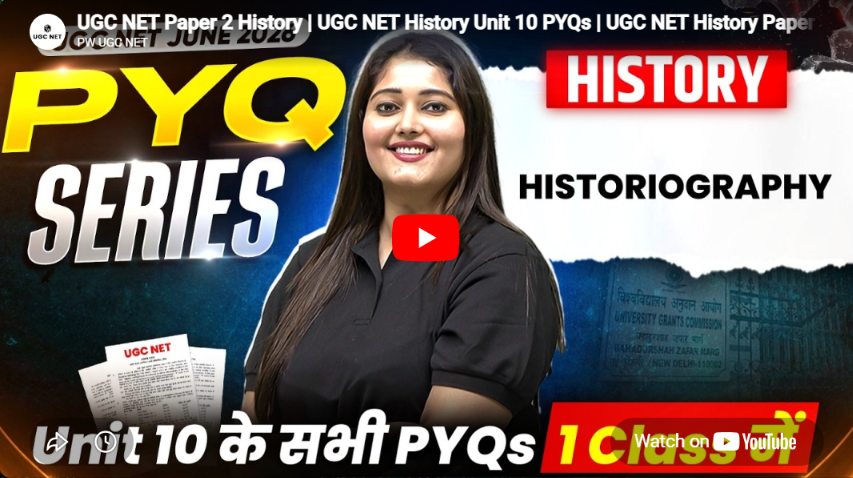
UGC NET History Unit 10 focuses on Historiography, examining the methods, approaches, and interpretations historians use to study and write history. This unit includes important topics such as schools of historiography, historical methods, sources of history, research methodology, and the contributions of major historians. Questions from this unit are regularly asked in the UGC NET History examination.
Practicing UGC NET History Unit 10 Previous Year Questions (PYQs) helps candidates understand important concepts and identify frequently asked themes. Many questions in this unit are based on historians, books, theories, schools of thought, and source analysis. Students who want detailed explanations and solutions of the PYQs can refer to the attached video discussion.
UGC NET History Unit 10 PYQs
Practicing PYQs from this unit helps you understand important concepts such as primary and secondary sources, Marxist historiography, Postmodernism, Subaltern Studies, and the theories of historians like R. G. Collingwood and Leopold von Ranke.
The following UGC NET History Unit 10 PYQs have been asked in previous examinations and cover some of the most important topics from Historiography.
Q1. Which of the following are correct?
A) History is concerned with human beings operating in society
B) History is concerned with change through time
C) History is not concerned with change through time
D) History is concerned with the concrete and the particular
E) History is not concerned with human beings operating in society
Options:
A) A, B, and D only
B) A, B, D, and E only
C) A, C, D, and E only
D) A, B, and E only
Q2. Which of the following are correct?
A) History provides us with a sense of our own identity
B) History helps us better understand the past
C) History does not provide the basic background for many other disciplines
D) History enables us to understand the tendencies of humankind, social institutions and all aspects of the human condition
E) The careful study of history teaches many critical skills
Options:
A) A, B, D, and E only
B) A, B, C, and D only
C) A, B, and C only
D) A, B, and D only
Q3. Which of the following are correct?
A) A primary source is a piece of evidence written or created during the period under investigation
B) Primary sources are the records of contemporaries who participated in, witnessed, or commented on the events one is studying
C) Primary sources do not include newspapers
D) A secondary source is an account of the period in question written after the events have taken place
E) The distinction between primary and secondary sources is always very clear
Options:
A) A, C, and D only
B) A, B, C, and D only
C) A, B, D, and E only
D) A, B, and D only
Q4. Which of the following points have been conventionally used to draw a fundamental distinction between History and Science?
A. History deals exclusively with the unique, while science deals with general phenomena
B. History, unlike science, involves issues of religion and morality
C. History deals with philosophical issues only
D. History is unable to predict
E. History is a series of lessons
Options:
A) A, C, E only
B) B, C, E only
C) D, C, E only
D) A, B, D only
Q5. Which of the following developments in History writing introduced a critical examination of the primary sources?
A) Church Historiography
B) Renaissance Historiography
C) Berlin Revolution in History Writing
D) Roman Historiography
Q6. Which text opens with the statement, “The historiography of Indian nationalism has for a long time been dominated by elitism”?
A) The Elementary Aspects of Peasant Insurgency in Colonial India
B) Subaltern Studies Vol. I
C) Rule of Property for Bengal: An Essay on the Idea of Permanent Settlement
D) Peasant Movement in Colonial India: North Bihar, 1917–1942
Q7. Which of the following are correct about R. G. Collingwood’s theory of history?
A. All history is the history of the process of events.
B. History is concerned with the purposeful actions of individuals.
C. Historian’s method is a detective’s method.
D. The writing of history is through the re-enactment of the thoughts of past actors in the minds of the historian.
E. His philosophy of history has been characterized as ‘radical historicism’.
Options:
A) B, C, D, and E only
B) A, B, C, D, E
C) C, D, and E only
D) A, B, and D only
Q8. Which of the following statements is not true for post-modernist historiography?
A) Sources which reflect the past are always written from somebody else's point of view
B) Causation and chronology are essential for history writing
C) The idea of sequential time may be abandoned in the writing of history
D) Historical sources do not have fixed and unalterable meaning
Q9. The 18th and 19th Centuries were dominated by the writings of European scholars, usually referred to as:
A) Nationalists
B) Marxists
C) Orientalists
D) Communists
Q10. Which one of the following statements regarding the Marxist school of Indian historiography is not correct?
A) The foundations of this school, so far as the study of the national movement is concerned, were laid by R. Palme Dutt and A. R. Desai, but several others developed it over the years.
B) They tend to see the national movement as a structured bourgeois movement.
C) They interpret the class character of the national movement in terms of its forms of struggle, its strategic retreats and compromises.
D) They believed that access to financial resources did not determine the ability to influence the course and direction of national politics.
UGC NET History Unit 10 PYQs FAQs
Q1. What are the important topics covered in UGC NET History Unit 10?
Q2. Which historian is associated with the critical use of primary sources?
Q3. What is the main focus of Postmodern Historiography?
Q4. Why are UGC NET History Unit 10 PYQs important?







Get Free Counselling Today
and Clear up all your Doubts
 Live & recorded classes available at easeDashboard for progress trackingLakhs of practice questions

