







UGC NET History Unit 8 PYQs, Question and Answers
UGC NET History Unit 8 PYQs focus on Modern India topics such as V.D. Savarkar, constitutional reforms, the Revolt of 1857, British policies, colonial science, and freedom movements. These 10 solved PYQs help students revise important concepts, chronology-based questions, and recurring exam themes.
 Aarti .10 Jun, 2026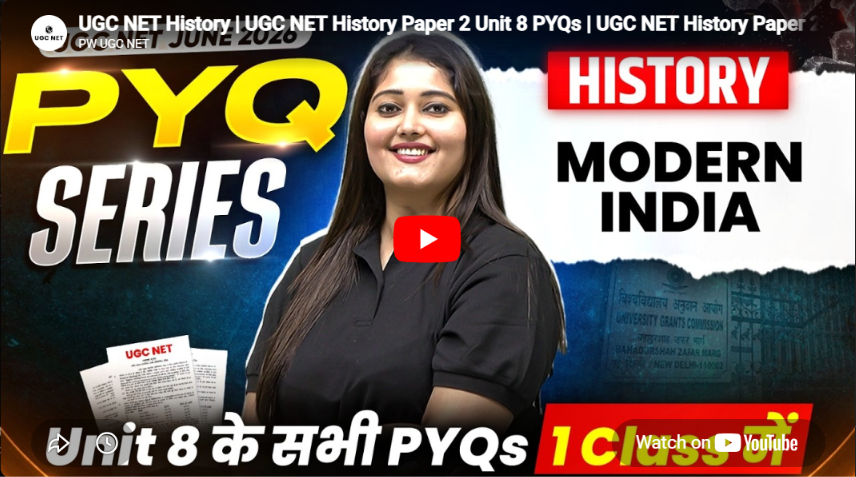
UGC NET History Unit 8 covers Modern India and is one of the most important sections of the History syllabus. Questions from this unit appear regularly in the examination. Many questions are direct, while others are based on chronology, assertion-reasoning, matching, and statement-based formats.
The UGC NET June 2026 examination for History will be conducted between June 22 and June 30, 2026. Solving PYQs before the examination can help students revise key concepts and understand the level of questions asked in this unit.
Students who want detailed explanations of concepts, answer analysis, and additional previous year questions can watch the attached video. The session discusses important Unit 8 PYQs and explains the approach required to solve them effectively.
UGC NET History Unit 8 PYQs
UGC NET History Unit 8 covers Modern Indian History, including nationalism, freedom movements, British policies, socio-religious reforms, and constitutional developments. Practicing previous year questions helps candidates identify important topics, recognize question patterns, and improve exam preparation.
Q1. Which one is/are correct out of the following?
(A) V.D. Savarkar was a graduate of Fergusson College.
(B) V.D. Savarkar availed of Krishna Verma's fellowship offer and left for London in June 1906.
(C) V.D. Savarkar established Mitra Mela at Nasik.
(D) V.D. Savarkar wrote "The Indian War of Independence, 1857".
(E) V.D. Savarkar became a member of the India House.
Options:
(A) (A), (B), (C), (D) only
(B) (A), (B), (C), (E) only
(C) (A), (B), (C), (D), (E) only
(D) (A), (B), (C) only
Answer: (C)
Q2. Arrange the following chronologically (Legal Reforms):
(A) Morley-Minto Reforms
(B) Government of India Act
(C) Montagu-Chelmsford Reforms
(D) India declared "Sovereign Democratic Republic."
(E) Constituent Assembly of India
Options:
(A) A, C, B, E, D
(B) A, B, C, D, E
(C) B, C, D, E, A
(D) E, C, D, B, A
Answer: (A)
Q3. 29th Mangal Pandey, a young soldier, was hanged on 29th March 1857 for attacking his superior officers. Mangal Pandey became a martyr at:
(A) Meerut
(B) Danapore
(C) Barrackpore
(D) Allahabad
Answer: (C) Barrackpore
Q4. Which of the following statements about India's constitutional development are correct?
(A) Bicameral legislatures were introduced at the centre by the Government of India Act 1935.
(B) Dyarchy was introduced in the provinces by the Government of India Act 1919.
(C) Annie Besant termed the Act of 1919 as unworthy of England to offer and unworthy of India to accept.
(D) Provincial autonomy was introduced by the Government of India Act 1935.
(E) The Congress rejected the Indian Council Act of 1919.
Options:
(A) (A), (B), and (C) only
(B) (B), (C), and (D) only
(C) (C), (D), and (E) only
(D) (B), (C), (D), and (E) only
Answer: (D)
Q5. Which of the following statements regarding the impact of Western ideas on India are correct?
(a) English education opened the flood-gates of Western ideas, which almost overwhelmed them at the beginning.
(b) The acceptance of Western ideas that came through the medium of English was synonymous with the acceptance of British rule.
(c) It immediately aroused political consciousness and resistance against political authority.
(d) It infused a spirit of rationalism that led to the revolt of mind against the tyranny of dogma and traditional authorities, beliefs, and customs.
Options:
(A) a, b, c
(B) a, d
(C) b, c
(D) b, c, d
Answer: (B)
Q6. Which of the following statements regarding the promotion of science during Colonial India are correct?
(a) Nineteenth-century Indian Science was a Eurocentric, centripetal, and hegemonistic discipline.
(b) For Mahendra Lal Sarkar, political nationalism had no meaning without science as its guiding spirit.
(c) The state involvement made colonial science philanthropic and promoted Indian interests.
(d) Colonial Science was inextricably woven into the whole fabric of colonialism.
Options:
(A) a, b
(B) a, c, d
(C) c, d
(D) a, b, d
Answer: (D)
Q7. Arrange the following events chronologically, starting from the earliest:
(A) The Cabinet Mission Plan
(B) Wavell's Plan
(C) Attlee's Announcement
(D) Mountbatten's Plan
(E) Cripps Proposal
Options:
(A) B, A, C, E, D
(B) E, B, A, C, D
(C) A, D, E, B, C
(D) A, C, E, B, D
Answer: (B)
Q8. Given below are two statements: one is labelled as Assertion (A) and the other is labelled as Reason (R).
Assertion (A): The Chauri Chaura event is being held responsible for delaying the attainment of Swaraj as envisaged in 1920.
Reason (R): The idea of Swaraj was not clearly defined, as asserted by many contemporaries.
Options:
(A) Both (A) and (R) are correct, and R is the correct explanation of A.
(B) Both (A) and (R) are correct, but R is NOT the correct explanation of A.
(C) (A) is correct, but (R) is not correct.
(D) (A) is not correct, but (R) is correct.
Answer: (A)
Q9. Which is/are correct regarding the impact of British rule?
A. The growth of the Indian foreign trade was neither natural nor normal; it was artificially fostered to serve imperialism.
B. The composition and character of the foreign trade were imbalanced.
C. India experienced a drain of wealth.
D. The ruin of indigenous industries and the absence of other avenues of employment forced millions of craftsmen to crowd into agriculture.
E. There was a progressive decline and destruction of urban and rural handicraft industries.
Options:
(A) A, B, C, and D only
(B) A, B, C, D, and E
(C) A, B, and C only
(D) A and B only
Answer: (B)
Q10. The Provincial Finances for the Local Self-Government were introduced under:
(A) Lord Ripon
(B) Lord Chelmsford
(C) Lord Morley
(D) Lord Mayo
Answer: (D) Lord Mayo
UGC NET History Unit 8 PYQs with Answers FAQs
What topics are covered in UGC NET History Unit 8?
Are chronology-based questions asked in UGC NET History Unit 8?
Which constitutional Acts are important for Unit 8 preparation?
Is the Revolt of 1857 important for UGC NET History Unit 8?
Why should students practice Unit 8 PYQs?







Get Free Counselling Today
and Clear up all your Doubts
 Live & recorded classes available at easeDashboard for progress trackingLakhs of practice questions

