







UGC NET History Unit 5 PYQs, Question and Answers
UGC NET History Unit 5 PYQs focus on Medieval India topics such as trade and commerce, Taqavi loans, Mughal administration, Akbar's religious policy, Sher Shah's reforms, revenue terms like Jama and Hasil, Tughlaq architecture, and chronology-based questions for exam revision.
UGC NET History Unit 5 focuses on Medieval India. This unit is one of the most important sections of the History syllabus. Every year, questions are asked about political history, administration, economy, religion, architecture, literature, and cultural developments of the medieval period.
Practising Previous Year Questions (PYQs) is one of the most effective ways to prepare for this unit. PYQs help students understand the exam pattern, frequently asked topics, and important concepts. They also improve accuracy and confidence before the examination.
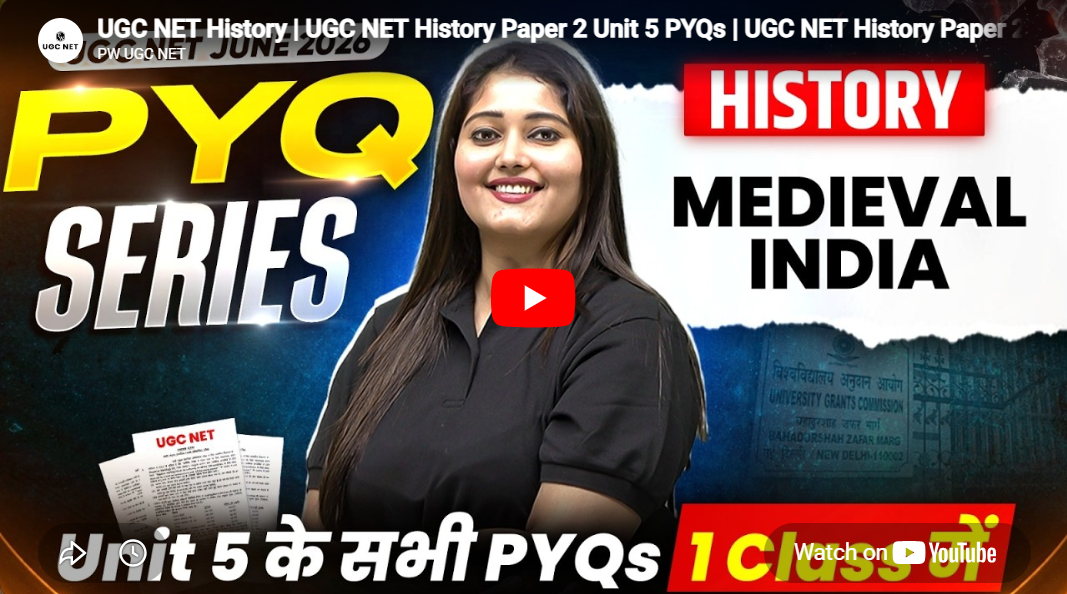
Watch UGC NET History Unit 5 PYQs Video for Medieval India Revision
UGC NET History Unit 5 covers several important topics from Medieval India, including administration, economy, architecture, literature, religion, and culture. While PYQs help students understand the exam pattern, detailed explanations can improve conceptual clarity and accuracy.
Students who want to practice additional PYQs and understand the reasoning behind the answers can watch the video below:
The session covers important PYQs, elimination techniques, chronology-based questions, administrative terms, important books and authors, Mughal policies, medieval economy, architecture, and many other exam-relevant topics. It can serve as an additional revision resource during the final phase of preparation.
Important UGC NET History Unit 5 PYQs with Answers and Explanations
Previous Year Questions help students understand the exam pattern and identify important topics from Medieval India. The questions below cover trade and commerce, Mughal administration, religious policies, architecture, chronology, and revenue systems that are frequently asked in UGC NET History.
Q1. Which statements are correct about trade and commerce in the medieval period?
(A) The Gujarat silk industry was entirely dependent on the import of raw silk from China in the course of the seventeenth century.
(B) Bengal received a quantity of opium from Bihar.
(C) Gujarat received lac from Bengal for the manufacture of lacquerware.
(D) Bengal's manufacture of conch-shell ornaments was based on the import of conch shells from Tuticorin.
Answer: (B), (C), and (D) Only
Q2. Regarding Taqavi loans, which of the following statements are NOT correct?
(i) These were given to peasants for agricultural purposes.
(ii) These were given to traders for trade purposes.
(iii) These were advanced through the Chaudhuris and Muqaddams, who distributed them among the individual peasants.
(iv) Chaudhuris and Muqaddams did not stand surety for their repayment.
Answer: (ii) and (iv) Only
Q3. Pick the wrong matches from the following options given below:
A. Hundi – Bill of Exchange
B. Jaziya – A tax imposed on non-Muslims by an Islamic State
C. Taccavi – A strength-giving drink of Mughals
D. Tehsil – A Garrison Post
E. Khyat – A chronicle in the form of manuscript in Rajasthan
Answer: C and D Only
Q4. Which of the following statements is/are true?
A. Sher Shah established an empire extending from Afghanistan to Orissa.
B. Sher Shah's use of Hindari language in administration was a measure of his practical sense.
C. Sher Shah enforced law and order with a heavy hand.
D. Sher Shah withdrew the circulation of silver coins.
E. Sher Shah built 3700 sarais.
Answer: B and C Only
Q5. Select the correct statements from the following:
A. Akbar's minters were careful to maintain a high quality coinage in each of the three metals.
B. Gold was nearly pure, silver never dropped below 96 percent pure and copper coins remained of high purity.
C. There was a free or open minting system.
D. In 1595, there were a total of 96 mints.
Answer: A, B and C Only
Q6. Match List I with List II
| List I | List II |
| Jama | Assessed Land Revenue |
| Hasil | Real Collected Revenue |
| Mahwar | Monthly Scales |
| Qabz | Security Money |
Answer: A-II, B-III, C-I, D-IV
Q7. Which of the following statements are correct about the religious policy of Akbar?
(A) He had abolished the pilgrimage tax.
(B) He built Ibadat Khana at Sikri in 1580.
(C) He proclaimed 'Mazhar' in 1579.
(D) He founded Din-i-Ilahi.
Answer: (A), (C) and (D) Only
Q8. In the context of 13–14th century arrange the following in chronological order:
A. First Mongol invasion during reign of Alauddin Khilji
B. Marco Polo visits Malabar Coast
C. Ibn Battuta in India
D. Alauddin Khilji's price control measures
E. Muhammad Tughlaq's token currency experiment
Answer: B, A, D, E, C
Q9. Arrange the following events of the reign of Alauddin Khilji in chronological order:
A. Expedition to Warangal
B. Malik Kafur's expedition to Devagiri
C. Alauddin Khilji captures Bhilsa
D. Siege of Chittor
E. Capture of Ranthambhor
Answer: C, E, D, B, A
Q10. Which of the following statements is correct?
A. Tughlaq architecture had sloping walls known as batter walls.
B. This feature was used in all Tughlaq buildings.
C. Tughlaqs used only grey sandstone in their buildings.
D. Firuz Shah Tughlaq's buildings used rubble masonry finished with lime plaster.
E. Bells and chains were common decorative motifs in all Firuz Shah Tughlaq buildings.
Answer: A and D Only
These questions highlight the major areas from Unit 5, such as the medieval economy, Mughal administration, religious policies, chronology, architecture, and revenue systems. Students should practice similar PYQs regularly, as these topics frequently appear in the UGC NET History examination.
UGC NET History Unit 5 PYQs FAQs
What topics are covered in UGC NET History Unit 5?
Why are PYQs important for UGC NET History Unit 5?
Which Mughal ruler is most important for Unit 5 preparation?
Are chronology-based questions asked in UGC NET History Unit 5?
Which medieval terms should students revise for Unit 5?






Get Free Counselling Today
and Clear up all your Doubts
 Live & recorded classes available at easeDashboard for progress trackingLakhs of practice questions

