






Time & Work, Definition, Formula, Tricks, and Examples
 Priyanka Dahima15 Jan, 2026
Share

Key Concepts for Time & Work: “ Time and Work" is a concept often used in mathematical problems and practical scenarios to understand the relationship between the amount of work done, the time taken to do it, and the number of people (or machines) involved. Time and work problems are especially useful in project management, engineering, and various other fields where efficiency and productivity are key. Pipes and cisterns Problems are also frequently questioned, and they are founded on the same labor and efficiency principles.
- Work : This refers to the total amount of tasks or jobs to be completed. It can be anything from constructing a building to completing a set of data entries.
- Time : The duration required to complete the work. This can be measured in hours, days, weeks, etc.
- Rate of Work : This is the amount of work done per unit of time. It can be for an individual or a group of people/machines.
- Efficiency : The productivity rate of an individual or group. Higher efficiency means more work is done in less time.
Time and Work Formula PDF
Time and Work formulas form the backbone of quantitative aptitude for SSC, BPSC, banking, and UPSC prelims, enabling rapid calculation of work rates, efficiencies, and combined efforts in competitive exam scenarios. Key concepts include Work = Rate × Time, individual efficiency as 1/n (where n = days to complete work), and combined work as the sum of individual rates for faster problem-solving. Download the comprehensive Time and Work Formula PDF below, featuring all essential formulas, shortcut tricks, solved examples, and practice questions tailored for exam preparation. This PDF resource covers pipes & cisterns variations, wage distribution ratios, and alternate work scenarios for complete mastery.
Time & Work Formula
Time and work problems are crucial in quantitative aptitude tests. To answer such problems fast, students need to grasp the time and work formula as well as the work and efficiency concept. Here, Time and work formula are given below
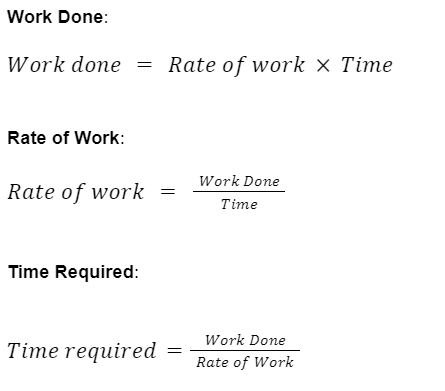
Combined Work : If two or more people (or machines) are working together, their combined work rate is the sum of their individual work rates.
Best Time & Work Examples
Candidates should acquire time-saving shortcuts that facilitate quicker computations if they want to score highly. Accuracy and speed are increased via consistent practice of practice questions on time. Additionally, applicants are able to evaluate their errors and improve their ideas by addressing time and work problems with solutions.

Tricks to Solve Time & Work Questions:
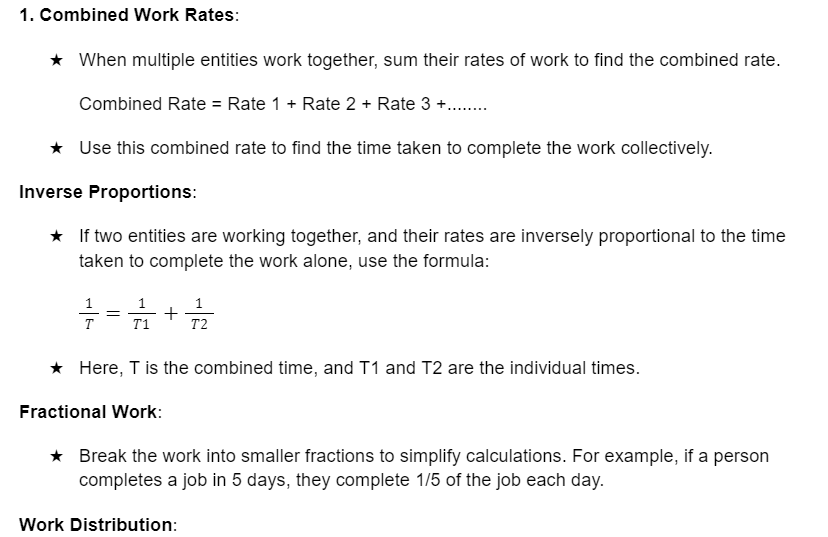 If different workers or machines have different efficiencies, distribute the work accordingly. For example, if Worker A is twice as efficient as Worker B, A will do twice the work of B in the same time period.
Problem-Solving Strategies
- Laying Out the Problem :
- Clearly define what one unit of work represents (e.g., one complete task).
- Identify all the rates of work and times given in the problem.
- Simplify Ratios :
- Convert all rates and times into simple fractions or decimals to make calculations easier.
- Use LCM for Multiple Workers :
- When dealing with multiple workers with different rates, using the Least Common Multiple (LCM) can simplify finding the total work done.
- Time Allocation :
- When dealing with alternating work schedules or shifts, calculate the work done in each segment and then sum them up.
Weightage of Time and Work in Banking Exams
The weightage of "Time and Work" questions can vary depending on the specific exam and the overall structure of the test. Here's a general overview:
Importance and Weightage:
- Quantitative Aptitude Section :
- Frequency : "Time and Work" questions frequently appear in this section.
- Weightage : Typically, you can expect 2-5 questions out of 35-50 in exams like IBPS PO, SBI PO, RBI Grade B, and clerical exams.
- Exam-Specific Insights :
- IBPS PO : Often includes 2-3 "Time and Work" questions.
- SBI PO : Similar pattern with 2-3 questions.
- RBI Grade B : Can vary, but usually includes a couple of questions.
- Clerical Exams : Slightly fewer questions, around 1-2, but still important.
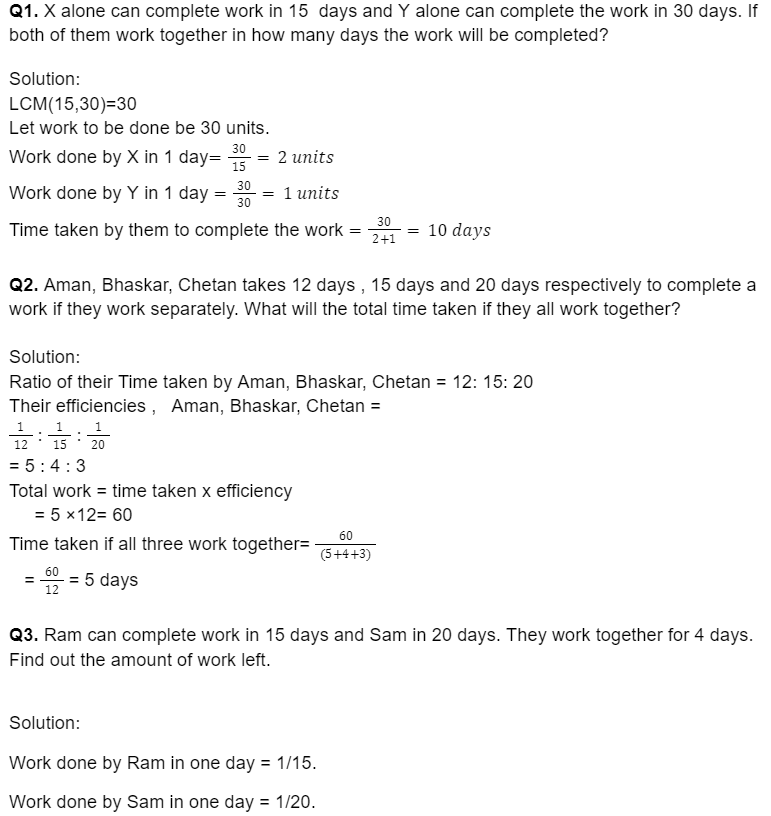
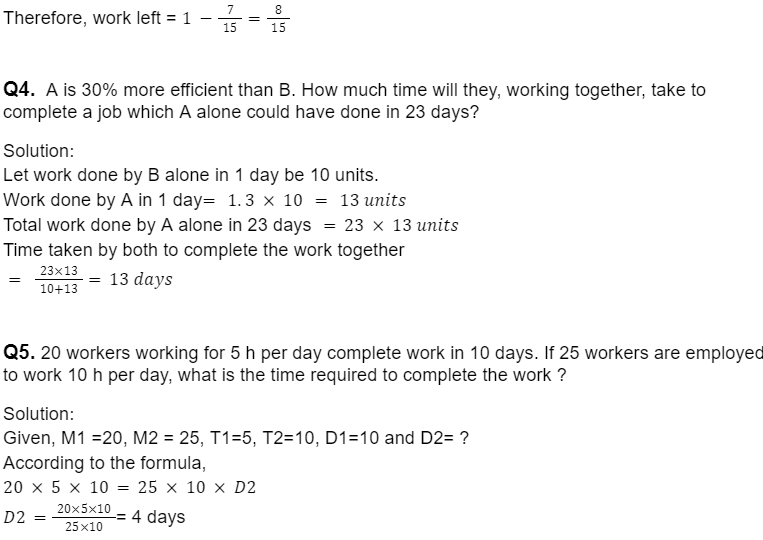
Time & Work Solved Problems
To achieve a good score, candidates should learn time-saving and work shortcuts that allow for faster calculations. Regular practice of practice questions on time improves accuracy and speed. Additionally, by addressing time and work problems with solutions, candidates may assess their mistakes and improve their concepts.

Previous Year Questions on Time And Work Asked In Banking Exams
- Q1. A can do a piece of work in 48 days, while B alone can do it in 64 days. If they worked together for 8 days, then what fraction of the work is remaining?
- Q2. A can do one-fourth of the work in 5 days. B can do 60% of the same work in 9 days. The total time we take to complete the work if both of them work together?
- Q3. P can do 1/ 2 of the work in 5 days, Q can do 3/ 5 of the work in 9 days, and R can do x of the work in 8 days. If they do the work together in 4 days, then find the value of x.
- Q4. A is 50% as efficient as B. C does half the work done by A and B together. If C alone does the work together in 20 days, then will A, B, and C do The Work?
- Q5. 20 Boys can complete a piece of work in 7 days if 8 more boys are put on the job. In how many days will the day complete the work?
Related Links Quadratic Equations Number System Vedic Maths Pie Chart DI Time and Work Problem on Ages Flow Chart DI Arithmetic DI Permutation and Combination