






CBSE Class 12 Physics Notes Chapter 5 Magnetism and Matter
 Ananya Gupta19 Feb, 2026
Share

CBSE Class 12 Physics Notes Chapter 5 Magnetism and Matter help you quickly revise key concepts before the exam tomorrow, 20 February 2026. This chapter explains how materials respond to magnetic fields, including topics like magnetization, magnetic intensity, magnetic susceptibility and permeability, and the behavior of dia-, para-, and ferromagnetic materials. It also covers the Earth’s magnetism, the tangent galvanometer, and the torque on magnetic dipoles. These notes simplify complex ideas, making it easier to understand important derivations and strengthen your preparation for the exam.
CBSE Class 12 Physics Notes Chapter 5 PDF
The PDF link for CBSE Class 12 Physics Notes Chapter 5 Magnetism and Matter is available below. The notes cover important topics like hysteresis and the classification of materials into diamagnetic, paramagnetic, and ferromagnetic types. Access the PDF to explore detailed explanations and illustrations that will enhance your understanding of magnetism and its effects on various substances.CBSE Class 12 Physics Notes Chapter 5 Magnetism and Matter PDF
CBSE Class 12 Physics Notes Chapter 5 Magnetism and Matter
Here we have provided CBSE Class 12 Physics Notes Chapter 5 Magnetism and Matter-Magnetic Field and Force
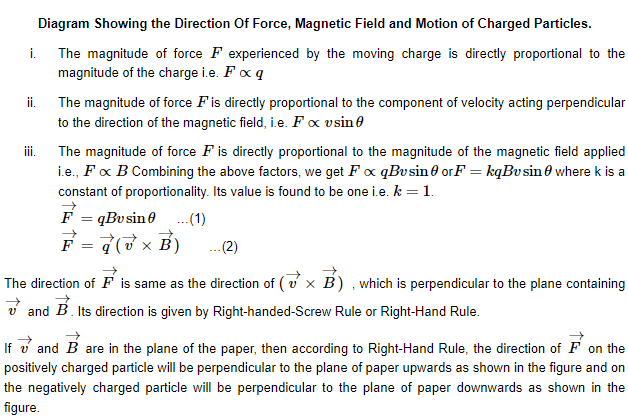
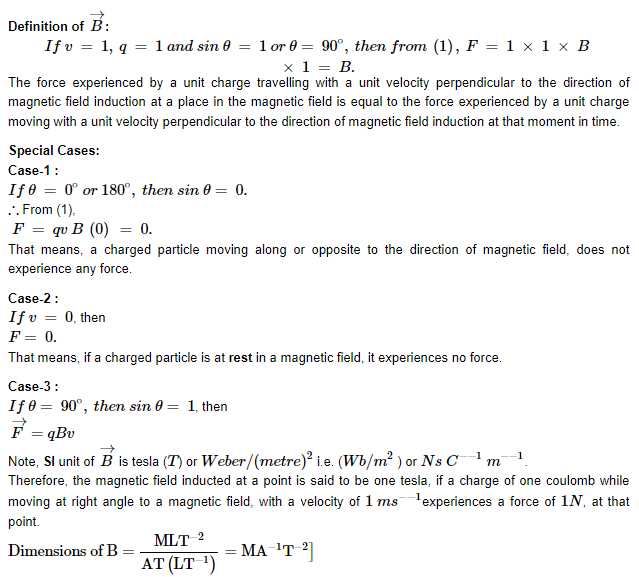
The magnetic field is a region around a magnet where materials or charged particles experience a magnetic force. This force can either attract or repel the charged particles depending on their relative positions. The magnetic field is generated by moving charges, such as currents in wires, and its strength and direction determine how strongly it influences other charges within its reach. The force experienced by a charged particle in a magnetic field depends on the charge's velocity, the magnetic field strength, and the angle between the particle's velocity and the field direction. This interaction between the magnetic field and moving charges is fundamental to various physical phenomena and applications.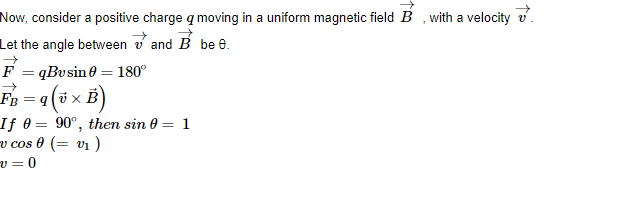
Lorentz Force
The Lorentz force is the force exerted on a charged particle moving through a region where both electric and magnetic fields are present. This force is a combination of the electric force and the magnetic force acting on the particle.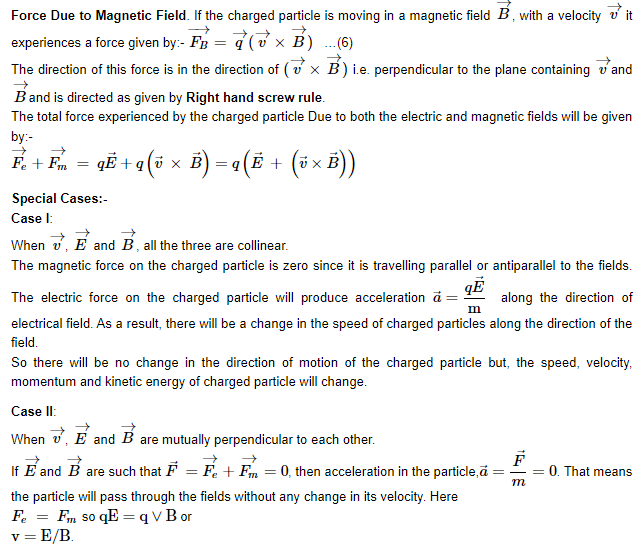
Motion of a Charged Particle in a Uniform Magnetic Field
When a charged particle moves through a uniform magnetic field, it experiences a force that causes its trajectory to bend into a circular or spiral path. This behavior is due to the Lorentz force, which acts perpendicular to both the velocity of the particle and the magnetic field.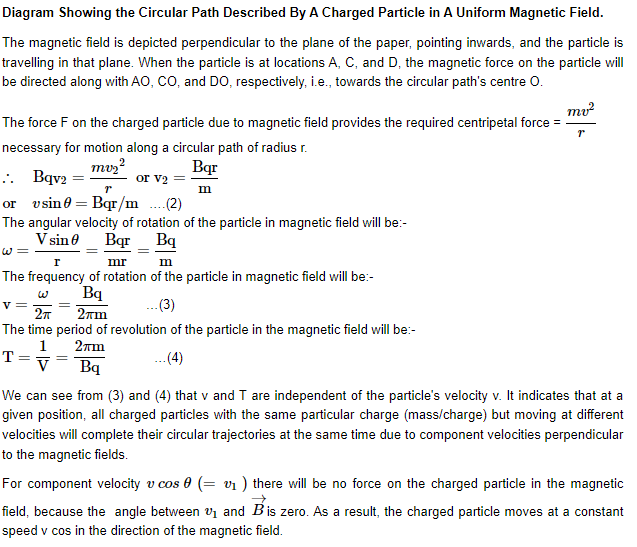
Motion in Combined Electron and Magnetic Fields
Velocity Filter
A velocity filter is a device that uses crossed electric and magnetic fields to select particles based on their velocity, irrespective of their mass or charge. It is designed to allow only those particles with a specific velocity to pass through, while others are deflected.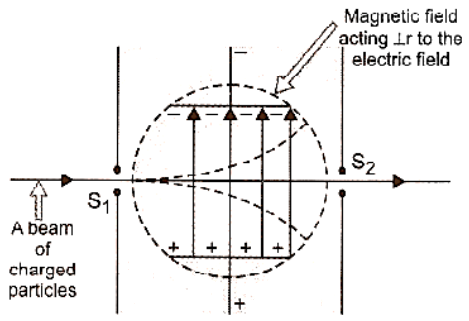
Force on a Current-Carrying Conductor Placed in a Magnetic Field
Consider a straight cylindrical conductor P Q of length l , area of cross-section A, carrying current I placed in a uniform magnetic field of induction, B . Let the conductor be placed along the X-axis and the magnetic field be acting in X plane making an angle θ with X-axis. Suppose the current I flows through the conductor from the end P to Q figure. Since the current in a conductor is due to motion of electrons, therefore, electrons are moving from the end Q to P .
How Are Magnetic Materials Classified?
Magnetic materials are classified based on their magnetic properties and how they respond to an external magnetic field. Here’s a simple explanation of the three main types:Diamagnetic Materials :
- Magnetic Susceptibility (χ) : Negative and very small.
- Behavior : Diamagnetic materials create an induced magnetic field opposite to the direction of the applied external magnetic field. They are weakly repelled by magnetic fields.
- Examples : Bismuth, copper, and graphite.
- Characteristics : These materials do not retain any magnetic properties once the external magnetic field is removed.
Paramagnetic Materials :
- Magnetic Susceptibility (χ) : Positive and small.
- Behavior : Paramagnetic materials have a weak and temporary magnetic attraction to an external magnetic field. The magnetic moments align with the external field but only while the field is applied.
- Examples : Aluminum, platinum, and certain metal ions.
- Characteristics : The alignment of magnetic moments in paramagnetic materials is relatively weak and disappears when the external field is removed.
Ferromagnetic Materials :
- Magnetic Susceptibility (χ) : Large and positive.
- Behavior : Ferromagnetic materials have a strong magnetic attraction and can retain magnetic properties even after the external magnetic field is removed. They exhibit spontaneous magnetization, meaning their magnetic moments align in the same direction even without an external field.
- Examples : Iron, nickel, and cobalt.
- Characteristics : These materials have high magnetic permeability and can be permanently magnetized, forming strong magnetic domains.
Permanent Magnets
Permanent magnets are materials that, when magnetized, retain their magnetic properties for a long time, even after the external magnetic field is removed. These magnets are made from ferromagnetic materials, such as iron, cobalt, or nickel, which have strong magnetic properties and can sustain their magnetization.Preparation Strategy for CBSE Class 12 Physics Notes Chapter 5 Magnetism and Matter
To score well in the exam tomorrow, 20 February 2026, follow this focused preparation strategy for effective last-minute revision:
Understand the Central Concepts: Focus on the main ideas like magnetization, magnetic intensity, magnetic susceptibility and permeability, and the behavior of dia-, para-, and ferromagnetic materials. A clear understanding of these concepts is crucial for theory and numerical questions.
Revise Important Laws and Formulas: Go through key relations involving magnetic field intensity, torque on a magnetic dipole, and the tangent galvanometer. Knowing these helps in solving both numerical and conceptual questions quickly.
Practice Numerical Problems: Solve a few important numerical problems related to magnetization, magnetic intensity, and torque to strengthen your problem-solving speed and accuracy.
Review Diagrams and Examples: Revise key diagrams such as magnetic field lines, behavior of magnetic materials, and tangent galvanometer setup. Examples in the notes help you explain concepts clearly in long-answer questions.
Use Notes for Quick Revision: Go through CBSE Class 12 Physics Notes Chapter 5 Magnetism and Matter for last-minute revision. Focus on highlighted points, important derivations, and key examples to clear doubts quickly.
CBSE Class 12 Physics Notes Chapter 5 Magnetism and Matter FAQs
What is Magnetism?
What is Lorentz Force?
What is Magnetic Susceptibility?
How does a velocity filter work?












 Live & recorded classes available at easeDashboard for progress trackingMillions of practice questions at your fingertips

