With the CBSE Class 12 Physics board exam on 20 February 2026 just around the corner, this is the right time to focus on high-scoring chapters like Magnetism and Matter. Many students find concepts such as magnetic field intensity, magnetization, susceptibility, and hysteresis difficult, especially under exam pressure.
Mistakes in numericals or derivations can lead to loss of valuable marks. The Class 12 Dual Nature of Matter and Radiation NCERT Solutions are designed to help you revise quickly, clear doubts instantly, and practise all important questions step by step, so you feel confident and fully prepared for the board examination.
Class 12 Physics Chapter 11 NCERT Solutions Dual Nature of Radiation and Matter
This chapter is high-scoring but tricky, and understanding it thoroughly can make a difference in your board exam marks.
With exams approaching, revising magnetic properties, laws, and numerical methods efficiently is critical.
These solutions help students clear doubts quickly, practice key problems step by step, and revise all important formulas and derivations in a focused manner.
Dual Nature of Radiation and Matter Class 12 NCERT Solutions (All Exercises)
Dual Nature of Radiation and Matter Exercise Solutions include step-by-step derivations, formula substitutions, and final answers with proper units. Students are advised to go through the theory first and then attempt these exercise questions for clarity.
Question 1. Find the (a) maximum frequency, and (b) minimum wavelength of X-rays produced by 30 kV electrons. Solution : Potential of the electrons, V = 30 kV = 3 × 10⁴ V Hence, the energy of the electrons, E = 3 × 10⁴ eV Where, e = Charge on an electron = 1.6 × 10⁻¹⁹ C (a)Maximum frequency produced by the X-rays = ν The energy of the electrons is given by the relation: E = hν Where, h = Planck’s constant = 6.626 × 10⁻³⁴ Js
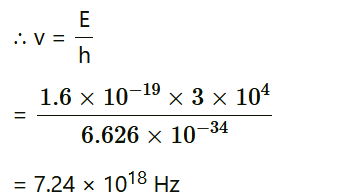
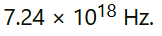
Hence, the maximum frequency of X-rays produced is
(b)The minimum wavelength produced by the X-rays is given as: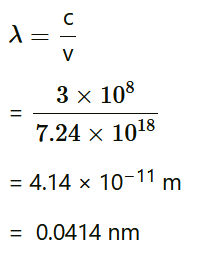
Hence, the minimum wavelength of X-rays produced is 0.0414 nm.
Question 2.The work function of caesium metal is 2.14 eV. When light of frequency 6 ×10¹⁴ Hz is incident on the metal surface, photoemission of electrons occurs.
What is the
(a) the maximum kinetic energy of the emitted electrons,
(b) Stopping potential, and
(c) the maximum speed of the emitted photoelectrons?
Solution : The work function of caesium metal,
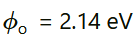
Frequency of light,
(a)The maximum kinetic energy is given by the photoelectric effect as: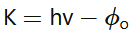 Where, h = Planck’s constant = 6.626 × 10⁻³⁴ Js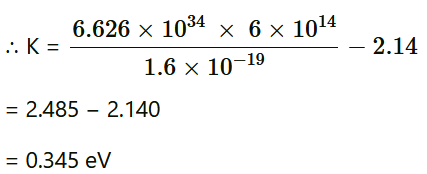
Hence, the maximum kinetic energy of the emitted electrons is 0.345 eV. (b)For stopping potential , we can write the equation for kinetic energy as: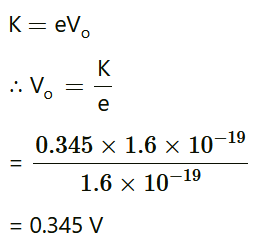
Hence, the stopping potential of the material is 0.345 V. (c)Maximum speed of the emitted photoelectrons = v Hence, the relation of kinetic energy can be written as: or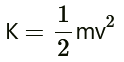 Where, m = Mass of an electron = 9.1 × 10⁻³¹ kg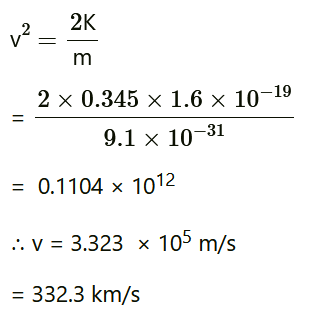
Hence, the maximum speed of the emitted photoelectrons is 332.3 km/s.
Question 3. The photoelectric cut-off voltage in a certain experiment is 1.5 V. What is the maximum kinetic energy of photoelectrons emitted?
Solution : Photoelectric cut-off voltage, V0 = 1.5 V The maximum kinetic energy of the emitted photoelectrons is given as: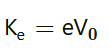
Where, e = Charge on an electron = 1.6 × 10⁻¹⁹ C
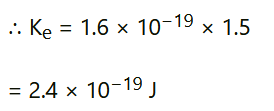
Therefore, the maximum kinetic energy of the photoelectrons emitted in the given experiment is 2.4 × 10⁻¹⁹ J.
Question 4. Monochromatic light of wavelength 632.8 nm is produced by a helium-neon laser. The power emitted is 9.42 mW.
(a) Find the energy and momentum of each photon in the light beam, (b) How many photons per second, on average, arrive at a target irradiated by this beam? (Assume the beam to have a uniform cross-section which is less than the target area), and
(c) How fast does a hydrogen atom have to travel to have the same momentum as that of the photon?
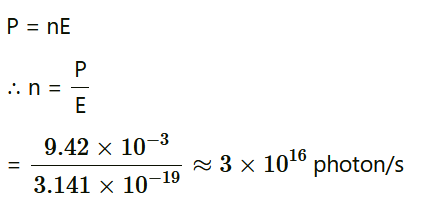
Solution : Wavelength of the monochromatic light, λ = 632.8 nm = 632.8 × 10⁻⁹ m Power emitted by the laser, P = 9.42 mW = 9.42 × 10⁻³ W Planck’s constant, h = 6.626 × 10⁻³⁴ Js Speed of light, c = 3 × 10⁸ m/s Mass of a hydrogen atom, m = 1.66 × 10⁻²⁷ kg (a)The energy of each photon is given as:
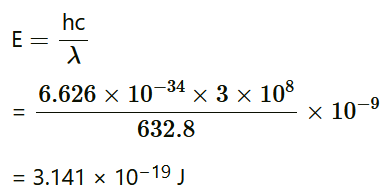
The momentum of each photon is given as:
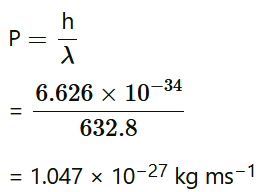
(b)Number of photons arriving per second, at a target irradiated by the beam = n Assume that the beam has a uniform cross-section that is less than the target area. Hence, the equation for power can be written as:
(c) The momentum of the hydrogen atom is the same as the momentum of the photon,
Momentum is given as: Where, v = Speed of the hydrogen atom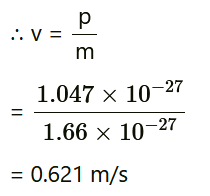
Question 5. In an experiment on the photoelectric effect, the slope of the cut-off voltage versus frequency of incident light is found to be 4.12 × 10⁻¹⁵ V s. Calculate the value of Planck’s constant.
Solution : The slope of the cut-off voltage (V) versus frequency (ν) of an incident light is given as:
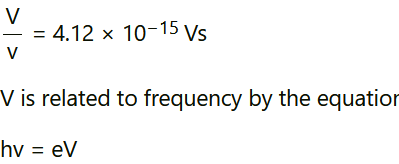
Where, e = Charge on an electron = 1.6 × 10⁻¹⁹ C h = Planck’s constant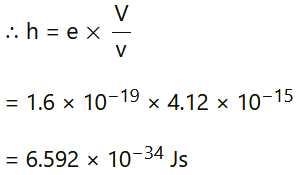
Therefore, the value of Planck’s constant is
Question 6. The threshold frequency for a certain metal is 3.3 × 10¹⁴ Hz. If the light of frequency 8.2 × 10¹⁴ Hz is incident on the metal, predict the cutoff voltage for the photoelectric emission.
Solution : Threshold frequency of the metal, Frequency of light incident on the metal,
 Charge on an electron, e = 1.6 × 10⁻¹⁹ C Planck’s constant, h = 6.626 × 10⁻³⁴ Js Cut-off voltage for the photoelectric emission from the metal =
 The equation for the cut-off energy is given as: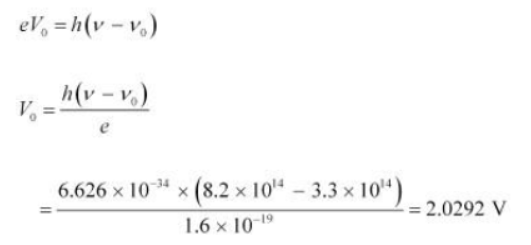
Therefore, the cut-off voltage for the photoelectric emission is
Question 7. The work function for a certain metal is 4.2 eV. Will this metal give photoelectric emission for incident radiation of wavelength 330 nm?
Solution : No The work function of the metal,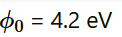 Charge on an electron, e = 1.6 × 10⁻¹⁹ C Planck’s constant, h = 6.626 × 10⁻³⁴ Js Wavelength of the incident radiation, λ = 330 nm = 330 × 10−9 m Speed of light, c = 3 × 10⁸ m/s The energy of the incident photon is given as: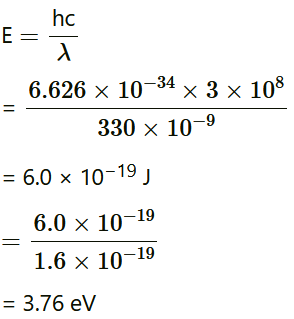
It can be observed that the energy of the incident radiation is less than the work function of the metal. Hence, no photoelectric emission will take place.
Question 8. Light of frequency 7.21 × 10¹⁴ Hz is incident on a metal surface. Electrons with a maximum speed of 6.0 × 10⁵ m/s are ejected from the surface.
What is the threshold frequency for the photoemission of electrons?
Solution : Frequency of the incident photon,
Maximum speed of the electrons, v = 6.0 × 10⁵ m/s Planck’s constant, h = 6.626 × 10⁻³⁴ Js Mass of an electron, m = 9.1 × 10⁻³¹ kg For threshold frequency ν0, the relation for kinetic energy is written as:
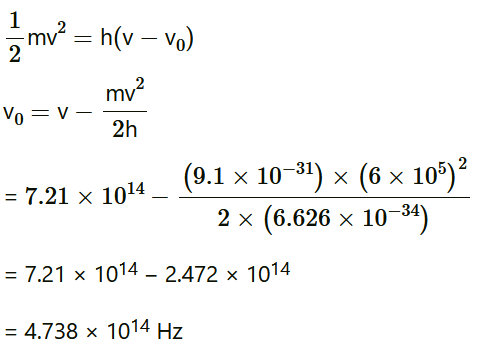
Therefore, the threshold frequency for the photoemission of electrons is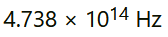
Solution : The wavelength of light produced by the argon laser, λ = 488 nm = 488 × 10−9 m Stopping potential of the photoelectrons, V0 = 0.38 V 1eV = 1.6 × 10⁻¹⁹ J ∴ V0 =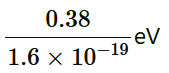
Planck’s constant, h = 6.6 × 10⁻³⁴ Js Charge on an electron, e = 1.6 × 10⁻¹⁹ C Speed of light, c = 3 × 10 m/s From Einstein’s photoelectric effect, we have the relation involving the work function Φ0 of the material of the emitter as:
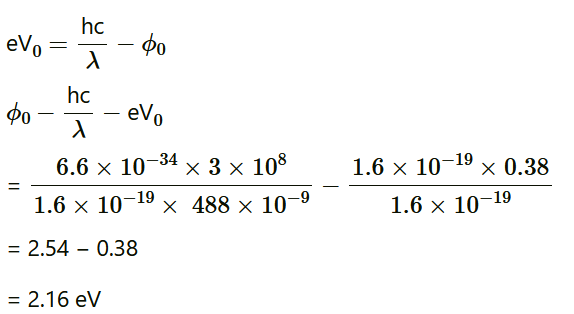
Therefore, the material with which the emitter is made has the work function of 2.16 eV.
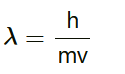
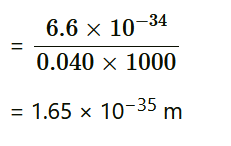
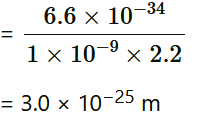
Question 10. What is the de Broglie wavelength of (a) a bullet of mass 0.040 kg travelling at the speed of 1.0 km/s, (b) a ball of mass 0.060 kg moving at a speed of 1.0 m/s, and (c) a dust particle of mass 1.0 × 10⁻⁹ kg drifting with a speed of 2.2 m/s?
Solution : (a)Mass of the bullet, m = 0.040 kg Speed of the bullet, v = 1.0 km/s = 1000 m/s Planck’s constant, h = 6.6 × 10⁻³⁴ Js De Broglie wavelength of the bullet is given by the relation:
(b) Mass of the ball, m = 0.060 kg Speed of the ball, v = 1.0 m/s De Broglie wavelength of the ball is given by the relation: 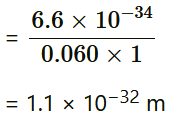
(c)Mass of the dust particle, m = 1 × 10⁻⁹ kg Speed of the dust particle, v = 2.2 m/s De Broglie wavelength of the dust particle is given by the relation:
Question 11. Show that the wavelength of electromagnetic radiation is equal to the de Broglie wavelength of its quantum (photon). Solution : The momentum of a photon having energy (hν) is given as: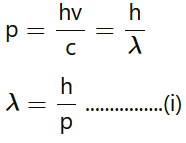
Where, λ = Wavelength of the electromagnetic radiation c = Speed of light h = Planck’s constant De Broglie wavelength of the photon is given as:
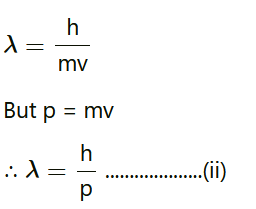
Where, m = Mass of the photon v = Velocity of the photon Hence, it can be inferred from equations (i) and (ii) that the wavelength of the electromagnetic radiation is equal to the de Broglie wavelength of the photon.
Last Minute Tips for Dual Nature NCERT Solutions for Class 12 Physics Exam
Here are Last-Minute Tips for Dual Nature of Radiation and Matter (NCERT Solutions) – Class 12 Physics to help you score well in the CBSE Class 12 Physics board exam on 20 February 2026:
-
Revise key concepts like photoelectric effect, Einstein’s photoelectric equation, and de Broglie wavelength.
-
Memorise important formulas and understand their physical meaning.
-
Practise numericals based on stopping potential, threshold frequency, and work function.
-
Go through all NCERT solved examples and back-exercise questions.
-
Focus on writing derivations step-by-step with proper units.
-
Avoid calculation mistakes by carefully substituting values in formulas.