


CBSE Class 9 Social Syllabus includes Chapter 5 Natural Vegetation and Wildlife. This chapter explains different types of forests, grasslands, desert vegetation, and the country’s rich wildlife diversity. To help students prepare effectively, Natural Vegetation and Wildlife Class 9 Important Questions based on the latest NCERT syllabus are given here.
These questions include short answers, long answers, map-based questions, and concept-based reasoning. They help you revise topics like tropical evergreen forests, thorn forests, mountain vegetation, national parks, sanctuaries, and conservation methods.
Natural Vegetation and Wildlife Class 9 Important Questions
CBSE Important Questions for Class 9 Social Science Geography Chapter 5 are given here:
Section –A [1 Mark]
-
Which of the following types of vegetation does rubber belong to?
(A) Tundra (B) Himalayan (C) Tidal (D) Tropical Evergreen
Ans. (D) Tropical Evergreen -
In which of the following state is the Simlipal bio- reserve located?
(A) Punjab (B) Delhi (C) Odisha (D) West Bengal
Ans. (C) Odisha
3. The tropical rainforest is characterized by:
(A) Dense vegetation and high biodiversity
(B) Sparse vegetation and low biodiversity
(C) Tall grasses and few trees
(D) Extreme cold temperatures
Ans. (A) Dense vegetation and high biodiversity
4. Assertion (A): The tropical rainforests are mostly evergreen.
Reason(R): The regions of tropical rainforests get abundant rainfall and have low temperature through the region.
(A) Both A and R are true and R explains A.
(B) Both A and R are true and R does not explains A.
(C) A is false but R is true.
(D) A is true but R is false.
Ans. (D) A is true but R is false.
5. One step taken by the Indian Government to conserve the forest is the setting of the Forest Research Institute at___:
(A) Hyderabad
(B) Dehradun
(C) Delhi
(D) Lucknow
Ans. (B) Dehradun
6. What position does India occupy in the world with regards to plant diversity?
Sol. Tenth place.
7. Give another name for natural vegetation.
Sol. Virgin vegetation
8. Why is there a great diversity in flora and fauna?
Sol. Differences in land, soil and climate cause a great diversity in the flora and fauna of a region.
9. Why are the southern slopes of the Himalayas covered with thicker vegetation as compared to northern slopes?
Sol. The southern slopes of the Himalayas get direct sunlight while the northern slopes receive indirect rays or oblique rays.
10. Name the two winds which cause rainfall in the major part of the Indian subcontinent.
Sol. South West Monsoons in summer & North East Monsoons in winter.
Section –B [2 Marks]
11. Distinguish between Tropical Evergreen and Deciduous forests.
Sol. Tropical Evergreen Forests: They are called rainforests. No definite time for trees to shed leaves. Rainfall is more than 200 cm.
Tropical Deciduous Forests: They are called Monsoon forests. Trees shed leaves for about six to eight weeks in the dry summer. Rainfall range is between 200 cm to 70 cm.
12. When the vegetation is altered, the animal life also changes’. How?
Sol. This happens because plants occur in distinct groups of communities in areas having similar climatic conditions. The nature of the plants in an area, to a large extent, determines the animal life in that area. All the plants and animals in an area are interdependent and interrelated to each other in their physical environment. Therefore when the vegetation changes, the animal life is affected.
13. Name two states where thorn forests and scrub vegetation are found. Which are the common animals found in these forests? Why is there absence of trees in these forests?
Sol. Thorn forests and scrub vegetation are found in Gujarat and Rajasthan. Camels, rats, wild ass are the common animals found in these forests. There is absence of trees because rainfall is less than 70 cm in these regions.
14. What is a bio-reserve? Give two examples.
Sol. Bio-reserves are protected areas. This is done to protect natural vegetation, wildlife and the environment. Examples: Sunderbans Gulf of Mannar
15. Explain with example how temperature can affect the type of vegetation?
Sol. On the slopes of the Himalayas, and hills of the Peninsula above, the height of 915m, the fall in the temperature affects the types of vegetation and its growth and changes it from tropical to subtropical temperature in the alpine vegetation.
Section –C [3 Marks]
16. How do human beings influence the ecology of a region?
Sol. Human beings influence the ecology of a region in the following ways:
(a) They utilise the vegetation and wildlife of a particular region.
(b) The greed of human beings leads to overutilization of these resources.
(c) They cut trees and kill the animals, thereby, creating an ecological imbalance.
17. Write a short note on the biodiversity in India.
Sol. Our country India is one of the 12 mega bio- diversity countries of the worid. With about 47,000 plant species, India occupies tenth place in the world and fourth in Asia in plant diversity.
• There are about 15,000 flowering plants in India, which account for 6 per cent in the world’s total number of flowering plants.
• The country has many non-flowering plants, such as ferns,’algae and fungi. India also has 90,000 species of animals, as well as, a rich variety of fish in its fresh and marine waters.
18. Name any three medicinal plants found in India with atleast one use of each.
Sol. The tree medicinal plants found in India are:
(a) Sarpagandha: It is used to treat blood pressure. It is found only in India.
(b) Jamun: The juice from ripe fruit is used to prepare vinegar, which is carminative and diuretic, and has digestive properties.
(c) Arjun: The fresh juice of leaves is a cure for earache. It is also used to regulate blood pressure
19. Write a short note on Mangrove Forests.
Sol. The mangrove tidal forests are found in the areas of coasts influenced by tides. Mud and silt get accumulated on such coasts. Dense mangroves are the common varieties with roots of the plants submerged under water. The deltas of the Ganga, the Mahanadi, the Krishna, the Godavari and the Kaveri are covered by such vegetation. In the Ganga-Brahmaputra delta, sundari trees are found, which provide durable hard timber. Palm, coconut, keora, agar, etc., also grow in some parts of the delta.
Royal Bengal Tiger is the famous animal in these forests. Turtles, crocodiles, gharials and snakes are also found in these forests.
Section –D [5 Marks]
20. What is the importance of biosphere reserve? What are its objectives?
Sol. Biosphere reserves are a series of multipurpose protected areas linked through a global network, intended to demonstrate the relationship between conservation and development. The main purpose of biosphere reserve is conservation of flora and fauna.
The main objectives are:
• Preserving plant and animal species of the area in natural forms.
• To protect flora and fauna from their overexploitation.
• To save endangered species and prevent extinction of valuable species.
• To undertake research and experimentation in forestry.
21. Describe how rainfall and relief influence the vegetation of an area.
Sol. Factors like rainfall and relief influence the natural vegetation of an area.
Rainfall: In India, almost the entire rainfall is brought in by the advancing southwest monsoon (June to September) and retreating northeast monsoons. Areas of heavy rainfall have more dense vegetation as compared to areas of less rainfall. Areas with more than 200 cm of annual rainfall have tropical evergreen rainforests. Tropical moist deciduous forests are found in areas with 100 to 200 cm of rainfall. Tropical dry deciduous forests are found in areas receiving rainfall between 100 cm and 70 cm. In regions with less than 70 cm of rainfall, the natural vegetation consists of thorny trees and bushes.
Relief: The type of vegetation found in an area depends upon the relief or landform of the area. The fertile level lands of plains are generally devoted to agriculture. Much of the natural vegetation is cleared or altered in such areas. Grasslands and woodlands develop in areas with undulating and rough terrains. Mountainous areas have succession of vegetation types according to the altitude of the area.
22. In mountainous area, there is change in natural vegetation due to decrease in temperature. Justify giving examples from different zones.
Sol. In the Himalayan region of our country, the vegetation differs according to the height.
• In the foothill, (the Shiwalik) are tropical deciduous forests. ‘Sal’ is the most important species of economic significance.
• The zone with altitude 1000 m – 2000 m consists of evergreen forests. Beech, chestnut, oak, etc., are the main trees.
• The zone between 1500m – 3000 m includes pine, cedar, silver fir and spruce. They are the famous coniferous trees, typical of the dry temperate region found in the inner Himalayan region.
• At the height of 3600 m or more, shrubs, scrubs, and grasses of alpine variety are found.
23. Give a brief description of Tropical Evergreen Forests.
Sol. • Tropical Evergreen Forests are found in areas receiving heavy rainfall of over 200 cm, well- distributed throughout the year. They are also known as rainforests.
• The warm, wet climate throughout the year supports luxuriant vegetation of all kinds including trees, shrubs and creepers.
• The trees grow very tall, reaching a height of 60 metres or even above. As the trees grow very close to each other, they form a thick canopy. The different types of vegetation form a multi-layered structure.
• The climate supports a large number of broad- leaved trees of different species. Ebony, mahogany, rosewood, rubber, cinchona, etc. are commercially important trees.
• These trees do not shed their leaves at the same time as there is no distinct dry season.
• This makes the forests evergreen as they retain their green look throughout the year.
Section E [4 Marks]
24. Read the extract given below and answer the questions that follow: Our country India is one of the 12 mega biodiversity countries of the world. With about 47,000 plant species India occupies tenth place in the world and fourth in Asia. There are about 15,000 flowering plants in India. Moreover, it also has approximately 90,000 species of animals as well as many varieties of fishes. Natural vegetation refers to a plant community, which has grown naturally without human aid and has been left undisturbed by humans for a long time. This is termed as virgin vegetation. Thus, cultivated crops and fruits, orchards form part of vegetation but not natural vegetation. The virgin vegetation, which are purely Indian are known as endemic or indigenous species but those which have come from outside India are termed as exotic plants.
(i) Why is India among the 12 mega biodiversity countries of the world? (1)
Sol. Firstly, India has about 47000 species of plants out of which 15000 are flowering plants. Moreover, it also has 90000 varieties of animal species. Therefore, wide varieties of flora and fauna make India among the 12 mega biodiversity countries of the world.
(ii) What is virgin vegetation?
Sol. Virgin vegetation refers to Natural vegetation. It is a type of vegetation which grows naturally and grows without human interference.
(iii) Define endemic and exotic plants.
Sol. Endemic plants: It is the natural vegetation, which is purely Indian. It is exclusively found in India. Therefore, such vegetation is known as endemic species. Exotic plants: The plants which have come from outside India are called exotic plants.
Section F [5 Marks]
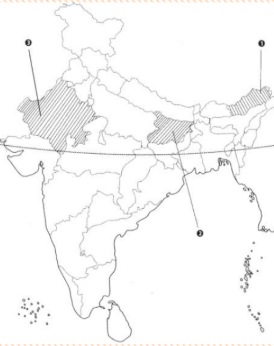
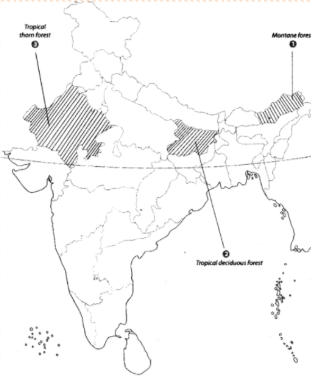
25. Features are marked by numbers in the given political map of India, Identify these features with the help of the following information and write their correct names on the lines marked in the map.
-
A type of vegetation
-
A type of vegetation
-
A type of vegetation
Sol.
Natural Vegetation and Wildlife Class 9 Important Questions PDF
If you prefer offline study, you can download the Natural Vegetation and Wildlife Class 9 Important Questions PDF from here. This PDF combines all the important questions of the chapter with clear explanations to support thorough exam preparation.
The PDF includes topic-wise questions on forest distribution, climatic influences, conservation programs, endangered species, and biosphere reserves. With this Natural Vegetation and Wildlife Important Questions PDF, you can revise the chapter easily. The questions are divided section-wise based on the marking scheme like 1-mark questions, 2-mark questions.
Natural Vegetation and Wildlife Class 9 Important Questions PDF
How to Use Natural Vegetation and Wildlife Important Questions for Exam Preparation
Preparing with the Natural Vegetation and Wildlife Class 9 Important Questions requires a structured approach. Here’s how you can prepare well:
-
Before attempting the questions, make sure you clearly understand climate influence, vegetation types, and wildlife distribution.
-
Begin with simple short-answer questions and gradually move to long-answer and reasoning questions. This builds your confidence and helps in better retention of concepts.
-
Attempt a set of Natural Vegetation and Wildlife Important Questions without looking at answers. Later, evaluate your performance to track progress.
-
Write down definitions, examples of vegetation types, and important protected areas. These notes are important for last-minute revision.
-
Use the Natural Vegetation and Wildlife Class 9 Important Questions PDF during your final revision. It consolidates everything you need in one place and saves time.
Related Chapters
Important Questions for Class 9 Social Science Geography Chapter 5 FAQs
What do Natural Vegetation and Wildlife Class 9 Important Questions include?
Are the Natural Vegetation and Wildlife Important Questions enough for exams?
Do these questions follow the latest CBSE exam pattern?
Is the PDF useful for last-minute revision?
Do these questions include national parks and wildlife conservation topics?


Have questions about your prep?
Our experts can answer all your questions