

NCERT Solutions for Class 10 Science Chapter 9 Light Reflection and Refraction are an essential resource for building a clear understanding of how light behaves in different situations. These solutions help you learn reflection through mirrors and refraction through various media with clarity, along with step-by-step numerical solving and ray diagrams.
Focusing on this chapter is beneficial as it forms an important part of Physics. Practising these solutions helps you improve speed and accuracy in solving mirror and lens formula-based questions, as well as handling long-answer and case-based problems effectively.
By using Class 10 NCERT Solutions for this chapter, you can strengthen your fundamentals, improve answer presentation, and revise concepts in line with the CBSE Class 10 Science syllabus.
Light Reflection and Refraction Class 10 NCERT Solutions
Class 10 exercise answers help you practice numericals, understand ray diagrams, and improve exam readiness.
1. Define the principal focus of a concave mirror.
Answer-
The principal focus of a concave mirror is the point on the principal axis where parallel light rays that strike the mirror converge after reflecting off its surface. This convergence occurs due to the mirror's curved shape, which directs the parallel rays to meet at this specific point.
2. The radius of curvature of a spherical mirror is 20 cm. What is its focal length?
Answer-
Radius of curvature (R) = 20 cm Radius of curvature of the spherical mirror = 2 × Focal length (f) R = 2f f= R/2 = 20 / 2 = 10 Therefore, the focal length of the spherical mirror is 10 cm.
3. Name the mirror that can give an erect and enlarged image of an object.
Answer-
A convex mirror is the type of mirror that can provide an erect and diminished image of an object. A concave mirror, on the other hand, can produce an erect and enlarged image only when the object is placed between the focal point and the mirror (i.e., within the focal length).
4. Why do we prefer a convex mirror as a rear-view mirror in vehicles?
Answer-
A convex mirror is widely used as a rear-view mirror in vehicles because it provides a larger field of view compared to flat or concave mirrors. This is due to the fact that convex mirrors diverge light rays, allowing them to spread out and cover a broader area. As a result, they produce an erect, virtual, and diminished image of objects, making it easier for drivers to see more of the traffic behind them.
5. Find the focal length of a convex mirror whose radius of curvature is 32 cm.
Answer-
Radius of curvature (R) = 32 cm Radius of curvature = 2 × Focal length (f) R= 2f f = R/2 = 32/2 = 16 Therefore, the focal length of the given convex mirror is 16 cm.
6. A concave mirror produces three times magnified (enlarged) real image of an object placed at 10 cm in front of it. Where is the image located?
Answer-
Magnification produced by a spherical mirror: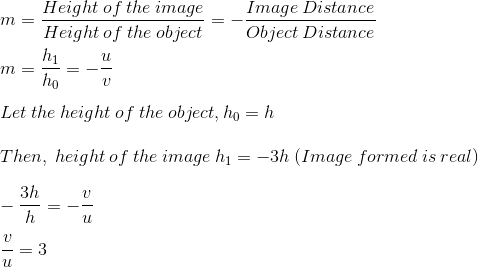
Object distance (u) = – 10 cm v = 3 × (- 10) = – 30 cm Therefore, the negative sign indicates that an inverted image is formed in front of the given concave mirror at a distance of 30 cm.
7. A ray of light travelling in air enters obliquely into water. Does the light ray bend towards the normal or away from the normal? Why?
Answer-
When a light ray travels from an optically rarer medium, like air, to an optically denser medium, such as water, the light ray slows down due to the higher refractive index of the denser medium. As a result, it bends towards the normal line, which is an imaginary line perpendicular to the surface at the point of incidence. This bending of light towards the normal is a direct consequence of the change in the light's speed as it moves between different media.
8. Light enters from air to glass, having a refractive index 1.50. What is the speed of light in the glass? The speed of light in vacuum is 3 x 10 8 ms -1 .
Answer-
Refractive index of a medium (nm) = Speed of light in vacuum/Speed of light in the medium Speed of light in vacuum (c) = 3 × 10 8 m/s Refractive index of glass (ng) = 1.50 Speed of light in the glass (v) = Speed of light in vacuum/ Refractive index of glass = c/ng =3 × 10 8 /1.50 = 2x 10 8 ms -1 .
9. Find out, from the table, the medium having the highest optical density. Also, find the medium with the lowest optical density.
| Material
medium |
Refractive index | Material medium | Refractive
index |
| Air | 1.0003 | Canada Balsam | 1.53 |
| Ice | 1.31 | – | – |
| Water | 1.33 | Rock salt | 1.54 |
| Alcohol | 1.36 | – | – |
| Kerosene | 1.44 | Carbon disulphide | 1.63 |
| Fused
quartz |
1.46 | Dense flint glass | 1.65 |
| Turpentine oil | 1.47 | Ruby | 1.71 |
| Benzene | 1.50 | Sapphire | 1.77 |
| Crown
glass |
1.52 | Diamond | 2.42 |
Answer-
Lowest optical density = Air Highest optical density = Diamond The optical density of a medium is inversely related to its refractive index. A medium with a high refractive index, like diamond, will have a high optical density, meaning it bends light significantly and slows it down more compared to a medium with a lower refractive index, like air. This explains why air has the lowest optical density and diamond has the highest.
10. You are given kerosene, turpentine and water. In which of these does the light travel fastest? Use the information given in the table.
| Material
medium |
Refractive index | Material medium | Refractive
index |
| Air | 1.0003 | Canada Balsam | 1.53 |
| Ice | 1.31 | – | – |
| Water | 1.33 | Rock salt | 1.54 |
| Alcohol | 1.36 | – | – |
| Kerosene | 1.44 | Carbon disulphide | 1.63 |
| Fused
quartz |
1.46 | Dense flint glass | 1.65 |
| Turpentine oil | 1.47 | Ruby | 1.71 |
| Benzene | 1.50 | Sapphire | 1.77 |
| Crown
glass |
1.52 | Diamond | 2.42 |
Answer-
- Refractive Index Relationship: The speed of light is inversely proportional to the refractive index of a medium. This means that as the refractive index decreases, the speed of light in that medium increases.
- Comparison: Since water has a lower refractive index compared to kerosene and turpentine, light travels faster in water than in these other substances.
11. The refractive index of diamond is 2.42. What is the meaning of this statement?
Answer-
12. Define 1 dioptre of power of a lens.
Answer-
1 dioptre (D) is defined as the power of a lens with a focal length of 1 meter.
13. A convex lens forms a real and inverted image of a needle at a distance of 50 cm from it. Where is the needle placed in front of the convex lens if the image is equal to the size of the object? Also, find the power of the lens.
Answer-
The position of the image should be at 2F since the image is real and the same size. It is given that the image of the needle is formed at a distance of 50 cm from the convex lens. Therefore, the needle is placed in front of the lens at a distance of 50 cm. Object distance (u) = – 50 cm Image distance, (v) = 50 cm Focal length = f According to the lens formula,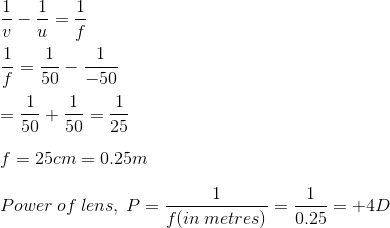
14. Find the power of a concave lens of focal length 2 m.
Answer-
The focal length of the concave lens (f) = 2 m Power of lens (P) = 1/f = 1/ (-2) = -0.5D
Light Reflection and Refraction Class 10 Exercise Answers
15. Which one of the following materials cannot be used to make a lens?
(a) Water
(b) Glass
(c) Plastic
(d) Clay
Answer –
(d) Clay cannot be used to make a lens because it is not transparent. For a lens to function properly, it must be able to transmit light through it, which requires the material to be transparent. Since clay is opaque and does not allow light to pass through, it cannot be used to make a lens that would focus or refract light. Lenses are typically made from materials like glass or plastic, which are transparent and can bend light to form images.
16. The image formed by a concave mirror is observed to be virtual, erect and larger than the object. Where should be the position of the object?
(a) Between the principal focus and the centre of curvature
(b) At the centre of curvature
(c) Beyond the centre of curvature
(d) Between the pole of the mirror and its principal focus.
Answer-
(d) The position of the object should be between the pole of the mirror and its principal focus.
17. Where should an object be placed in front of a convex lens to get a real image of the size of the object?
(a) At the principal focus of the lens
(b) At twice the focal length
(c) At infinity
(d) Between the optical centre of the lens and its principal focus.
Answer –
(b) The object should be placed at twice the focal length
18. A spherical mirror and a thin spherical lens have a focal length of -15 cm. The mirror and the lens are likely to be
(a) both concave
(b) both convex
(c) the mirror is concave, and the lens is convex
(d) the mirror is convex, but the lens is concave
Answer –
(a) Both are likely to be concave.
19. No matter how far you stand from a mirror, your image appears erect. The mirror is likely to be
(a) plane
(b) concave
(c) convex
(d) either plane or convex
Answer –
(d) The mirrors are likely to be either plane or convex
20. Which of the following lenses would you prefer to use while reading small letters found in a dictionary?
(a) A convex lens of focal length 50 cm
(b) A concave lens of focal length 50 cm
(c) A convex lens of focal length 5 cm
(d) A concave lens of focal length 5 cm
Answer –
(c) A convex lens of focal length 5 cm can be used while reading small letters found in a dictionary
21. We wish to obtain an erect image of an object, using a concave mirror of focal length 15 cm. What should be the range of distance of the object from the mirror? What is the nature of the image? Is the image larger or smaller than the object? Draw a ray diagram to show the image formation in this case.
Answer-
The range of the distance of the object = 0 to 15 cm from the pole of the mirror. Nature of the image = virtual, erect, and larger than the object.
22. Name the type of mirror used in the following situations.
(a) Headlights of a car
(b) Side/rear-view mirror of a vehicle
(c) Solar furnace
Support your answer with a reason.
Answer-
(a) Concave Mirror: Concave mirrors are used in car headlights because they can focus light into a powerful parallel beam. When the light source is placed at the principal focus of the concave mirror, the mirror reflects the light in a parallel direction, which is ideal for illuminating the road.
23. One-half of a convex lens is covered with black paper. Will this lens produce a complete image of the object? Verify your answer experimentally. Explain your observations.
Answer-
Yes, it will produce a complete image of the object, even when the lower half of the lens is covered with black paper. This can be verified by observing the image of a distant object, such as a tree, on a screen. Although the image will still be visible, the intensity or brightness of the image will be reduced due to the obstruction of light from the covered part of the lens.
24. An object 5 cm in length is held 25 cm away from a converging lens of focal length 10 cm. Draw the ray diagram and find the position, size and nature of the image formed.
Answer-
Height of the object, h 0 = 5 cm, Distance of the object from the converging lens, u = -25 cm. Focal length of a converging lens, f = 10 cm. Using the lens formula,
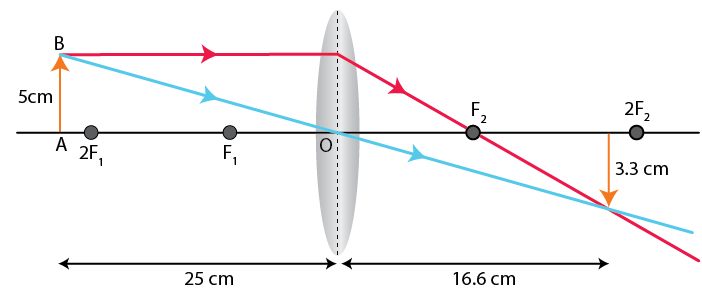
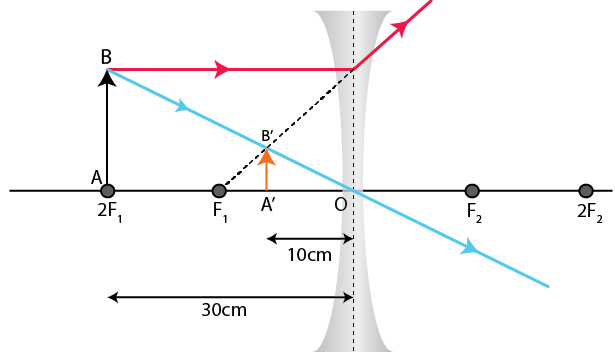
25. A concave lens of focal length 15 cm forms an image 10 cm from the lens. How far is the object placed from the lens? Draw the ray diagram.
Answer-
Focal length of concave lens (OF 1 ), f = – 15 cm. Image distance, v= – 10 cm. According to the lens formula,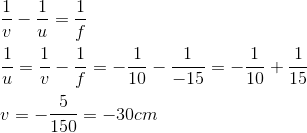
26. An object is placed at a distance of 10 cm from a convex mirror of focal length 15 cm. Find the position and nature of the image.
Answer-
Focal length of convex mirror (f) = +15 cm. Object distance (u) = – 10 cm. According to the mirror formula,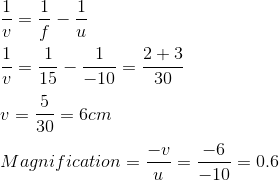
27. The magnification produced by a plane mirror is +1. What does this mean?
Answer-
The positive sign indicates that the image formed by a plane mirror is virtual and erect. Since the magnification is 1, it means that the image is of the same size as the object.
28. An object 5 cm is placed at a distance of 20 cm in front of a convex mirror of radius of curvature 30 cm. Find the position, nature and size of the image.
Answer-
Object distance (u) = – 20 cm Object height (h) = 5 cm Radius of curvature (R) = 30 cm Radius of curvature = 2 × Focal length R = 2f f = 15 cm According to the mirror formula,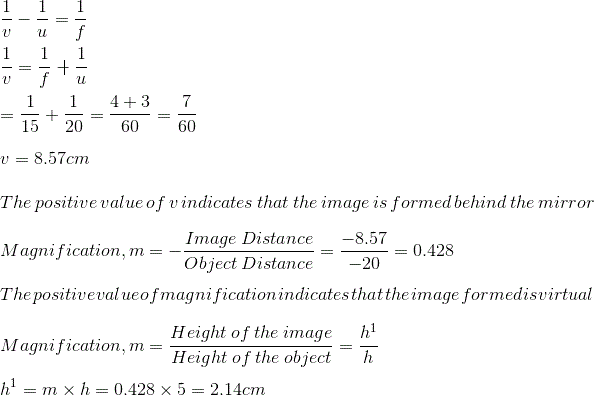 The positive value of image height indicates that the image formed is erect. Hence, the image formed is erect, virtual, and smaller in size.
30. An object of size 7.0 cm is placed at 27 cm in front of a concave mirror of focal length 18 cm. At what distance from the mirror should a screen be placed so that a sharply focused image can be obtained? Find the size and nature of the image.
Answer-
Object distance (u) = – 27 cm Object height (h) = 7 cm Focal length (f) = – 18 cm According to the mirror formula,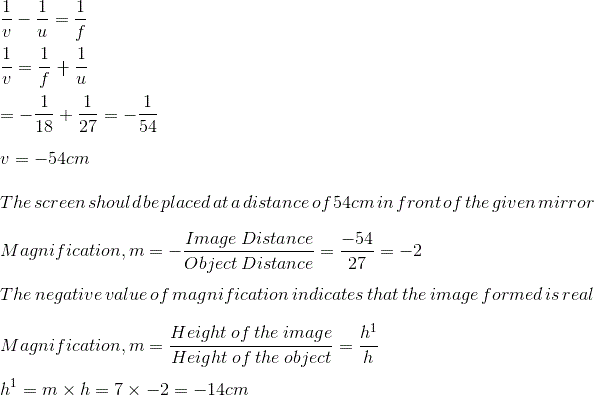
31. Find the focal length of a lens of power -2.0 D. What type of lens is this?
Answer-
Power of lens (P) = 1/f P = -2D f = -1/2 = -0.5 m A concave lens has a negative focal length. Therefore, it is a concave lens.
32. A doctor has prescribed a corrective lens of power +1.5 D. Find the focal length of the lens. Is the prescribed lens diverging or converging?
Answer-
Power of lens (P) = 1/f P = 1.5D f = 1/1.5 = 10/15 = 0.66 m A convex lens has a positive focal length. Therefore, it is a convex lens or a converging lens.Why Are Class 10 Light Reflection and Refraction Important?
NCERT Solutions for Class 10 are based on the CBSE Class 10 syllabus offering effective preparation support for you to score good marks in your board exams.
-
Clear Understanding of Concepts: NCERT Solutions for Class 10 Light Reflection and Refraction explain topics like reflection, refraction, lenses, and mirrors in a simple and easy-to-grasp manner.
-
Accurate Answers: The solutions provide precise answers aligned with the CBSE exam pattern, helping students score well in exams.
-
Step-by-Step Explanations: Each question is solved with detailed steps, making it easier to understand and apply formulas correctly.
-
Practice for Exams: Light Reflection and Refraction Class 10 Questions and Answers help students prepare effectively for board exams.
-
Time-Saving Revision: The solutions act as concise class 10 notes for quick revision before exams.
-
Improved Problem-Solving Skills: Students get hands-on practice with numerical problems, enhancing accuracy and speed during exams.
-
Concept Application: Helps in understanding real-life applications of light reflection and refraction concepts.
Related Links
NCERT Solutions for Class 10 Science Chapter 9 FAQs
What is Light Reflection and Refraction in Class 10?
Are these NCERT Solutions helpful for exams?
Can I use these solutions for quick revision?
Do these solutions include all exercise questions?