








Class 10 Maths Chapter 10 Some Applications of Trigonometry Exercise 10.1 NCERT Solutions
 Ananya Gupta28 May, 2026
Exercise 10.1 of Chapter 10, Some Applications of Trigonometry introduces you to the practical use of trigonometric ratios in solving problems related to heights and distances, an important topic covered in the CBSE Class 10th syllabus
These NCERT Solutions provide step-by-step explanations for every question. It will help you understand the correct approach, from interpreting the problem to forming diagrams and applying the right formulas.
NCERT Solutions for Class 10 Maths Chapter 10 Exercise 10.1
1. A circus artist is climbing a 20 m long rope, which is tightly stretched and tied from the top of a vertical pole to the ground. Find the height of the pole, if the angle made by the rope with the ground level is 30° (see figure ).
Answer:
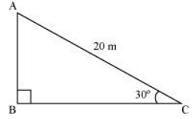
Let AB be the vertical pole Ac be 20 m long rope tied to point C.
In right ΔABC, sin 30° = AB/AC
⇒ 1/2 = AB/20
⇒ AB = 20/2
⇒ AB = 10
The height of the pole is 10 m.
2. A tree breaks due to storm and the broken part bends so that the top of the tree touches the ground making an angle 30° with it. The distance between the foot of the tree to the point where the top touches the ground is 8 m. Find the height of the tree.
Answer:
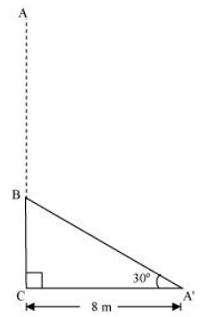
Let AC be the broken part of the tree.
∴ Total height of the tree = AB+AC
In right ΔABC, cos 30° = BC/AC
⇒ √3/2 = 8/AC
⇒ AC = 16/√3
Also, tan 30° = AB/BC
⇒ 1/√3 = AB/8
⇒ AB = 8/√3
Total height of the tree = AB+AC
= 16/√3 + 8/√3
= 24/√3
3. A contractor plans to install two slides for the children to play in a park. For the children below the age of 5 years, she prefers to have a slide whose top is at a height of 1.5 m, and is inclined at an angle of 30° to the ground, whereas for elder children, she wants to have a steep slide at a height of 3 m, and inclined at an angle of 60° to the ground. What should be the length of the slide in each case?
Answer:

There are two slides of height 1.5 m and 3 m. (Given)
Let AB is 1.5 m and PQ be 3 m slides.
ABC is the slide inclined at 30° with length AC and PQR is the slide inclined at 60° with length PR.
A/q, In right ΔABC, sin 30° = AB/AC ⇒ 1/2 = 1.5/AC ⇒ AC = 3m also,
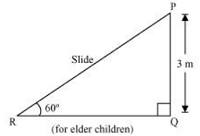
In right ΔPQR, sin 60° = PQ/PR
⇒ √3/2 = 3/PR
⇒ PR = 2√3 m
Hence, length of the slides are 3 m and 2√3 m respectively.
4. The angle of elevation of the top of a tower from a point on the ground, which is 30 m away from the foot of the tower, is 30°. Find the height of the tower.
Answer:
Let AB be the height of the tower and C is the point elevation which is 30 m away from the foot of the tower.
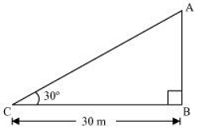
In right ΔABC, tan 30° = AB/BC
⇒ 1/√3 = AB/30
⇒ AB = 10√3
Thus, the height of the tower is 10√3 m.
5. A kite is flying at a height of 60 m above the ground. The string attached to the kite is temporarily tied to a point on the ground. The inclination of the string with the ground is 60°. Find the length of the string, assuming that there is no slack in the string.
Answer:
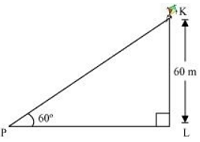
Let BC be the height of the kite from the ground, AC be the inclined length of the string from the ground and A is the point where the string of the kite is tied.
A/q, In right ΔABC, sin 60° = BC/AC
⇒ √3/2 = 60/AC
⇒ AC = 40√3 m
Thus, the length of the string from the ground is 40√3 m.
6. A 1.5 m tall boy is standing at some distance from a 30 m tall building. The angle of elevation from his eyes to the top of the building increases from 30° to 60° as he walks towards the building. Find the distance he walked towards the building.
Answer:
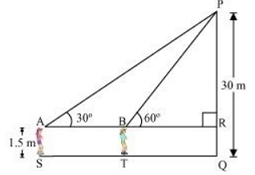
Let the boy initially stand at point Y with inclination 30° and then he approaches the building to point X with inclination 60°.
∴ XY is the distance he walked towards the building.
Also, XY = CD.
Height of the building = AZ = 30 m
AB = AZ - BZ = (30 - 1.5) = 28.5 m
A/q, In right ΔABD, tan 30° = AB/BD
⇒ 1/√3 = 28.5/BD
⇒ BD = 28.5√3 m
Also, In right ΔABC, tan 60° = AB/BC
⇒ √3 = 28.5/BC
⇒ BC = 28.5/√3 = 28.5√3/3 m
∴ XY = CD = BD - BC = (28.5√3 - 28.5√3/3)
= 28.5√3(1-1/3)
= 28.5√3 × 2/3
= 57/√3 m.
Thus, the distance the boy walked towards the building is 57/√3 m.
7. From a point on the ground, the angles of elevation of the bottom and the top of a transmission tower fixed at the top of a 20 m high building are 45° and 60° respectively. Find the height of the tower.
Answer:
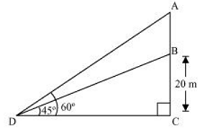
Let BC be the 20 m high building. D is the point on the ground from where the elevation is taken.
Height of transmission tower = AB = AC - BC
In right ΔBCD, tan 45° = BC/CD
⇒ 1 = 20/CD
⇒ CD = 20 m
Also, In right ΔACD, tan 60° = AC/CD
⇒ √3 = AC/20
⇒ AC = 20√3 m
Height of transmission tower = AB = AC - BC
= (20√3 - 20) m
= 20(√3 - 1) m.
8. A statue, 1.6 m tall, stands on the top of a pedestal. From a point on the ground, the angle of elevation of the top of the statue is 60° and from the same point the angle of elevation of the top of the pedestal is 45°. Find the height of the pedestal.
Answer:

Let AB be the height of the statue.
D is the point on the ground from where the elevation is taken.
Height of pedestal = BC = AC - AB
In right ΔBCD, tan 45° = BC/CD
⇒ 1 = BC/CD
⇒ BC = CD.
Also, In right ΔACD, tan 60° = AC/CD
⇒ √3 = AB+BC/CD
⇒ √3CD = 1.6 m + BC
⇒ √3BC = 1.6 m + BC
⇒ √3BC - BC = 1.6 m
⇒ BC(√3-1) = 1.6 m
⇒ BC = 1.6/(√3-1) m
⇒ BC = 0.8(√3+1) m
Thus, the height of the pedestal is 0.8(√3+1) m.
9. The angle of elevation of the top of a building from the foot of the tower is 30° and the angle of elevation of the top of the tower from the foot of the building is 60°. If the tower is 50 m high, find the height of the building.
Answer:

Let AB be the building and CD be the tower
In ΔCDB, CB/BD = tan 60º 50/BD = √3 BD = √3/50
In ΔABD, (AB)/(BD) = tan 30º
AB = 50/√3 x 1/√3 = 50/3 = 16 2/3
Therefore, the height of the building is 16 2/3 m.
10. Two poles of equal heights are standing opposite each other on either side of the road, which is 80 m wide. From a point between them on the road, the angles of elevation of the top of the poles are 60° and 30°, respectively. Find the height of the poles and the distances of the point from the poles.
In right triangle PRQ,
In ΔABO (AB)/(BO) = tan 60º
AB/BO = √3 BO
= AB/√3
In ΔCDO, (CD)/(DO) = tan 30º
CD/80 - BO = 1/√3 CD x √3
= 80 - BO CD x √3
= 80 - AB/√3 CD x √3 + AB/√3 = 80
Since the poles are of equal heights,
CD = AB CD[√3 + 1/√3]
= 80 CD[3+1/√3]
= 80 CD = 20√3 BO
= AB/√3 = CD/√3
= [20√3/√3]m = 20m
DO = BD − BO = (80 − 20) m = 60 m
Hence the heights of the poles are 20√3 m each and the distances of the point from poles are 20 m and 60 m respectively.
11. A TV tower stands vertically on a bank of a canal. From a point on the other bank directly opposite the tower, the angle of elevation of the top of the tower is 60°. From another point 20 m away from this point on the line joining this point to the foot of the tower, the angle of elevation of the top of the tower is 30° (see figure). Find the height of the tower and the width of the canal.

Answer:
In ΔABC, AB/BC = tan 60º
AB/BC = √3 BC = AB/ √3
In ΔABD, AB/BD = tan 30º
AB/BC+CD = 1/√3 [AB/(AB/√3) + 20]
= 1/√3 [AB x √3/AB + 20 x √3]
= 1/√3 3AB = AB + 20√3
= 2AB = 20√3 AB
= 10√3m
BC = AB/√3 = {10√3/√3}m = 10m
Hence, the height of the tower is 10√3 m and the width of the canal is 10 m.
12. From the top of a 7 m high building, the angle of elevation of the top of a cable tower is 60° and the angle of depression of its foot is 45°. Determine the height of the tower.
Answer:

Let AB be a building and CD be a cable tower.
In ΔABD, AB/BD = tan 45º
7/BD = 1 BD = 7 m
In ΔACE, AE = BD = 7 m
CE/AE = tan 60º
CE/7 = √3 CE = 7 x √3 CD
= CE + ED = [7 x √3 + 7]m = 7[√3 + 1]m
Hence, the height of the tower is 7[√3 + 1]m.
13. As observed from the top of a 75 m high lighthouse from the sea-level, the angles of depression of two ships are 30° and 45°. If one ship is exactly behind the other on the same side of the lighthouse, find the distance between the two ships.
Answer:

Let AB be the lighthouse and the two ships be at point C and D respectively.
In ΔABC, AB/BC = tan 45º
75/BC = 1 BC = 75 m
In ΔABD, AB/BD = tan 30º
75/BC+CD = 1/√3
75/75+CD = 1/√3
75 x √3 = 75 + CD
75[√3 - 1]m = CD
Hence the distance between the two ships is 75[√3 - 1]m
14. A 1.2 m tall girl spots a balloon moving with the wind in a horizontal line at a height of 88.2 m from the ground. The height of 88.2 m from the ground. The angle of elevation of the balloon from the eyes of the girl at any instant is 60°. After some time, the angle of elevation reduces to 30° (see Fig. 9.13). Find the distance travelled by the balloon during the interval.

Answer:
In right triangle ABC,
Let the initial position A of balloon change to B after some time and CD be the girl.
In ΔACE, AE/CE
= tan 60º (AF - EF)/(CE)
= tan 60º 88.2 - 1.2/CE
= √3 87/CE
= √3 CE
= 87/√3
= 87x√3m
In ΔBCG, (BG)/(CG)
= tan 30º 88.2 - 1.2/CG
= 1/√3 87/CG
= 1/√3 CG = 87x√3 m
Distance travelled by balloon = EG = CG − CE
= (87x√3 - 29x√3 )m = 58√3m
Hence the distance travelled by the balloon during the interval is 58√3 m.
15. A straight highway leads to the foot of a tower. A man standing at the top of the tower observes a car at an angle of depression of 30°, which is approaching the foot of the tower with a uniform speed. Six seconds later, the angle of depression of the car is found to be 60°. Find the time taken by the car to reach the foot of the tower from this point.
Answer:

Let AB be the tower. The initial position of the car is C, which changes to D after six seconds.
In ΔADB, AB/DB = tan 60º
AB/DB = √3 DB = AB/√3
In ΔABC, AB/BC = tan 30º
AB/BD + DC = 1/√3
AB √3 = BD + DC
AB √3 = AB/√3 + DC
DC = AB √3 - AB/√3
= AB(√3 - 1/√3)
= 2AB/√3
Time taken by the car to travel a distance DC (i.e.2AB/√3) = 6 seconds.
Time taken by the car to travel a distance DB (i.e. AB/√3)
= [6/2AB/√3] x [AB/√3] = 6/2 = 3 seconds.
Hence, the further time taken by the car to reach the foot of the tower is 3 seconds.
16. The angles of elevation of the top of a tower from two points at a distance of 4 m and 9 m from the base of the tower and in the same straight line with it are complementary. Prove that the height of the tower is 6 m.
Answer:
.png)
Let AQ be the tower and R, S are the points 4m, 9m away from the base of the tower respectively.
The angles are complementary.
Therefore, if one angle is θ, the other will be 90 − θ.
In ΔAQR, AQ/QR = tanΘ AQ/4 = tanΘ ... 1
In ΔAQS, AQ/SQ = tan(90 - Θ) AQ/9 = cot Θ ...2
On multiplying equations (1) & (2) (AQ/4)(AQ/9) = (tanΘ).(cot Θ)
AQ²/36 = 1 AQ² = 36 AQ = √36 AQ = ±6
However, height cannot be negative. Therefore, the height of the tower is 6 m
How to Score Better in Class 10 Maths Exam?
Scoring well in Class 10 Maths requires clear concepts, regular practice, and a focus on accuracy and answer presentation. To score better, you should:
-
Build Strong Concepts:
Focus on understanding concepts in Class 10 Maths instead of memorising steps, as this helps in solving application-based questions.
-
Work on Weak Areas:
Focus on difficult topics from the Class 10 Maths syllabus instead of skipping them to avoid losing marks.
-
Revise Formulas Daily:
Regular revision of PW Class 10 Maths MIQs helps avoid calculation mistakes in exams.
-
Practise Regularly:
Solve all CBSE Class 10 NCERT questions multiple times to strengthen your basics and improve accuracy.
-
Solve Previous Year Papers:
Practising CBSE Class 10 Previous Year Question Papers (PYQs) helps you understand question patterns and important topics.
NCERT Solutions for Class 10 Maths Chapter 10 Exercise 10.1 FAQs
What is the focus of Exercise 10.1 in Chapter 10 of Class 10 Maths?
How do trigonometric ratios help in solving problems in Exercise 10.1?
What types of problems are included in Exercise 10.1?
How can NCERT Solutions help in understanding Exercise 10.1?




Have questions about your prep?
Our experts can answer all your questions
 Live & recorded classes available at easeDashboard for progress trackingLakhs of practice questions

