







RS Aggarwal Solutions for Class 10 Maths Chapter 9 Exercise 9.3
In this article we have provided RS Aggarwal Solutions for Class 10 Maths Chapter 9 Exercise 9.3 prepared by our experts to help students to prepare better for their examinations.
 Ananya Gupta11 Jul, 2024
RS Aggarwal Solutions for Class 10 Maths Chapter 9 Exercise 9.3: The RS Aggarwal Solutions for Class 10 Maths Chapter 9 Exercise 9.3 provide detailed explanations and step-by-step solutions to problems involving the cumulative frequency distribution and its graphical representation.
These solutions prepared by subject experts at Physics Wallah, help students understand how to construct and interpret cumulative frequency curves (ogives). By practicing these exercises, students can enhance their ability to analyze and interpret data trends effectively.RS Aggarwal Solutions for Class 10 Maths Chapter 9 Exercise 9.3 Overview
The RS Aggarwal Solutions for Class 10 Maths Chapter 9 Exercise 9.3 prepared by subject experts from Physics Wallah provide clear and simple explanations of cumulative frequency distribution and its graphs. These solutions help students learn how to create and understand cumulative frequency curves (ogives). By practicing these exercises, students can improve their skills in analyzing and interpreting data.RS Aggarwal Solutions for Class 10 Maths Chapter 9 Exercise 9.3 PDF
The PDF link for RS Aggarwal Solutions for Class 10 Maths Chapter 9 Exercise 9.3 is available below. This PDF contains solutions prepared by subject experts at Physics Wallah provide clear and simple explanations for problems related to cumulative frequency distribution and its graphical representation.RS Aggarwal Solutions for Class 10 Maths Chapter 9 Exercise 9.3 PDF
RS Aggarwal Solutions for Class 10 Maths Chapter 9 Mean Median Mode Of Grouped Data Cumulative Frequency Graph And Ogive Exercise 9.3
Here we have provided RS Aggarwal Solutions for Class 10 Maths Chapter 9 Exercise 9.3 for the ease of students so that they can prepare better for their exams.
Solution:
Here, the maximum class frequency is 45. The class corresponding to this frequency is the modal class. ⇒ modal class = 30 - 40 ∴ lower limit of the modal class (l) = 30 Modal class size (h) = 10 Frequency of the modal class (f1) = 45 Frequency of class preceding the modal class (f0) = 35 Frequency of class succeeding the modal (f2) = 25 Mode is given by, Mode = l + ( f1 − f0 2f1 − f0 − f2 ) × h ⇒ Mode = 30 + ( 45−35 2(45)−35−25) × 10 ⇒ Mode = 30 + ( 10 30) × 10 ⇒ Mode = 30 + 3.33 = 33.33 Hence, the mode is 33.33
Solution:
Here, the maximum class frequency is 28. The class corresponding to this frequency is the modal class. ⇒ modal class = 40 - 60 ∴ lower limit of the modal class (l) = 40 Modal class size (h) = 20 Frequency of the modal class (f1) = 28 Frequency of class preceding the modal class (f0) = 16 Frequency of class succeeding the modal (f2) = 20 Mode is given by, Mode = l + ( f1 − f0 2f1 − f0 − f2 ) × h ⇒ Mode = 40 + ( 28−16 2(28)−16−20) × 20 ⇒ Mode = 40 + ( 12 20) × 20 ⇒ Mode = 40 + 12 = 56 Hence, the mode is 56.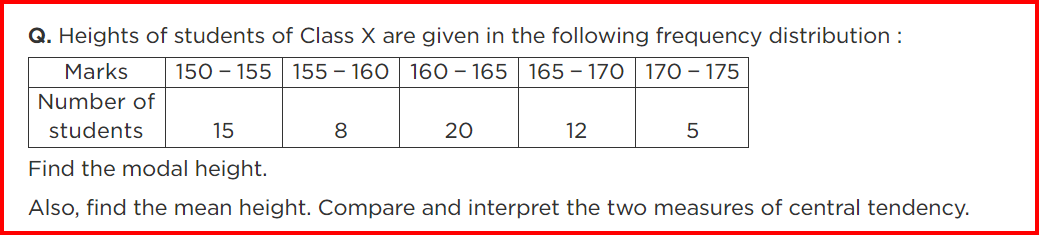 Solution:
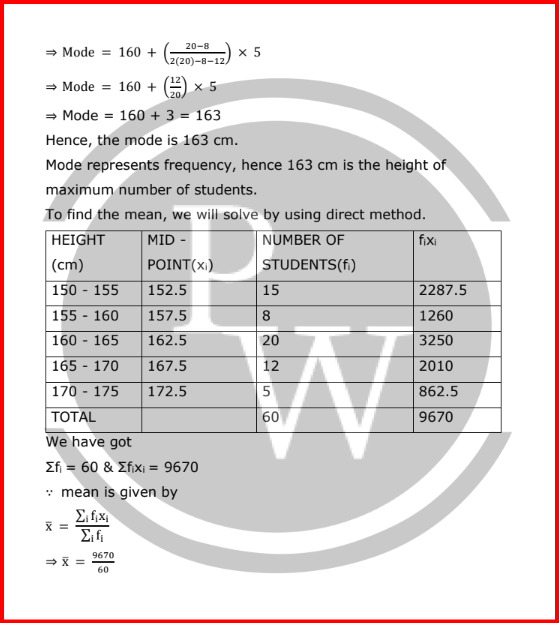
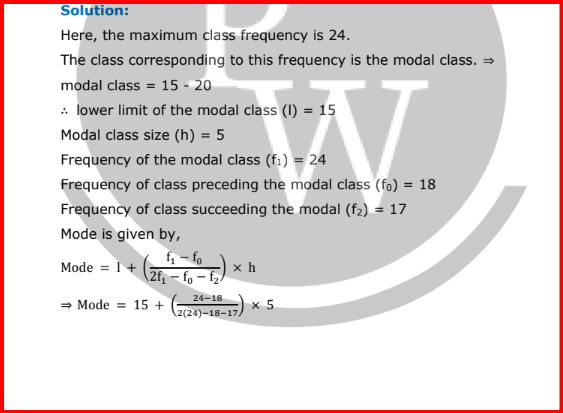
Here, the maximum class frequency is 20.
The class corresponding to this frequency is the modal class. ⇒
modal class = 160 - 165
∴ lower limit of the modal class (l) = 160
Modal class size (h) = 5
Frequency of the modal class (f1) = 20
Frequency of class preceding the modal class (f0) = 8
Frequency of class succeeding the modal (f2) = 12
Mode is given by,
Mode = l + (f1 − f02f1 − f0 − f2) × h
Solution:
Here, the maximum class frequency is 20.
The class corresponding to this frequency is the modal class. ⇒
modal class = 160 - 165
∴ lower limit of the modal class (l) = 160
Modal class size (h) = 5
Frequency of the modal class (f1) = 20
Frequency of class preceding the modal class (f0) = 8
Frequency of class succeeding the modal (f2) = 12
Mode is given by,
Mode = l + (f1 − f02f1 − f0 − f2) × h

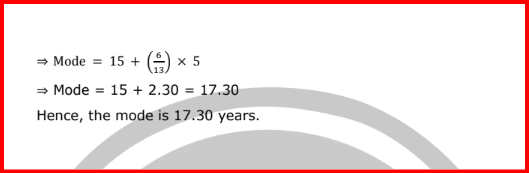
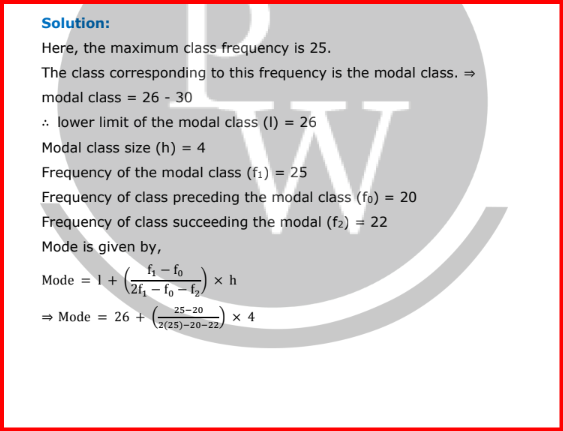 ⇒ Mode = 26 + (58) × 4
⇒ Mode = 26 + 2.5 = 28.5
Hence, the mode is 28.5.
⇒ Mode = 26 + (58) × 4
⇒ Mode = 26 + 2.5 = 28.5
Hence, the mode is 28.5.
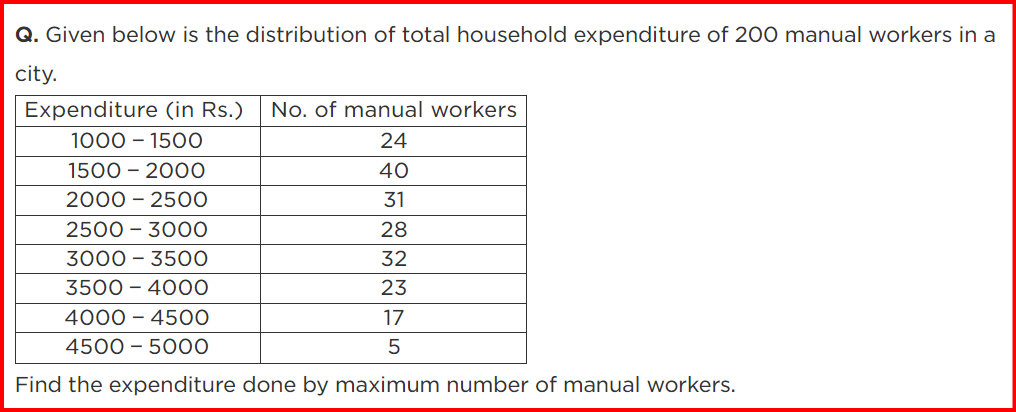 Expenditure done by maximum number of manual workers is
estimated by finding mode.
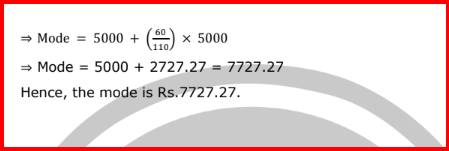
So here, the maximum class frequency is 40.
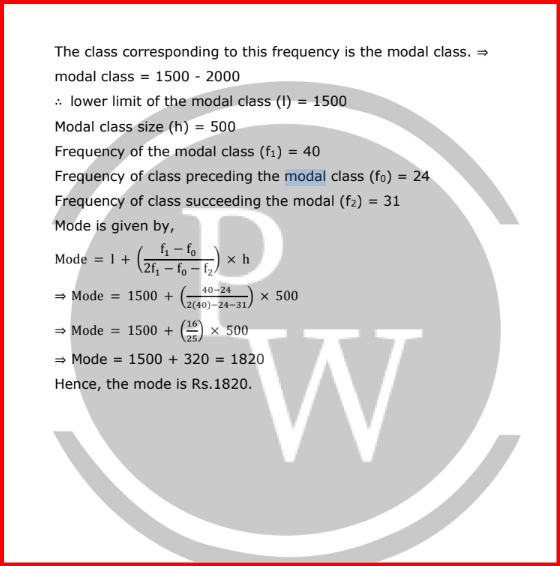
Expenditure done by maximum number of manual workers is
estimated by finding mode.
So here, the maximum class frequency is 40.

Benefits of RS Aggarwal Solutions for Class 10 Maths Chapter 9 Exercise 9.3
- Clear Explanations: The solutions provide clear explanations and step-by-step methods to help students understand cumulative frequency distribution and ogive graphs.
- Expert Guidance: Prepared by subject experts from Physics Wallah, these solutions ensure accuracy and reliability in learning the topic.
- Graphical Representation Skills: Students learn how to construct and interpret cumulative frequency curves (ogives), improving their ability to visualize and analyze data.
- Enhanced Problem-Solving: By practicing these solutions, students can develop strong problem-solving skills, crucial for exams and real-life applications.
- Comprehensive Practice: The exercises provide ample practice opportunities, reinforcing understanding and confidence in applying cumulative frequency concepts.
RS Aggarwal Solutions for Class 10 Maths Chapter 9 Exercise 9.3 FAQs
What is cumulative frequency distribution?
Cumulative frequency distribution is a way to summarize data by showing the total frequency of values less than or equal to a certain value in a data set.
How do you construct an ogive curve using cumulative frequency data?
To construct an ogive (cumulative frequency curve), plot points where each point represents the cumulative frequency against the upper class boundaries. Then connect these points smoothly to form the curve.
Why is ogive used in statistics?
Ogives are used to visualize and analyze cumulative frequency distributions. They help identify trends, distribution patterns, and critical values in data sets.
How do you interpret an ogive curve?
An ogive curve shows how data accumulates over time or across intervals. The steepness of the curve indicates the rate at which data accumulates. Interpreting an ogive helps in understanding the distribution and cumulative behavior of data.


🔥 Trending Blogs


Talk to a counsellorHave doubts? Our support team will be happy to assist you!


Check out these Related Articles

Join 15 Million students on the app today!
 Live & recorded classes available at easeDashboard for progress trackingMillions of practice questions at your fingertips


Free Learning Resources
PW Books
Notes (Class 10-12)
PW Study Materials
Notes (Class 6-9)
Ncert Solutions
Govt Exams
Our Other Websites
Class 6th to 12th Online Courses
Govt Job Exams Courses
UPSC Coaching
Defence Exam Coaching
Gate Exam Coaching
Other Exams
Know about Physics Wallah
Physics Wallah is an Indian edtech platform that provides accessible & comprehensive learning experiences to students from Class 6th to postgraduate level. We also provide extensive NCERT solutions, sample paper, NEET, JEE Mains, BITSAT previous year papers & more such resources to students. Physics Wallah also caters to over 3.5 million registered students and over 78 lakh+ Youtube subscribers with 4.8 rating on its app.
We Stand Out because
We provide students with intensive courses with India’s qualified & experienced faculties & mentors. PW strives to make the learning experience comprehensive and accessible for students of all sections of society. We believe in empowering every single student who couldn't dream of a good career in engineering and medical field earlier.
Our Key Focus Areas
Physics Wallah's main focus is to make the learning experience as economical as possible for all students. With our affordable courses like Lakshya, Udaan and Arjuna and many others, we have been able to provide a platform for lakhs of aspirants. From providing Chemistry, Maths, Physics formula to giving e-books of eminent authors like RD Sharma, RS Aggarwal and Lakhmir Singh, PW focuses on every single student's need for preparation.
What Makes Us Different
Physics Wallah strives to develop a comprehensive pedagogical structure for students, where they get a state-of-the-art learning experience with study material and resources. Apart from catering students preparing for JEE Mains and NEET, PW also provides study material for each state board like Uttar Pradesh, Bihar, and others
Copyright © 2026 Physicswallah Limited All rights reserved.