






Jupiters Bruises Reading Answers with IELTS Passage
 Tabassum Mustafa17 Jul, 2025
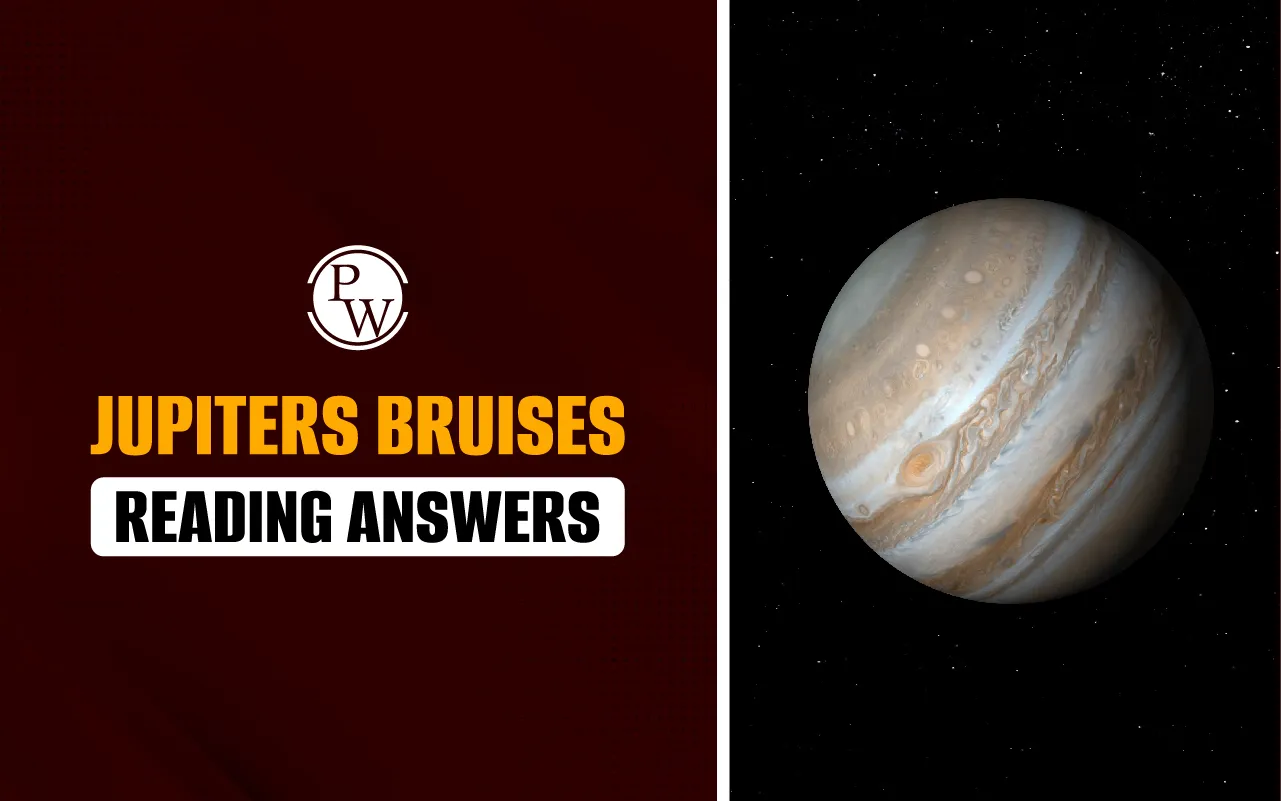
Jupiters Bruises Reading Answers: The IELTS Reading Section can be highly scoring if candidates can effectively understand the passage. However, candidates may find science-based passages like Jupiter’s Bruises reading answers challenging to grasp. Therefore, it is essential to carefully read all the paragraphs of the passage and identify their main idea. Additionally, it is crucial to understand how to approach the IELTS reading on planets and space. This practice not only boosts one’s confidence but also enhances their comprehension of real-world scientific situations.
The IELTS reading passage on Jupiter’s bruises is particularly important for the exam because it tests skills like identifying facts, understanding scientific terminology, and grasping cause-and-effect relationships. This topic highlights the real implications of planetary collisions and space observation. By practising such passages during preparation, students can improve their problem-solving ability, which is essential to perform well in the actual exam.
Free IELTS Reading Practice Tests
Jupiters Bruises Reading Answers IELTS Passage
Understanding Jupiter impacts, IELTS reading explanation is crucial for aspirants as it combines complex scientific concepts with complex vocabulary. This makes it an excellent resource for practice purposes. Here are the Jupiters Bruises reading answers IELTS passage. Candidates should carefully read the passage and answer the questions that follow:
Reading Passage: Jupiter's Bruises
A In 1994 the comet Shoemaker-Levy 9 collided with the planet Jupiter, causing great excitement in the world of astronomy. The article which follows was written after the first impact.
B Shoemaker-Levy 9 has plunged into Jupiter, and the Hubble Space Telescope has moved away to look at other objects in space. Amateur astronomers, however, are still watching Jupiter see what bruises wore loft on the mighty planet by the comet crash of 1994. There was tremendous excitement in astronomical circles during the collision of comet and planet. It is now time to see what has been learned from this impact.
C One question which may never be answered: Was Shoemaker-Levy 9 a comet, or was it an asteroid instead? Comets tend to be a mixture of ice, rock, and dust, along with other substances, like carbon monoxide, that evaporate quickly to form a halo and a tail. Scientists studying the chemical composition of the spots on Jupiter where Shoemaker-Levy 9 (S-L 9) hit thought they might see evidence of water and oxygen, two of the expected products when an icy comet vaporizes. But except for one unconfirmed report, researchers have found only ammonia, hydrogen sulfide, and sulfur gas.
D Asteroids are rockier than comets. Yet an asteroid can have a halo or a tail, made mostly of dust. Says Hal Weaver of the Space Telescope Institute: The only real evidence that SL-9 was a comet is that it broke apart, and we've never seen that in an asteroid. But maybe this was a fragile asteroid'.
E Amateur astronomer David Levy, who with Eugene and Carolyn Shoemaker discovered SL-9. points out that comets were originally distinguished by their appearance. They are objects that look like fuzzy stars with tails, and in any previous century, astronomers would have called this discovery a comet. On that basis, argues Levy, 'S-L 9 is a comet, period.
F The apparent absence of water at the impact sites provides a clue about how far the SL-9 fragments penetrated Jupiter's atmosphere before exploding. Theorists think that a layer of water vapor es some 95 km below the visible cloud tops; above the vapor layer, about 50 km down, are clouds believed to consist of a sulfur compound. Since no water seems to have been stirred up, the explosion probably took place in the presumed sulfide layer.
G If researchers confirm that the sulfur rose from Jupiter, it will be a major discovery,' says University of Arizona astronomer Roger Yelle. We've always believed that much of the color in Jupiter's clouds comes from sulfur compounds, but we've never delected them.
H No one knows why the points of impact are so dark, but it is clear that they are very high up in Jupiter's atmosphere, since the planet's stripes can be seen through them. Astronomers believe the collisions will provide an opportunity to study the winds above Jupiter's cloud tops. The mark left by the first impact is already starting to be spread around. There are also hints of seismic waves ripples that may have traveled to a dense layer of liquid hydrogen thousands of kilometers down and then bounced back up to the surface, creating rings half the size of the planet's visible face. These waves may offer clues to Jupiter's internal structure.
I The spots that were made by the collision will undoubtedly blow away eventually, but it's much too soon to tell if there will be any permanent changes in Jupiter. There is still every chance that the impacts, especially from the four fragments that hit in nearly the same place, will destabilize the atmosphere and create a new, permanent cyclone like Jupiter's Great Red Spot.
J It's also possible that the show isn't quite over. Theorists using a computer model argue that debris has lagged behind the original 21 major fragments. These stragglers, they predict, will keep hitting Jupiter for months to come. Unlike the previous fragments, the latecomer will smash into the near side of the planet, giving astronomers a chance to watch some strikes directly. Is the theory plausible? Says one astronomer, 'We've had so many surprises from S-L 9 already that I wouldn't rule anything out.
Also Read:
Jupiters Bruises Reading Answers IELTS Questions
Here are the set of questions based on the above passage. IELTS aspirants must understand the type of questions and then answer them to test their knowledge.
Questions 1–4: Matching Information
Match the following statements with the correct paragraph (A–J).
-
Scientists are unsure whether the impacting body was a comet or an asteroid.
-
A computer model suggests more impacts might happen.
-
The impacts might help uncover internal features of Jupiter.
-
A clue about where the explosion happened in Jupiter’s atmosphere.
Questions 5–8: True / False / Not Given
-
Shoemaker-Levy 9 was the first and only comet to ever strike Jupiter.
-
Astronomers saw all of the effects directly.
-
David Levy believes SL-9 should be considered a comet based on historical definitions.
-
The impact left permanent marks on Jupiter’s surface.
Questions 9–13: Sentence Completion
Complete the sentences in two or less words by taking reference from the passage.
-
The presence of __________ would confirm SL-9 was a comet.
-
Astronomers believe sulfur compounds affect Jupiter’s __________.
-
The collision marks are located high in the planet’s __________.
-
Seismic waves may reveal the planet’s __________ structure.
-
A new permanent __________ could form due to the impacts.
What are the IELTS Reading Answers for Jupiter’s Surface Marks?
Here are the IELTS reading answers for planetary collisions passage questions along with their explanation. Candidates should go through each answer to analyse their performance and identify the areas where they need to improve.
Answer 1-4:
-
C (Paragraph C discusses the uncertainty over whether Shoemaker-Levy 9 was a comet or asteroid.)
-
J (Paragraph J explains the computer model predicting additional impacts.)
-
H (Paragraph H mentions seismic waves that could reveal internal structure.)
-
F (Paragraph F talks about sulfur cloud levels indicating explosion depth.)
Answer 5-8:
-
Not Given (The passage does not state whether this was the first ever comet to hit Jupiter.)
-
False (Paragraph J mentions that prior impacts weren’t directly visible, but future ones might be.)
-
True (Paragraph E quotes David Levy supporting the comet label based on appearance.)
-
False (Paragraph I states the marks will “undoubtedly blow away eventually.”)
Answer 9-13:
-
water and oxygen
-
clouds’ color
-
atmosphere
-
internal
-
cyclone
| IELTS Reading Band Score | IELTS Listening Band Score |
| IELTS Speaking Band Score | IELTS Writing Band Score |
Guidance of PW IELTS
Physics Wallah offers a few popular online IELTS courses for all students. Follow the latest IELTS articles to better prepare for the exam.
| IELTS Registration | IELTS Eligibility Criteria |
| IELTS Exam Pattern | IELTS Syllabus |
| IELTS Exam Dates | IDP IELTS Test Centers |
Jupiters Bruises Reading Answers FAQs
How to solve IELTS reading passage on Jupiter?
Why is the IELTS reading passage on Jupiters bruises important?
What is the ideal time to read Jupiters Bruises reading answers passage?
How to find IELTS reading answers for planetary collisions?










 Live & recorded classes available at easeDashboard for progress trackingLakhs of practice questions

