






Miles Davies Reading Answers with IELTS Passage
 Porishmita .3 Jul, 2025
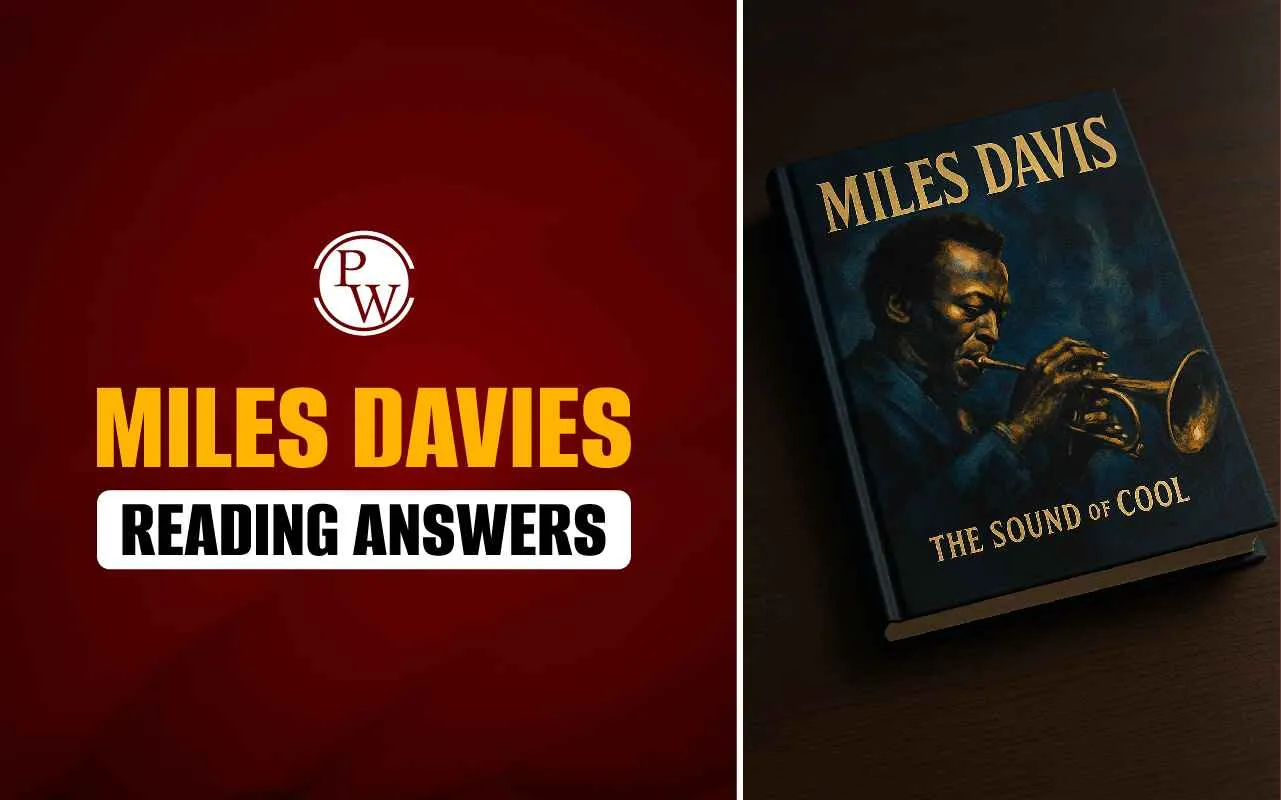
Miles Davies Reading Answers: In the IELTS Reading test, you may encounter passages about influential figures in music, art, or science. This passage on Miles Davis, a legendary American jazz musician, is a classic example of a biography-based reading passage. It discusses Davis's musical evolution, personal challenges, and contributions to jazz and other genres. You will be asked to identify main ideas, matching information, and understand the writer’s tone or attitude, all common IELTS question types.
Free IELTS Reading Practice Tests
Miles Davies Reading Answers Passage
You should spend about 20 minutes on Questions 1-13, which are based on the Reading Passage below.
Miles Davies
A At the age of thirteen, Miles Davis was given his first trumpet, lessons were arranged with a local trumpet player, and a musical odyssey. These early lessons, paid for and supported by his father, had a profound effect on shaping Davis’ signature sound. Whereas most trumpeters of the era favoured the use of vibrato (a wobbly quiver in pitch inflected in the instrument’s tone), Davis was taught to play with a long, straight tone, a preference his instructor reportedly drilled into the young trumpeter with a rap on the knuckles every time Davis began using vibrato. This clear, distinctive style never left Davis. He continued playing with it for the rest of his career, once remarking, ‘If I can’t get that sound, I can’t play anything.’
B Having graduated from high school in 1944, Davis moved to New York City, where he continued his musical education both in the clubs and in the classroom . His enrolment in the prestigious Julliard School of Music was short- lived. However – he soon dropped out, criticising what he perceived as an over-emphasis on the classical European repertoire and a neglect of Davis did later acknowledge, however, that this time at the school was invaluable in terms of developing his trumpet-playing technique and giving him a solid grounding in music theory. Much of his early training took place in the form of jam sessions and performances in the clubs of 52nd Street, where he played alongside both up-and-coming and established members of the jazz pantheon such as Coleman Hawkins. Eddie ‘Lockjaw’ Davis, and Thelonious Monk.
C In the late 1940s, Davis collaborated with nine other instrumentalists, including a French horn and tuba player, to produce The Birth of Cool, an album now renowned for the inchoate sounds of what would later become known as ‘cool’ in contrast to popular jazz styles of the day, which featured rapid rollicking beats, shrieking vocals, and short, sharp horn blasts. Davis’ album was the forerunner of a different kind of sound – thin, light horn-playing, hushed drums and a more restrained, formal arrangement. Although it received little acclaim at the time (the liner notes to one of Davis’ later recordings call it a ‘spectacular failure ), in hindsight, The Birth of Cool has become recognised as a pivotal moment in jazz history, cementing – alongside his 1958 recording, Kind of Blue – Davis’ – legacy as one of the most innovative musicians of his era.
D Though Davis’ trumpet playing may have sounded effortless and breezy, this ease rarely carried over into the rest of his life. The early 1950s, in particular, were a time of great personal turmoil. After returning from a stint in Paris, Davis suffered from prolonged depression, which he attributed to the unravelling of a number of relationships, including his romance with a French actress and some musical partnerships that ruptured as a result of creative disputes. Davis was also frustrated by his perception that he had been overlooked by the music critics, who were hailing the success of his collaborators and descendants in the ‘cool’ tradition, such as Gerry Mulligan and Dave Brubeck, but who afforded him little credit for introducing the cool sound in the first place.
E In the latter decades of his career, Davis broke out of exclusive jazz settings and began to diversify his output across a range of musical styles. In the 1960s, he was influenced by early funk performers such as Sly and the family Stone, which then expanded into the jazz-rock fusion genre – of which he was a frontrunner – in the 1970s. Electronic recording effects and electric instruments were incorporated into his sound. By the 1980s, Davis was pushing the boundaries further, covering pop anthems such as Cyndi Lauper’s Time after Time and Michael Jackson’s Human Nature, dabbling in hip hop, and even appearing in some movies.
F Not everyone was supportive of Davis’ change of tune. Compared to the recordings of his early career, universally applauded as linchpins of the jazz oeuvre, trumpeter Wynston Marsalis derided his fusion work as being ‘not true jazz’, and pianist Bill Evans denounced the ‘corrupting influence’ of record companies, noting that rock and pop ‘draw wider audiences’. In the face of this criticism, Davis remained defiant, commenting that his earlier recordings were part of a moment in time that he had no ‘feel’ for any more. He firmly believed that remaining stylistically inert would have hampered his ability to develop new ways of producing music. From this perspective, Davis’ continual revamping of genre as not merely a rebellion, but an evolution, a ‘necessary path that allowed him to release his full musical potential.
Also Read:
Miles Davies Reading Answers Sample Questions
Questions 1–5: Matching Information
Match the correct paragraph (A–F) with the information below.
-
A rejection of traditional music education
-
An opinion about a significant musical shift
-
Incorporation of new music styles and technologies
-
Description of early training and its influence
-
Feelings of being underappreciated
Questions 6–10: True/False/Not Given
6. Davis always preferred classical music.
7. The album The Birth of Cool was initially unsuccessful.
8. Davis was never interested in modern genres.
9. His sound included electronic effects in later years.
10. Davis was influenced by French jazz musicians.
Questions 11–13: Multiple Choice
11. What made Davis’s trumpet style unique?
-
A. Use of high vibrato
-
B. Loud tone
-
C. Straight, clear tone
-
D. Use of classical chords
-
Why did Davis leave Julliard?
-
A. He was expelled
-
B. He preferred jazz clubs
-
C. He disliked the curriculum focus
-
D. He couldn’t afford tuition
-
What was Davis’s response to criticism of his later work?
-
A. He returned to traditional jazz
-
B. He ignored the critics
-
C. He defended his need to evolve
-
D. He quit producing music
Miles Davies Reading Answers with Explanations
Answers to Questions 1-13
|
Question |
Answer |
Explanation |
|---|---|---|
|
1 |
B |
Davis left Julliard due to its focus on classical music. |
|
2 |
F |
Critics debated his shift to fusion/pop, but Davis defended the evolution. |
|
3 |
E |
Davis included funk, electronic, and pop styles in later decades. |
|
4 |
A |
Early trumpet lessons taught him a straight tone, which defined his style. |
|
5 |
D |
Davis felt unrecognised by critics despite his influence on 'cool' jazz. |
|
6 |
False |
He disliked the classical music focus at Julliard. |
|
7 |
True |
The Birth of Cool initially failed but was later recognised as pivotal. |
|
8 |
False |
Davis explored pop and hip hop, showing interest in modern genres. |
|
9 |
True |
He used electronic effects and instruments in the 1970s. |
|
10 |
Not Given |
The passage doesn’t mention French jazz musicians influencing Davis. |
|
11 |
C |
Davis was known for his straight, clear trumpet tone. |
|
12 |
C |
He left Julliard due to dissatisfaction with the classical curriculum. |
|
13 |
C |
He defended his shift in style as necessary for creative growth. |
| IELTS Reading Band Score | IELTS Listening Band Score |
| IELTS Speaking Band Score | IELTS Writing Band Score |
Guidance of PW IELTS
Physics Wallah offers a few popular online IELTS courses for all students. Follow the latest IELTS articles to better prepare for the exam.
| IELTS Registration | IELTS Eligibility Criteria |
| IELTS Exam Pattern | IELTS Syllabus |
| IELTS Exam Dates | IDP IELTS Test Centers |
Miles Davies Reading Answers FAQs
What type of passage is the Miles Davies reading?
What IELTS reading question types appear in this passage?
Was Miles Davis involved only in jazz music?
Did critics support his musical experimentation?
Why is this passage challenging for IELTS students?










 Live & recorded classes available at easeDashboard for progress trackingLakhs of practice questions

