








UGC NET Political Science Unit 5 International Relations Important PYQs
UGC NET Political Science Unit 5 International Relations PYQs help candidates revise important topics such as the Treaty of Westphalia, the United Nations, regional organizations, international treaties, environmental conferences, global governance, and contemporary international events. Regular PYQ practice improves conceptual understanding, factual accuracy, and exam performance for the UGC NET exam scheduled from 22 June to 30 June 2026.
 Priyanka Yadav10 Jun, 2026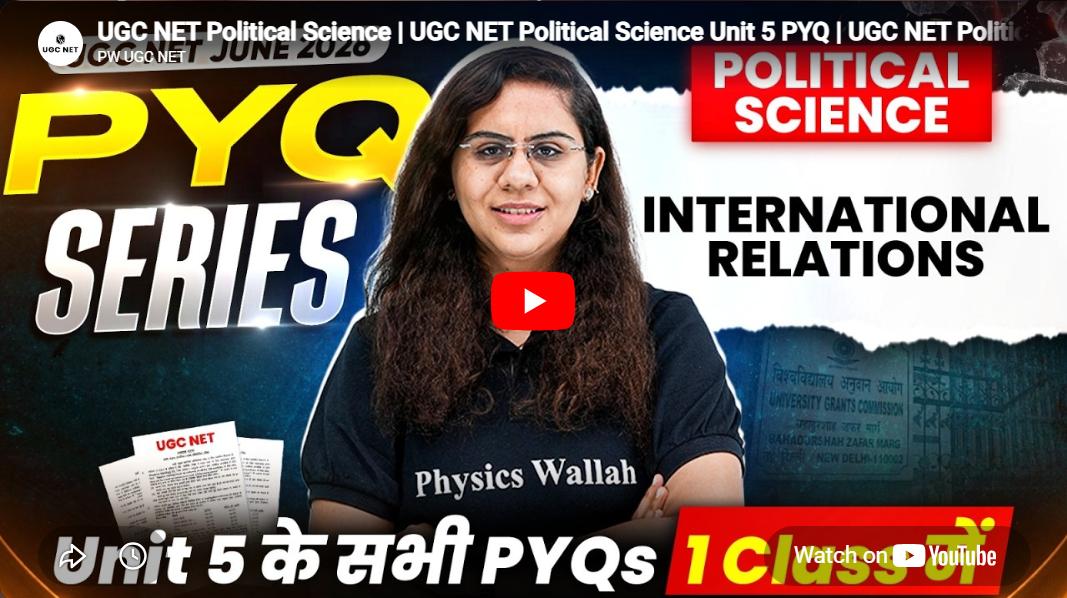
International Relations is one of the most important sections of the UGC NET Political Science Unit 5. Questions are frequently asked on international organizations, treaties, Cold War developments, environmental summits, global governance institutions, and contemporary international affairs. Candidates often face difficulty because the unit requires both conceptual understanding and factual knowledge of important events, dates, organizations, and agreements.
With the UGC NET exam scheduled from 22 June to 30 June 2026, practicing Previous Year Questions (PYQs) can help candidates identify recurring themes, improve factual retention, and develop confidence in solving assertion-reason, match-the-following, and chronology-based questions.
What Does the UGC NET Political Science Unit 5 International Relations PYQ Session Cover?
This UGC NET Political Science Unit 5 session focuses on important International Relations topics that have appeared repeatedly in previous examinations with detailed answers and explanations. Key topics discussed include:
-
Origins and evolution of International Relations
-
Treaty of Westphalia and state sovereignty
-
United Nations and global governance
-
Regional organizations and international cooperation
-
Cold War events and nuclear arms-control treaties
-
Environmental conferences and global environmental governance
-
Bretton Woods institutions and international political economy
-
Contemporary international affairs and political developments
-
Assertion-reason, match-the-following, and chronology-based questions
-
PYQ trends and exam-oriented revision strategies
Important PYQs for UGC NET Political Science Unit 5: International Relations
These important Previous Year Questions cover major International Relations topics that are frequently asked in UGC NET Political Science examinations.
Q1. Which foreign country's Prime Minister abruptly announced his resignation while he was in Saudi Arabia on 4th November 2017?
(A) Jordon
(B) Lebanon
(C) Kuwait
(D) Syria
Q2. Arrange the following major international initiatives on the environment in descending order:
A. UN Convention on Law of the Sea (UNCLOS)
B. Convention on International Trade in Endangered Species (CITES)
C. UN Conference on the Human Environment (UNCHE)
D. The World Meteorological Organization (WMO) was established
E. Antarctic Treaty
Choose the correct answer from the options given below:
(A) A, B, C, D, E
(B) D, E, B, C, A
(C) A, B, C, E, D
(D) E, C, D, A, B
Q3. PM Narendra Modi met Donald Trump, the newly elected President of the United States of America, in Washington D.C. in-
(A) December 2024
(B) January 2025
(C) April 2025
(D) February 2025
Q4. In which year did the Bali Terror Bombings take place?
(A) 1999
(B) 2002
(C) 2006
(D) 2007
Q5. In which year did the United Nations General Assembly adopt the Millennium Development Goals?
(A) 2007
(B) 1993
(C) 2000
(D) 1997
Q6. Arrange the Directors-General of GATT/WTO as per their tenure in chronological order:
A. Eric Wyndham White
B. Olivier Long
C. Arthur Dunkel
D. Peter Sutherland
E. Ngozi Okonjo-Iweala
Choose the correct answer from the options given below:
(A) A, B, C, D, E
(B) B, C, D, E, A
(C) C, D, E, B, A
(D) D, A, B, C, E
Q7. Arrange the following initiatives/establishments by United Nations in chronological order:
A. UN Roll Back Malaria Initiative
B. Universal Declaration on Human Genome and Human Rights
C. Global Polio Eradication Initiative
D. Establishment of University of Peace, Costa Rica
Choose the correct answer from the options given below:
(A) C, B, A, E, D
(B) C, A, B, E, D
(C) D, C, B, A, E
(D) D, B, C, A, E
Q8. Who of the following thinkers are not associated with Realist school?
(A) A and B Only
(B) B and C Only
(C) C and A Only
(D) D and E Only
Q9. Who wrote "Hindu Theory of International Relations"?
(A) Swami Vivekanand
(B) William Jones
(C) Benoy Kumar Sarkar
(D) Aurobindo Ghosh
Q10. Chronologically arrange the moments of crises of modern capitalism:
A. U.S. sub-prime mortgage crisis
B. Argentine economic crisis
C. Dot com crisis in IT-related stocks
D. Mexican economic crisis
Choose the correct answer from the options given below:
(A) D, B, C & A
(B) B, D, A & C
(C) A, B, C & D
(D) D, B, A & C
Preparation Tips for UGC NET Political Science Unit 5 International Relations
UGC NET Political Science Unit 5 includes topics ranging from international organizations, environmental summits, and contemporary global developments. Candidates can strengthen their preparation by focusing on the following areas:
-
Revise important treaties and agreements such as the Treaty of Westphalia, SALT, START, INF, and other arms-control treaties.
-
Prepare timelines of major international events, including the Cold War, Korean War, Vietnam War, Cuban Missile Crisis, and recent global conflicts.
-
Learn the establishment years, objectives, and headquarters of important international organizations and regional groupings.
-
Focus on United Nations institutions, global governance mechanisms, and environmental conferences such as Stockholm, Rio Earth Summit, and COP summits.
-
Practice assertion-reason, match-the-following, and chronology-based questions, as these are frequently asked from International Relations.
-
Keep track of important contemporary international developments, world leaders, and major geopolitical events that may be linked to conceptual questions.
-
Solve Previous Year Questions (PYQs) regularly to identify recurring themes and improve accuracy in factual and conceptual questions.
These topics are repeatedly tested in UGC NET Political Science examinations, making regular revision and PYQ practice essential for scoring well in Unit 5 International Relations.
UGC NET Political Science Unit 5 PYQs FAQs
Which topics are most important in UGC NET Political Science Unit 5 International Relations?
Why should candidates practice UGC NET Political Science Unit 5 PYQs?
How can I prepare effectively for UGC NET Political Science Unit 5 International Relations?


Have questions about your prep?
Our experts can answer all your questions


 Live & recorded classes available at easeDashboard for progress trackingLakhs of practice questions

