








UGC NET Political Science Unit 9 PYQs, Important Questions
UGC NET Political Science Unit 9 PYQs help candidates revise important Public Administration topics in a simple and organized way. These questions cover key books, important thinkers such as Max Weber, F.W. Taylor, and Herbert Simon, administrative theories, and the development of Public Administration. Regular PYQ practice improves concept clarity, revision, and exam performance in the UGC NET.
 Aarti .10 Jun, 2026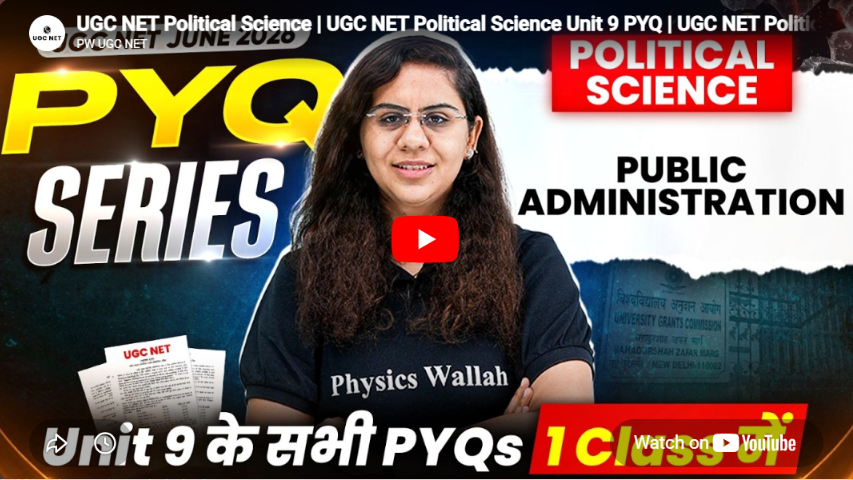
UGC NET Political Science Unit 9 focuses on Public Administration, an important section of the syllabus. It includes topics such as administrative theories, organizational structures, motivation theories, behavioral approaches, and New Public Management (NPM). Questions are often asked about important books, thinkers, concepts, and theories.
Practicing Previous Year Questions (PYQs) is one of the best ways to prepare for this unit. PYQs help candidates understand the exam pattern, identify frequently asked topics, connect important concepts with thinkers, and improve accuracy in the actual UGC NET examination.
What Does the UGC NET Political Science Unit 9 PYQ Session Cover
This unit overview covers the key concepts that have been repeatedly tested in previous UGC NET examination cycles. The major focus areas include:
-
Classical, Bureaucratic, and Scientific Management Foundations (Weber, Taylor, Fayol).
-
Human Relations Approaches and Behavioral Interventions (Elton Mayo, Mary Parker Follet, Chester Barnard).
-
Theories of Motivation, Hierarchy of Needs, and Satisficing Paradigms (Maslow, Herzberg, Simon).
-
The Structural Chronology and Eras of Evolution of Public Administration.
-
Comparative Public Administration paradigms and Ecological Models (F.W. Riggs).
-
Features, Anti-Goals, and Institutional Mechanisms of New Public Administration (NPA) and New Public Management (NPM).
Important PYQs for UGC NET Political Science Unit 9
The following previous year questions are based on the important topics that are commonly asked in UGC NET Political Science examinations.
Q1. Match List I with List II:
| Author List I | Books List II |
| (A) Dwight Waldo | (I) Management Challenges for the 21st Century |
| (B) Peter Drucker | (II) The Study of Public Administration |
| (C) Rensin Likert | (III) The Motivation to Work |
| (D) Frederick Herzberg | (IV) The Human Organisation |
Choose the correct answer from the options given below:
(A) A-II, B-I, C-IV, D-III
(B) A-III, B-IV, C-I, D-II
(C) A-I, B-II, C-III, D-IV
(D) A-IV, B-III, C-II, D-I
Q2. Who wrote the book 'Development Administration: Concepts, Goals, Methods'?
(A) George F. Gant
(B) Sabu Thomas
(C) Fred Riggs
(D) Michel Crozier
Q3. Luther Gulick's four basis of departmentalisation are:-
A. Purpose
B. Process
C. Persons
D. Place
E. Protest
Choose the most appropriate answer from the options given below:
(A) A, B, C, E Only
(B) B, D, E, C Only
(C) A, B, C, D Only
(D) D, A, E, B Only
Q4. Rational Choice Theory's impact on Public Administration has been strongly felt in the areas such as as :
(A) Organization Behaviour
(B) Local Government
(C) Public Service Delivery
(D) Theory of Democratic Administration
Choose the correct answer from the options given below :
(A) (A), (B) and (C) Only
(B) (A), (B) and (D) Only
(C) (A) and (C) Only
(D) (B) and (C) Only
Q5. Match List - I with List - II.
| List - I | List - II |
| (A) Theory of Motivation | (I) Mary Parker Follett |
| (B) Psychologically oriented imprint on research into industrial relations | (II) Douglas McGregor |
| (C) Administrative processes are more important than hierarchy and authority | (III) Elton Mayo |
| (D) Focus on values like citizen responsiveness, worker and citizen participation in decision making | (IV) H.G. Frederickson |
Choose the correct answer from the options given below :
(A) (A)-(I), (B)-(III), (C)-(II), (D)-(IV)
(B) (A)-(II), (B)-(I), (C)-(III), (D)-(IV)
(C) (A)-(II), (B)-(III), (C)-(I), (D)-(IV)
(D) (A)-(IV), (B)-(II), (C)-(III), (D)-(I)
Q6. Match List-I with List-II.
| List-I (Theories) | List-II (Propounder) |
| A. Scientific Management | I. Karl Marx |
| B. Linking Pin Model | II. Frederick W. Taylor |
| C. Alienation of Bureaucracy | III. Dwight Waldo |
| D. New Public Administration | IV. Rensis Likert |
Choose the correct answer from the options given below:
(A) A-III, B-II, C-IV, D-I
(B) A-II, B-IV, C-I, D-III
(C) A-IV, B-III, C-I, D-II
(D) A-I, B-II, C-IV, D-III
Q7. Who introduced to organizations the concepts of the 40-hour week, time and motion studies and piece-rate compensation systems, as well as a fair day's work for a fair day's pay?
(A) Woodrow Wilson
(B) Frederick Taylor
(C) Max Weber
(D) Elton Mayo
Q8. Arrange the following administrative thinkers/theorists chronologically:
A. F.W. Willoughby
B. Max Weber
C. David Easton
D. Elton Mayo
Choose the correct answer from the options given below:
(A) A, B, C, D
(B) D, C, B, A
(C) B, A, D, C
(D) C, B, A, D
Q9. Which of the following statements is/are incorrect regarding New Public Management (NPM)?
(A) NPM is aggressively result oriented and objective focused.
(B) NPM views public administration from the managerial angle.
(C) NPM believes in the separation of steering from rowing.
(D) NPM have attributes like raw bureaucratic power, internalization, and concentration.
Q10. Given below are two statements: one is labelled as Assertion A and the other is labelled as Reason R :
Assertion A: The assumptions of Theory 'Y' is that integration of behaviour is the key process in management
Reason R : Theory 'Y' results in the creation of conditions conducive for the members to achieve their own goals by directing their efforts towards the success of the enterprise.
In the light of the above statements, choose the correct answer from the options given below. (A) Both A and R are true and R is the correct explanation of A
(B) Both A and R are true but R is not the correct explanation of A
(C) A is true but R is false
(D) A is false but B is true
Preparation Tips for UGC NET Political Science Unit 9
Public Administration can be a scoring unit if you study it in a planned way. Use these simple tips to prepare better and improve your performance in the exam:
-
Make Comparison Charts: Compare important theories and thinkers side by side, such as Classical Theory vs Human Relations Theory or Bureaucracy vs New Public Management.
-
Master the Chronological Eras: Study the evolution of Public Administration from the Politics-Administration Dichotomy to modern Public Policy approaches in chronological order, from Dichotomy Era to the Principles Stage, the Era of Challenge, through to contemporary Public Policy Perspectives.
-
Use Memory Tricks: Create simple mnemonics to remember important scholars and their ideas, such as Douglas McGregor (Theory X and Theory Y) and F.W. Riggs (Prismatic Society).
-
Focus on Key Concepts: Memorize important models, principles, and classifications, including Taylor’s Scientific Management and Luther Gulick’s POSDCORB.
-
Practice Elimination from PYQs: Solve PYQs regularly to improve your understanding of concepts and develop the ability to eliminate incorrect options quickly.
UGC NET Political Science Unit 9 PYQs FAQs
Which topics are most important in UGC NET Political Science Unit 9?
How do Unit 9 PYQs help in UGC NET preparation?
Which thinkers are frequently asked in Unit 9 questions?


Have questions about your prep?
Our experts can answer all your questions




 Live & recorded classes available at easeDashboard for progress trackingLakhs of practice questions

