








UGC NET Political Science Unit 8 PYQs, Important Questions
 Priyanka Yadav10 Jun, 2026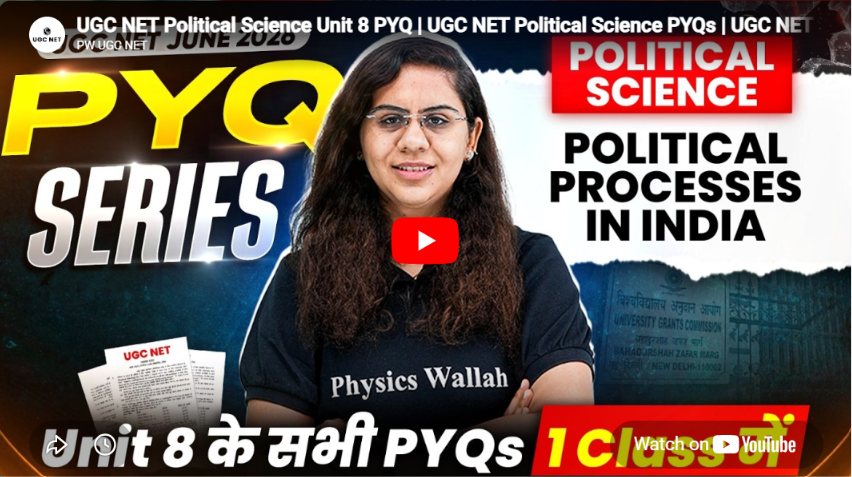
UGC NET Political Science Unit 8 focuses on Political Processes in India. This unit covers topics such as political parties, social movements, federalism, electoral politics, regional movements, public policy, and democratic developments. Questions from this unit appear regularly in the examination and are often asked in statement-based, matching, chronology, and factual formats.
The UGC NET June 2026 examination is scheduled between June 22 and June 30, 2026. Solving previous year questions from Unit 8 helps candidates revise important events, political developments, committees, movements, and leaders that are frequently asked in the examination.
The PYQ session discussed several important questions from this unit and highlighted recurring topics that candidates should revise carefully. Students who want detailed solutions, explanations, and a comprehensive discussion of these previous year questions can watch the attached video for better understanding and exam-oriented preparation.
UGC NET Political Science Unit 8 PYQs
UGC NET Political Science Unit 8 PYQs cover important topics such as political developments, committees, social movements, local governance, and electoral processes. Practicing these questions can help candidates understand the type of questions frequently asked from Unit 8.
Q1. Who was the first Non-Congress Chief Minister of Karnataka?
(A) E.M.S. Namboodiripad
(B) Ram Krishna Hegde
(C) H.D. Deve Gowda
(D) S.R. Bommai
Answer: (B) Ram Krishna Hegde
Q2. In September 2000, the Government of India had set up a High-Level Committee on the Indian Diaspora under the Chairmanship of:
(A) L.M. Singhvi
(B) K. Natwar Singh
(C) P. Chidambaram
(D) Ranjan Gogoi
Answer: (A) L.M. Singhvi
Q3. The ‘United Sovereign Bengal’ (1947) proposal was advocated by:
(A) Chittaranjan Das
(B) Abul Hashim
(C) Bhulabhai Desai
(D) Sikandar Hayat Khan
Answer: (B) Abul Hashim
Q4. Which British Prime Minister stated that the Jallianwala Bagh massacre was “Unutterably Monstrous”?
(A) Winston Churchill
(B) Harold Macmillan
(C) Sir Anthony Eden
(D) William Ewart Gladstone
Answer: (A) Winston Churchill
Q5. Narasimha Rao fought and won elections from:
(A) Andhra Pradesh, Orissa, and Maharashtra
(B) West Bengal and Rajasthan
(C) Assam and Kerala
(D) Nagaland and Arunachal Pradesh
Answer: (A) Andhra Pradesh, Orissa, and Maharashtra
Q6. In which year was Dr. Syama Prasad Mookerjee elected as a member of the Bengal Legislative Council?
(A) 1933
(B) 1931
(C) 1929
(D) 1927
Answer: (C) 1929
Q7. Given below are two statements:
Assertion (A): Swami Sahajanand Saraswati formed the Bihar Provincial Kisan Sabha in 1929 to mobilize peasant grievances against Zamindari attacks on their occupancy rights.
Reason (R): At the Lucknow Session of the Congress in 1936, the All India Kisan Sabha was formed with Swami Sahajanand Saraswati as its President.
(A) Both A and R are correct, and R is the correct explanation of A
(B) Both A and R are correct, but R is not the correct explanation of A
(C) A is correct, but R is not correct
(D) A is not correct, but R is correct
Answer: (B) Both A and R are correct, but R is not the correct explanation of A
Q8. Indira Gandhi broke the cycle of simultaneous polls of Lok Sabha and State Assemblies by holding a mid-term Lok Sabha election in:
(A) 1977
(B) 1980
(C) 1967
(D) 1971
Answer: (D) 1971
Q9. In which year did the Viceroy of India pass the Resolution on Local Self-Government that led to democratic forms of municipal governance in India?
(A) 1882
(B) 1879
(C) 1877
(D) 1885
Answer: (A) 1882
Q10. The Government set up a third committee on police reforms under the stewardship of former Union Home Secretary K. Padmanabhaiah in the year:
(A) 2000
(B) 1990
(C) 2010
(D) 1982
Answer: (A) 2000
These PYQs highlight important personalities, committees, political developments, and governance-related themes from Unit 8. Candidates should revise the associated facts and concepts while practicing similar questions for the UGC NET Political Science examination.
UGC NET Political Science Unit 8 PYQs FAQs
What does UGC NET Political Science Unit 8 cover?
Who was the first non-Congress Chief Minister of Karnataka?
Who chaired the High-Level Committee on the Indian Diaspora in 2000?
. In which year was the Bihar Provincial Kisan Sabha formed?
Which committee on police reforms was headed by K. Padmanabhaiah?


Have questions about your prep?
Our experts can answer all your questions

 Live & recorded classes available at easeDashboard for progress trackingLakhs of practice questions

