








UGC NET Political Science Unit 6 PYQs: Panchsheel, NPT, CTBT & Strategic Autonomy
UGC NET Political Science Unit 6 PYQs cover frequently asked topics in Indian Foreign Policy, including Panchsheel, strategic autonomy, nuclear doctrine, India-China relations, diaspora diplomacy, and major treaties, helping candidates identify recurring exam patterns and important concepts.
 Priyanka Yadav10 Jun, 2026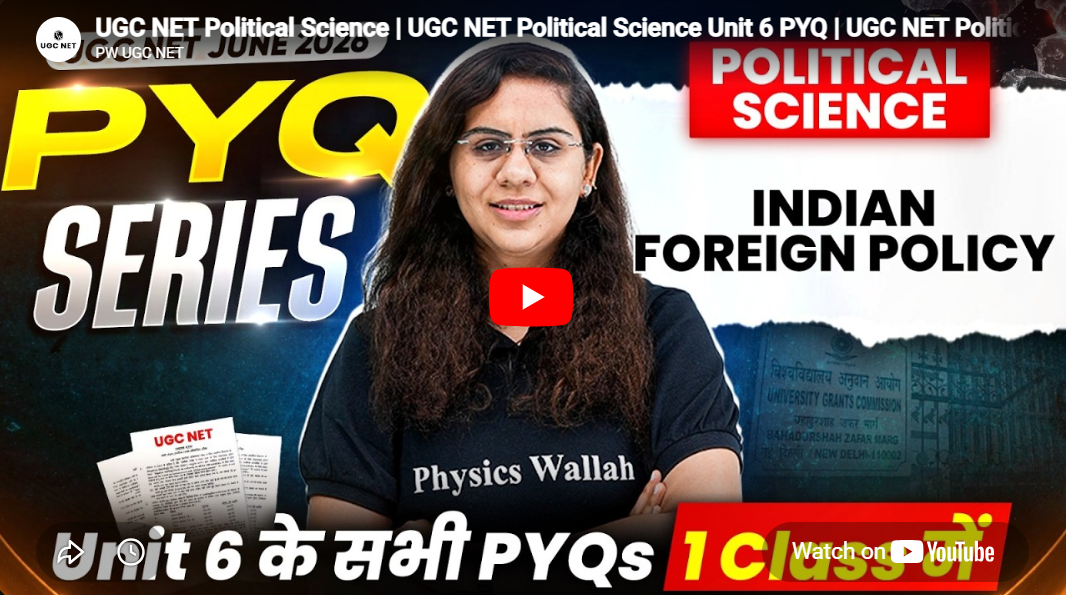
International Relations is one of the most important sections of the UGC NET Political Science Unit 5. Questions are frequently asked on international organizations, treaties, Cold War developments, environmental summits, global governance institutions, and contemporary international affairs. Candidates often face difficulty because the unit requires both conceptual understanding and factual knowledge of important events, dates, organizations, and agreements.
With the UGC NET exam scheduled from 22 June to 30 June 2026, practicing Previous Year Questions (PYQs) can help candidates identify recurring themes, improve factual retention, and develop confidence in solving assertion-reason, match-the-following, and chronology-based questions.
Detailed Video on UGC NET Political Science Unit 6 PYQs
The revision session focused on important previous-year questions from UGC NET Political Science Unit 6. The discussion covered Panchsheel, Tashkent Declaration, Gujral Doctrine, India's Nuclear Doctrine, India-China relations, India-Pakistan relations, Look East Policy, Act East Policy, NAM, BIMSTEC, SAGAR, and India's strategic autonomy.
The session also explained chronological questions, assertion-reason questions, match-the-following questions, and statement-based MCQs. Students were advised to focus on important dates, treaties, Prime Ministers, and foreign policy doctrines because these areas are frequently asked in UGC NET Political Science examinations.
UGC NET Political Science Unit 6 PYQs
The following previous-year questions from UGC NET Political Science Unit 6 cover important topics related to Indian Foreign Policy and International Relations.
Question 1
Jawaharlal Nehru became the first Prime Minister of India in 1947. Events under Nehru's leadership include:
A. The National Planning Commission appointed Nehru as its Chairman in 1950.
B. Nehru visited China in 1958 and signed the Panch-Sheel Treaty.
C. Nehru fought three general elections.
D. In 1952, the first of the five IITs was set up.
E. India signed a treaty with Nepal in 1950.
Choose the correct answer from the options given below:
(A): A, B, C, D Only
(B): A, C, D, E Only
(C): A, B, D, E Only
(D): B, C, D Only
Answer: (B) A, C, D, E Only
Question 2
Given below are two statements: one is labelled as Assertion A and the other is labelled as Reason R.
Assertion A: The Tashkent Declaration was signed by President Ayub Khan of Pakistan and Lal Bahadur Shastri, Prime Minister of India, on January 10, 1966.
Reason R: The Tashkent Declaration was meant to form a framework for lasting peace between India and Pakistan.
In light of the above statements, choose the most appropriate answer from the options given below:
(A) Both A and R are correct, and R is the correct explanation of A
(B) Both A and R are correct, but R is NOT the correct explanation of A
(C) A is correct, but R is not correct
(D) A is not correct, but R is correct
Answer: (A)
Question 3
India believes in and practices strategic autonomy in its foreign policy.
(A) India refused to be a party to any military alliance during the Cold War.
(B) India procured its weapons from all possible sources.
(C) India yielded to American pressure to reduce its oil imports from Iran.
(D) India refused to yield to Western pressure not to import oil from Russia because of its invasion of Ukraine.
(E) India refused to sign the NPT and CTBT to protect its strategic autonomy.
Choose the correct answer from the options given below:
(A): (A), (B), and (C) Only
(B): (B), (C), and (D) Only
(C): (A), (B), (D), and (E) Only
(D): (A), (C), (D), and (E) Only
Answer: (C): (A), (B), (D), and (E) Only
Question 4
Arrange the following events/incidents related to Sino-India relations chronologically.
(A) Chinese Invasion of India
(B) Wuhan Spirit
(C) Galwan Valley Incident
(D) Chennai Connect
(E) Nathu La Skirmishes
Choose the correct answer from the options given below:
(A): (A), (E), (B), (D), (C)
(B): (E), (A), (B), (D), (C)
(C): (A), (E), (D), (B), (C)
(D): (A), (E), (C), (B), (D)
Answer: (A): (A), (E), (B), (D), (C)
Question 5
Which among the following is not correct about India's Nuclear Policy?
(A) Credible Minimum Nuclear Deterrence
(B) No First Use
(C) In the Post-Pokhran-II phase, India has agreed to sign the NPT and the CTBT
(D) Homi J. Bhabha is the architect of India's nuclear programme
Answer: (C)
Question 6
Match List I with List II.
| List I | List II |
| (A) Indo-Soviet Friendship Treaty | (I) Narendra Modi |
| (B) Pokhran II | (II) Narasimha Rao |
| (C) Look East Policy | (III) Atal Bihari Vajpayee |
| (D) Panchamrit | (IV) Indira Gandhi |
Choose the correct answer from the options given below.
Answer:
(A) → (IV)
(B) → (III)
(C) → (II)
(D) → (I)
Question 7
Arrange the following events related to India's Foreign Policy in ascending order.
(A) Indo-US Nuclear Deal
(B) Gujral Doctrine
(C) Panchsheel
(D) Panchamrit
(E) Look East Policy
Choose the correct answer from the options given below:
(A): (C), (E), (D), (A), (B)
(B): (C), (E), (A), (B), (D)
(C): (E), (C), (B), (A), (D)
(D): (C), (E), (B), (A), (D)
Answer: (D): (C), (E), (B), (A), (D)
Question 8
India's diaspora is a strategic asset for the country.
(A) India receives the largest volume of remittances.
(B) Illegal Indian migrants have given a bad name to India.
(C) Indian Americans played a key role in the passing of the Indo-US nuclear deal.
(D) India-trained engineers were instrumental in ushering in the IT revolution in the US and then bringing it to India.
(E) The Indian Diaspora is a source of soft power for India.
Choose the correct answer from the options given below:
(A) (A), (C), (D), and (E) Only
(B) (A), (B), (C), and (D) Only
(C) (A) and (B) Only
(D) (B), (C), (D), and (E) Only
Answer: (A): (A), (C), (D), and (E) Only
Question 9
India is emerging as a great power due to its:
A. Growing economic power
B. Military capacities
C. Decreasing soft power
D. Diplomatic Relations
E. Increasing conflicts with neighbours
Choose the correct answer from the options given below:
(A) A, B, D Only
(B) B, C, E Only
(C) C, D, E Only
(D) A, D, E Only
Answer: (A) A, B, D Only
Question 10
Which of the following statements are correct?
(A) India will not use its nuclear weapons against non-nuclear states.
(B) India is committed to no-first use of nuclear weapons.
(C) India will transfer nuclear technology to friendly countries.
(D) India will extend its nuclear umbrella to its friendly neighbouring countries in South Asia.
(E) India will develop a credible nuclear deterrent capability.
Choose the correct answer from the options given below:
(A) (A), (B), and (E) Only
(B) (A), (B), (C), and (E) Only
(C) (A), (B), and (C) Only
(D) (A), (B), (D), and (E) Only
Answer: (A): (A), (B), and (E) Only
Question 11
Which Indian Prime Minister has ever visited Minar-e-Pakistan in Lahore?
(A) Jawaharlal Nehru
(B) Lal Bahadur Shastri
(C) Atal Bihari Vajpayee
(D) Manmohan Singh
Answer: (C) Atal Bihari Vajpayee
Question 12
Who wrote the book "Engaging India: Diplomacy, Democracy and the Bomb"?
(A) C. Raja Mohan
(B) Muchkund Dubey
(C) Jaswant Singh
(D) Strobe Talbott
Answer: (D) Strobe Talbott
Question 13
Given below are two statements: one is labelled as Assertion A and the other is labelled as Reason R.
Assertion A: India has historically been deemed a safe haven for refugees.
Reason R: India has no refugee law and has not signed the 1951 Refugee Convention.
Choose the most appropriate answer from the options given below:
(A) Both A and R are correct, and R is the correct explanation of A
(B) Both A and R are correct, but R is not the correct explanation of A
(C) A is correct, but R is not correct
(D) A is not correct, but R is correct
Answer: (B)
Question 14
Choose the correct statements given below:
(A) India is among the first countries to establish diplomatic relations with the EEC.
(B) The bilateral relationship was upgraded to a strategic partnership in 2004.
(C) The EU is also one of the largest sources of FDI for India.
(D) The EU is a member of the UN General Assembly.
Choose the correct answer from the options given below:
(A) A, B, and C
(B) B, C, and D
(C) A, C, and D
(D) A, B, and D
Answer: (A) A, B and C
Question 15
With which country did India sign the declaration to promote the building of a harmonious world of durable peace and common prosperity through developing a strategic and cooperative partnership for peace and prosperity?
(A) United States
(B) China
(C) United Kingdom
(D) Japan
Answer: (B) China
UGC NET Political Science Unit 6 contains several important topics related to Indian Foreign Policy. Questions are regularly asked about treaties, diplomatic doctrines, chronology, Prime Ministers, international organizations, and India's nuclear policy.
Candidates should focus on PYQs because they provide a clear understanding of important examination trends. Regular revision of these questions can strengthen conceptual clarity and improve examination performance.
UGC NET Political Science Unit 6 PYQs FAQs
What does UGC NET Political Science Unit 6 cover?
Why are PYQs important for Unit 6?
Which topics are important in Unit 6 PYQs?
Has India signed the NPT and CTBT?
Which Prime Minister is linked with the Look East Policy?


Have questions about your prep?
Our experts can answer all your questions
 Live & recorded classes available at easeDashboard for progress trackingLakhs of practice questions

