








Dadabhai Naoroji: Life, Drain Theory, Social Reforms, and Contributions
Dadabhai Naoroji, known as the Grand Old Man of India, was a pioneer of Indian nationalism, an economist, and a social reformer. He is best remembered for his Drain Theory, efforts for social reforms, and significant contributions to India’s struggle for independence.
 Deeksha Dixit1 Dec, 2025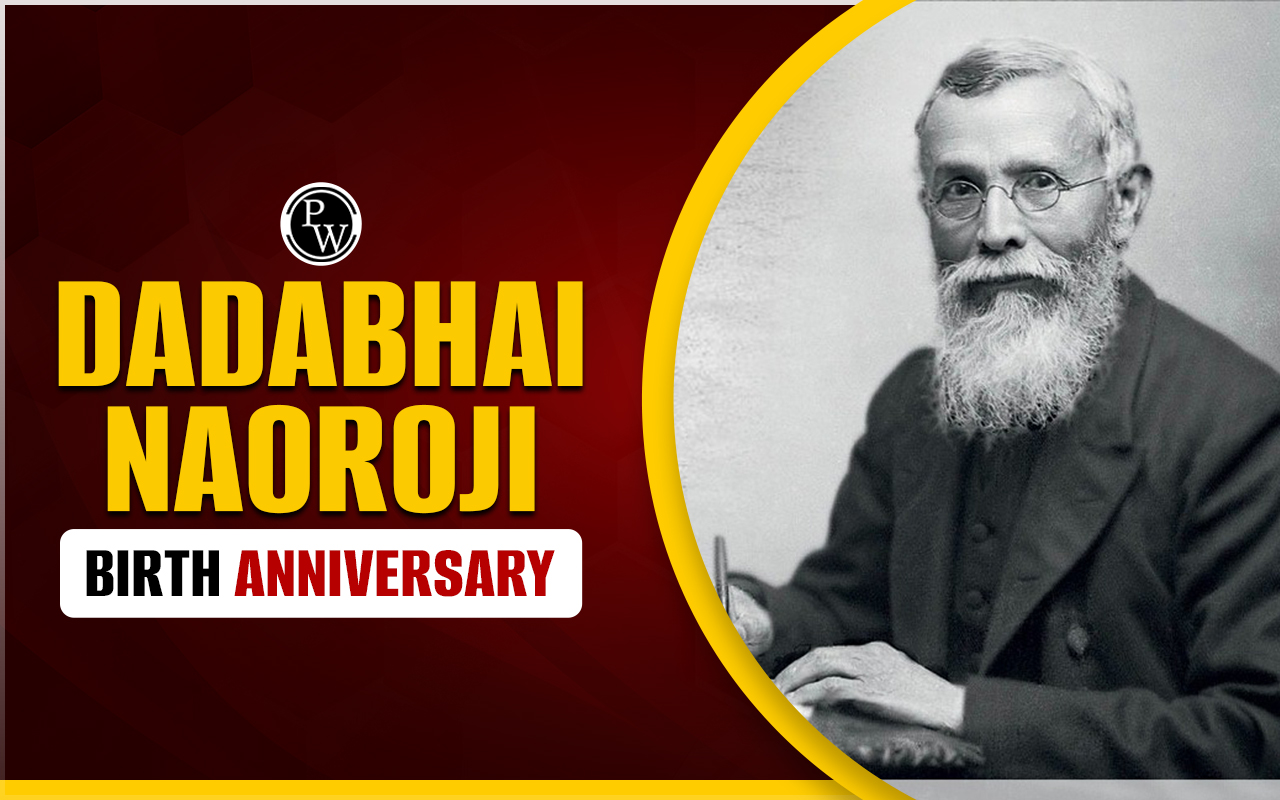
Dadabhai Naoroji (1825–1917) remains one of the most towering and influential figures in the history of the Indian independence movement. Revered as the "Grand Old Man of India," this Parsi-Zoroastrian scholar, educator, politician, and economist was instrumental in shaping the political consciousness of the nation.
His groundbreaking work in exposing the economic exploitation under British rule provided the nationalist movement with a solid, factual, and intellectual foundation.
From becoming the first Indian professor at Elphinstone College to serving as the first Asian member of the British Parliament, Dadabhai Naoroji dedicated his life to advocating for the rights of the Indian people using constitutional methods.
Dadabhai Naoroji
Dadabhai Naoroji was born on September 4, 1825, into a priestly Parsi family in Bombay (now Mumbai). Despite losing his father at a young age, his mother ensured he received a quality education.
-
He was an academically brilliant student at Elphinstone College, where he earned the prestigious Clare Scholarship.
-
In 1845, soon after graduation, he made history by becoming the first Indian to be appointed as a Professor at the same college, teaching Mathematics and Natural Philosophy.
-
His later academic career included a professorship of Gujarati at University College London.
-
Beyond academia, he also ventured into business, becoming a partner in Cama & Co., the first Indian company established in London, and later starting his own cotton trading firm.
Dadabhai Naoroji's Economic Contribution
One of Dadabhai Naoroji's most significant and enduring contributions was his pioneering analysis of colonial economics, formalized in his 'Drain of Wealth' Theory. He meticulously argued that Britain was systematically impoverishing India by draining its wealth without any corresponding economic return.
-
The Theory: Naoroji explained that a huge portion of India's revenue was being transferred to Britain in the form of salaries, pensions, and remittances paid to British officials and army personnel, as well as profits made by British companies in India.
-
Key Literary Work: He compiled his findings in his influential book, Poverty and Un-British Rule in India (published in 1901), which meticulously calculated this wealth outflow.
-
Impact: His work provided the nationalist movement with an irrefutable, data-driven critique of British rule, making the masses aware of the true nature of colonial exploitation. It was his use of statistical data, collected from sources like Parliamentary Returns, that led to him being called the man who "brought statistics into politics".
The theory was so influential that it led to the formation of the Royal Commission on Indian Expenditure (1896), of which Naoroji himself was a member, to review the financial burdens placed on India.
Dadabhai Naoroji The First Indian in the British Parliament
Dadabhai Naoroji's political involvement was not confined to India; he took India's cause to the heart of the British Empire.
-
In 1892, he achieved a historic milestone by becoming the first British Indian to be elected as a Member of Parliament (MP) to the British House of Commons.
-
He represented the Central Finsbury constituency as a member of the Liberal Party.
-
In Parliament, he used his platform to consistently raise issues concerning India, focusing on poverty, high taxation, and the need for administrative reforms and fair representation for Indians.
-
Known as the "Unofficial Ambassador of India," his presence in the British political system was a vital link, advocating for Indian self-rule and economic justice on a global stage.
Role in the Indian National Congress (INC)
Dadabhai Naoroji was one of the pivotal figures in the formation of the Indian National Congress (INC) in 1885. He believed that a national platform was essential for Indians to voice their grievances and political demands.
-
He served as the President of the INC on three occasions:
-
1886 (Calcutta Session)
-
1893 (Lahore Session)
-
1906 (Calcutta Session)
-
His 1906 Presidential Address was particularly significant as it was the first time that the demand for 'Swaraj' (self-rule) was officially declared as the concrete political goal of the INC, marking a major turning point in the movement.
-
He belonged to the Moderate school of thought within the Congress, advocating for constitutional methods like petitions and protests to achieve reforms, though he was vocal in his criticism of British policies.
-
Before the INC, he co-founded the London Indian Society (1865) and the East India Association (1867) in London to present the Indian point of view to the British public and politicians.
Dadabhai Naoroji as a Social Reformer
Beyond his political and economic activism, Dadabhai Naoroji was a staunch advocate for social reform, particularly within his own Parsi community and Indian society at large.
-
Parsi Reform: In 1851, he co-founded the Rahnumai Mazdayasan Sabha (Guides on the Mazdayasne Path) to restore the Zoroastrian religion to its original purity. He also started the Gujarati publication Rast Goftar (The Truth Teller) in 1854 to promote social reforms within the Parsi community.
-
Women's Education: He was a major proponent of women's education, establishing several schools for girls.
-
Equality: He actively supported social changes such as widow remarriage and advocated for equal laws and rights for men and women, rejecting caste restrictions.
Literary Works and Legacy of Dadabhai Naoroji
Dadabhai Naoroji was a prolific writer whose works educated both Indians and the British about the economic injustices of colonial rule.
|
Literary Works and Legacy of Dadabhai Naoroji |
||
|
Notable Literary Works of Dadabhai Naoroji |
Year |
Focus/Contribution |
|
Poverty and Un-British Rule in India |
1901 |
Seminal work detailing the 'Drain of Wealth' theory. |
|
Poverty of India |
1876 |
One of his earliest detailed papers on the economic condition of the country. |
|
The Causes of Indian Famines |
N/A |
Emphasized how British policies contributed to large-scale human suffering. |
Legacy: Dadabhai Naoroji's lifelong service earned him the title "Grand Old Man of India". His commitment to constitutional methods, economic justice, and social equity significantly influenced subsequent generations of leaders, including Mahatma Gandhi and Gopal Krishna Gokhale. He laid the foundation for modern Indian nationalism and economic thought, making his contributions crucial to the eventual success of the freedom struggle.
Dadabhai Naoroji Birth Anniversary FAQs
Why is Dadabhai Naoroji called the 'Grand Old Man of India'?
What is the 'Drain of Wealth' Theory associated with Dadabhai Naoroji?
What was Dadabhai Naoroji's major contribution to the Indian National Congress (INC)?
What was the historical significance of Dadabhai Naoroji's election to the British Parliament?
Name two important books written by Dadabhai Naoroji.




Have questions about your prep?
Our experts can answer all your questions









 Live & recorded classes available at easeDashboard for progress trackingMillions of practice questions at your fingertips

