

What is Magnetic Effects of Electric Current?
Magnetic effects of electric current refer to the phenomenon where electric current produces a magnetic field. This topic is central to understanding how many modern technologies work.
These notes provide a concise overview of crucial concepts related to magnetism and electricity, which are important for CBSE Class 10 Science Notes Chapter 13.
Magnetic Effect of Electric Current Notes
This section covers essential concepts about magnetic effects, summarizing them for quick understanding.
Magnets
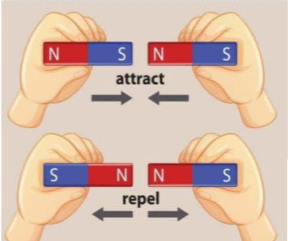
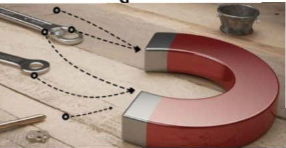
A magnet is an object that attracts materials like iron, nickel, and cobalt. Every magnet has two poles: a North pole and a South pole. Like poles repel each other, while unlike poles attract. A freely suspended magnet aligns with Earth's geographic north.
Magnetic Field
The space around a magnet where its magnetic force can be felt is called the Magnetic Field. This field has both a direction and a magnitude. Its direction is the path a free North pole would take.
Magnetic Field Lines
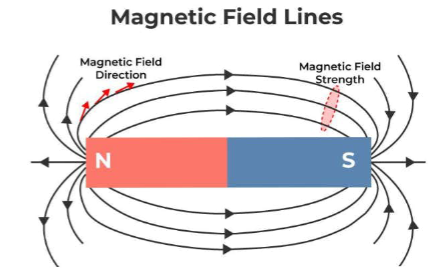
Magnetic Field Lines are imaginary lines that show the direction and strength of a magnetic field.
Properties of Magnetic Field Lines:
-
Outside a magnet, lines go from North to South pole.
-
Inside a magnet, lines go from South to North pole.
-
They form continuous closed curves.
-
Two field lines never cross each other. If they did, a compass at that point would show two directions, which is impossible.
-
Where field lines are closer, the magnetic field is strong. Where they are farther apart, the field is weak.
Oersted’s Discovery
Hans Christian Oersted discovered that an electric current creates a magnetic field around it. He observed that a compass needle deflects when placed near a current-carrying wire. The direction of deflection changes if the current direction reverses. This was a critical step in understanding the magnetic effect of electric current.
Magnetic Field Patterns
-
Straight Current-Carrying Wire: The magnetic field lines are concentric circles around the wire. Their direction is given by Maxwell's Right-Hand Thumb Rule.
-
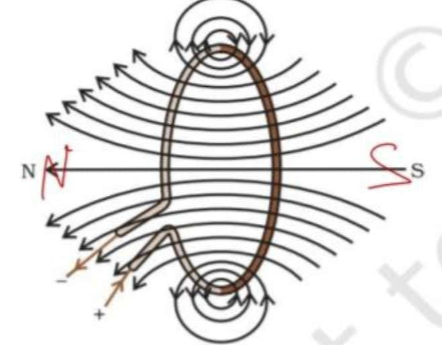
Circular Loop: Each segment of a current-carrying circular loop creates a magnetic field. Near the center, the field lines are almost straight and perpendicular to the loop plane.
-
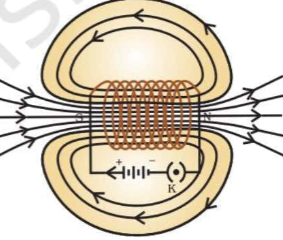
Solenoid: A solenoid is a coil of many circular turns of insulated copper wire. When current flows, it acts like a bar magnet. The magnetic field inside a solenoid is uniform and strong.
Electromagnets
An electromagnet is a temporary magnet formed when current flows through a coil, often wrapped around a soft iron core. Its magnetism exists only when current is present. The strength and polarity can be controlled by changing the current or its direction.
| Feature | Bar Magnet | Solenoid | Electromagnet |
|---|---|---|---|
| Nature | Permanent | Temporary (when current flows) | Temporary (stronger than solenoid) |
| Magnetic Field | Fixed | Exists when current flows | Exists when current flows, stronger |
| Polarity Control | Fixed | Can be reversed | Can be reversed |
Alternating Current (AC) and Direct Current (DC)
Direct Current (DC)
-
Flows in only one direction.
-
Supplied by cells and batteries.
-
Not suitable for long-distance transmission due to high power loss.
-
Voltage cannot be easily changed.
Alternating Current (AC)
-
Changes direction periodically.
-
Produced by AC generators at power stations.
-
Preferred for long-distance transmission.
-
Voltage can be easily stepped up or down using transformers.
Force on a Current-Carrying Conductor
When a current-carrying conductor is placed in a magnetic field, it experiences a force. This force can cause the conductor to move. The direction of this force is given by Fleming's Left-Hand Rule. The magnitude of this force depends on the current, magnetic field strength, conductor length, and the angle between the current and the magnetic field.
Electromagnetic Induction
Electromagnetic Induction is the process of generating electric current in a conductor by changing the magnetic field around it. This can occur by moving a magnet near a coil or changing the current in a nearby conductor. The induced current's direction is determined by Fleming's Right-Hand Rule.
Domestic Electric Circuits
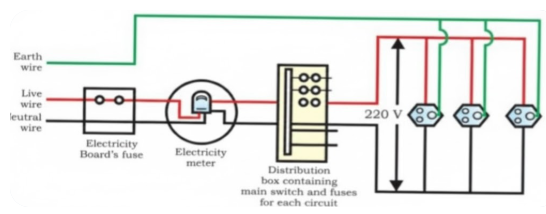
Household electrical wiring uses three types of wires: live wire (red, 220V), neutral wire (black, 0V), and earth wire (green, for safety). Circuits are connected in parallel to ensure consistent voltage and independent operation of appliances.
-
Overloading: Happens when too many appliances draw current from a single circuit, or when live and neutral wires touch (short circuit), causing a large current flow.
-
Fuses: Safety devices with a low melting point. They break the circuit during overloading or short circuits, protecting appliances and preventing fires.
Electrical Safety Devices
Earthing
Earthing is a safety measure where the metallic body of an appliance is connected to the ground using a low-resistance wire.
-
Prevents electric shock in case of current leakage.
-
Provides a safe path for excess current to flow into the earth.
Electric Fuse
A fuse is a safety device made of a thin wire with:
-
Low melting point
-
High resistance
When excess current flows due to overloading or short circuit, the fuse wire melts and breaks the circuit.
-
5A fuse: Used for low-power appliances like bulbs and fans.
-
15A fuse: Used for high-power appliances like geysers, irons, and heaters.
Short Circuit and Overloading
-
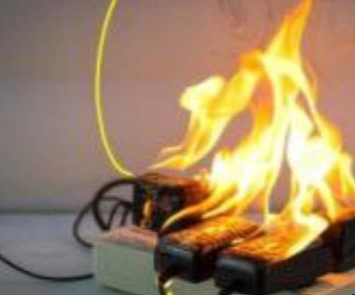
Short Circuit: Occurs when live and neutral wires come in direct contact, causing a sudden rise in current due to very low resistance.
-
Overloading: Happens when too many high-power appliances are connected to the same circuit, drawing more current than the circuit can handle.
Key Rules of Magnetic Effects of Electric Current
Maxwell's Right-Hand Thumb Rule
Imagine holding a current-carrying wire with your right hand. Your thumb points in the direction of the current. Then, your curled fingers show the direction of the magnetic field lines around the wire.
Fleming's Left-Hand Rule
Extend your left hand's thumb, forefinger, and middle finger perpendicular to each other. If your forefinger points in the magnetic field direction and your middle finger points in the current direction, then your thumb shows the direction of the force on the conductor.
Fleming's Right-Hand Rule
Stretch your right hand's thumb, forefinger, and middle finger perpendicular. If your forefinger indicates the magnetic field direction and your thumb points in the motion direction of the conductor, your middle finger will show the direction of the induced current.
Tips to Score High Marks in Magnetic Effect of Electric Current
To score well in the Magnetic Effect of Electric Current chapter in the Class 10 Science board exam, students should focus on concept clarity, diagrams, and practical applications. Here are key strategies:
-
Understand the Concept of Magnetic Field Around Current
-
Visualize the magnetic field lines around a straight conductor, circular loop, and solenoid.
-
Apply the Right-Hand Thumb Rule to determine the direction of the magnetic field.
-
-
Master Fleming’s Left-Hand and Right-Hand Rules
-
Use the Left-Hand Rule to find the direction of force in motors.
-
Use the Right-Hand Rule to determine the direction of induced current in generators.
-
-
Practice Diagram-Based Questions
-
Draw neat, labeled diagrams of solenoids, electromagnets, and field patterns.
-
Diagram accuracy can fetch easy marks, so practice repeatedly.
-
-
Relate Concepts to Applications
-
Understand real-life applications like electric bells, relays, electric motors, and electromagnetic cranes.
-
Explain working principles briefly if asked in descriptive questions.
-
-
Revise Formulae and Definitions
-
Remember key definitions: magnetic field, electromagnet, solenoid, and flux.
-
Revise formulas for magnetic field strength around a straight conductor and solenoid if numerical problems appear.
-
Related Links
CBSE Magnetic Effect of Electric Current Notes FAQs
What is a magnetic field?
How does Oersted experiment relate to the magnetic effect of electric current notes?
What is the role of a solenoid?


Have questions about your prep?
Our experts can answer all your questions