

Control and coordination class 10 notes chapter 6: Control and coordination is an important chapter from the Class 10 Science Syllabus and carries significant weight in the board exam. It explains how living organisms regulate body functions and respond to environmental changes in an organized manner.
Students often feel confused between nervous control and hormonal control or while revising endocrine glands and plant movements. These notes explain reflex actions, brain functions, hormones, and plant coordination clearly and as per the NCERT.
With structured explanations and important diagrams, these notes help students revise effectively and write accurate, stepwise answers in the Class 10 Science board examination.
Control and Coordination Class 10 Notes PDF
Control and Coordination Class 10 Notes PDF serve as a structured revision tool for students preparing for the Class 10 Science board exam. As this chapter includes multiple systems and detailed diagrams, having concise and well-arranged notes becomes extremely useful during exam preparation.
The PDF covers key areas such as stimuli and responses, reflex actions, the human nervous system, endocrine glands and hormones, as well as plant hormones and movements.
With properly organised definitions, labelled diagrams, comparison tables, and important NCERT-based points, these notes help students revise concepts quickly, avoid confusion, and write accurate answers in the Class 10 Science board examination.
Control and coordination class 10 notes PDF
What is Control and Coordination?
Control and coordination class 10 refers to how living organisms regulate their activities and respond to changes.
These CBSE Class 10 Science Chapter 6 notes explore how animals, through nervous and endocrine systems, and plants, through chemical signals, achieve this.
These notes for control and coordination simplify complex biological processes for easy understanding. Mastering these concepts is vital for a strong biology foundation.
Control and Coordination Class 10 Notes
Living organisms maintain their life processes by controlling internal functions and coordinating responses to the environment.
Stimuli and Responses
-
A stimulus is any change in the internal or external environment of an organism that can be detected. These changes may include light, heat, sound, pressure, chemicals, or changes inside the body, such as hunger or hormone levels.
-
A response is the action or reaction shown by an organism after detecting a stimulus. Responses help organisms adjust to their surroundings, protect themselves from danger, and maintain normal body functions. For example, sweating in hot weather or pulling the hand away from a hot object.
-
Coordination is the process by which different organs and body systems work together in a controlled and organized manner to produce an effective response to a stimulus. It ensures that the response is timely, accurate, and beneficial for the organism’s survival.
Receptors and Effectors
-
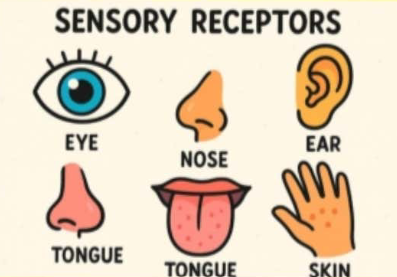
Receptors: Receptors are specialized cells or sensory organs that detect specific stimuli, such as light, heat, pain, or sound. Effectors are muscles or glands that carry out the response by producing movement or secretions.
-
Effectors: Muscles or glands that act in response to a stimulus received from the nervous system.
| Receptors | Sense Organ | Stimuli |
|---|---|---|
| Photoreceptors | Eyes | Light |
| Olfactory Receptors | Nose | Smell |
| Gustatory Receptors | Tongue | Taste |
| Phonoreceptors | Ear | Sound |
| Thermoreceptors | Skin | Heat/Cold |
| Nociceptors | Skin | Pain |
Nerve Cells or Neurons
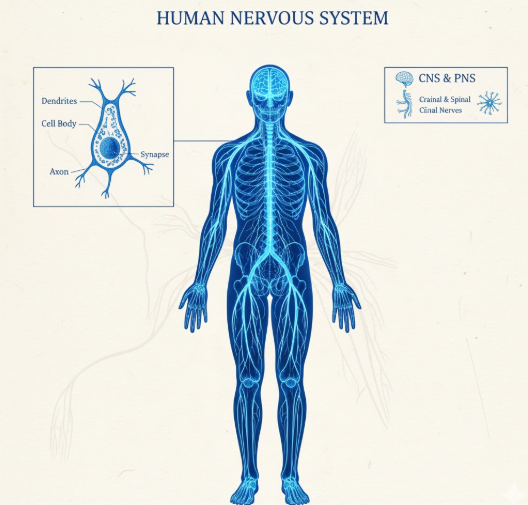
A neuron is the basic structural and functional unit of the nervous system. It is the longest cell in the body. Neurons carry messages as electrical impulses.
-
Nerve: A bundle of nerve fibres transmitting signals between the brain and other body parts.
-
Neuron Parts:
-
Dendrite: Receives information.
-
Cell Body (Cyton): Processes the received impulse.
-
Axon: Transmits the impulse away from the cell body.
-
Nerve Endings: Release neurotransmitters.
Synapse
A synapse is the microscopic gap between two neurons. It transmits electrical impulses from one neuron to another. Chemicals called neurotransmitters cross this gap. They generate a new electrical impulse in the next neuron's dendrite.
Types of Neurons
-
Sensory Neurons: Carry impulses from receptors to the Central Nervous System (CNS).
-
Motor Neurons: Carry impulses from the CNS to effectors (muscles or glands).
-
Relay Neurons (Interneurons): Connect sensory and motor neurons.
Coordination in Animals
Animals achieve coordination through two interconnected systems: the Nervous System, which provides rapid responses, and the Endocrine System, which regulates slower but long-lasting activities.
Human Nervous System
The human nervous system coordinates various body functions. It consists of the brain, spinal cord, and nerves.
-
Central Nervous System (CNS): Includes the brain and spinal cord. It processes information and sends commands.
-
Peripheral Nervous System (PNS): Includes all nerves outside the CNS. It connects the CNS to receptors and effectors.
-
Somatic Nervous System: Controls voluntary actions.
-
Autonomic Nervous System (ANS): Controls involuntary actions. It has two parts:
-
Sympathetic System: Prepares the body for stress (fight or flight).
-
Parasympathetic System: Calms the body, conserving energy.
Brain Regions
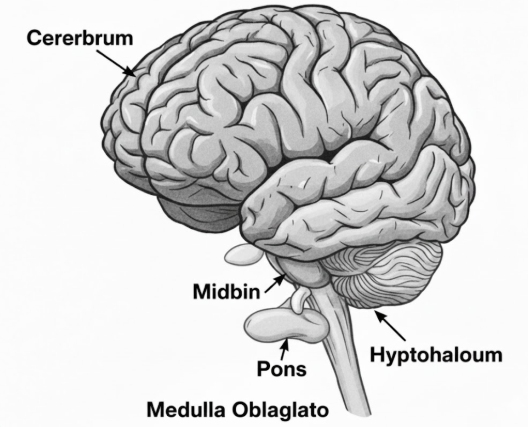
The brain has three main parts:
-
Forebrain: The thinking part. Includes the Cerebrum (for memory, intelligence, senses) and Diencephalon (for pressure and discomfort).
-
Midbrain: Connects the forebrain and hindbrain. Controls vision and hearing reflexes.
-
Hindbrain: Includes Cerebellum, Pons, and Medulla.
-
Cerebellum: Coordinates muscle actions and maintains body balance and posture. This is the part of the brain that controls balance and coordination.
-
Pons: Relays signals between the forebrain and cerebellum.
-
Medulla Oblongata: Controls involuntary actions like heart rate, breathing, blood pressure, salivation, and vomiting.
Which Part of the Brain Controls Balance and Coordination
The cerebellum, a part of the hind-brain, controls balance, posture, and coordination of voluntary movements. It ensures:
-
Smooth and precise muscular activity
-
Maintenance of body balance
-
Proper posture while standing, walking, or running
Damage to the cerebellum can result in loss of balance and uncoordinated movements.
Protection of the Brain and Spinal Cord
-
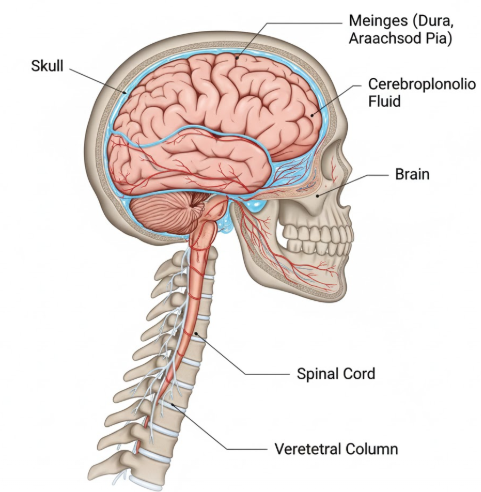
Brain: The brain is protected by the hard cranium (skull), which provides mechanical support. It is further covered by three protective membranes called meninges and surrounded by cerebrospinal fluid (CSF). The CSF acts as a shock absorber, preventing damage due to sudden movements or injuries.
-
Spinal Cord: The spinal cord is enclosed within the vertebral column (backbone), which protects it from physical injury. Like the brain, it is covered by meninges and surrounded by cerebrospinal fluid (CSF), ensuring safe transmission of nerve impulses between the brain and the rest of the body.
Reflex Actions
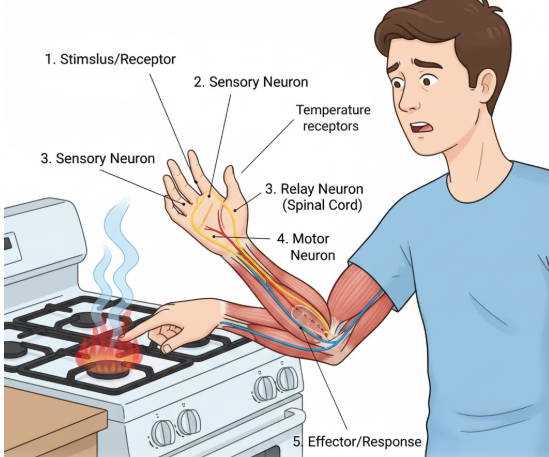
A reflex action is a sudden, quick, involuntary movement not involving conscious thought. It protects the body by providing a rapid reaction.
-
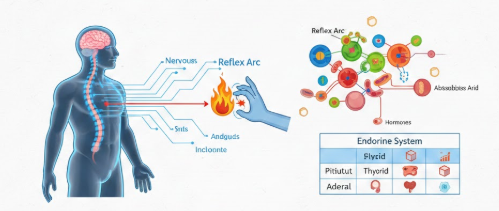
Reflex Arc: The pathway nerve impulses follow during a reflex action. It involves a receptor, sensory neuron, spinal cord (interneuron), motor neuron, and effector. Reflex arcs are efficient because they bypass complex brain processing, allowing instant reactions.
Endocrine System and Hormones
The endocrine system is a network of ductless glands. These glands produce and release hormones directly into the bloodstream. Hormones are chemical messengers that regulate various body functions.
|
Gland |
Hormone |
Function |
Related Disease
|
|---|---|---|---|
|
Hypothalamus |
GHRH |
Stimulates pituitary gland |
|
|
Pituitary Gland |
Growth Hormone |
Body growth, bone development |
Deficiency: Dwarfism, Excess: Gigantism |
|
Thyroid Gland |
Thyroxine |
Regulates carbohydrate, protein, fat metabolism |
Iodine Deficiency: Goitre |
|
Adrenal Gland |
Adrenaline |
Prepares body for emergency (fight or flight) |
|
|
Pancreas |
Insulin |
Controls blood sugar levels |
Deficiency: Diabetes |
|
Testes |
Testosterone |
Male secondary sexual characteristics |
|
|
Ovaries |
Oestrogen, Progesterone |
Female secondary sexual characteristics, menstrual cycle |
|
-
Feedback Mechanism: Regulates the timing and amount of hormone release. For example, high blood sugar causes the pancreas to release more insulin.
Coordination in Plants
Plants coordinate responses to stimuli using electrical and chemical signals. They lack a nervous system.
-
Movement in Plants:
-
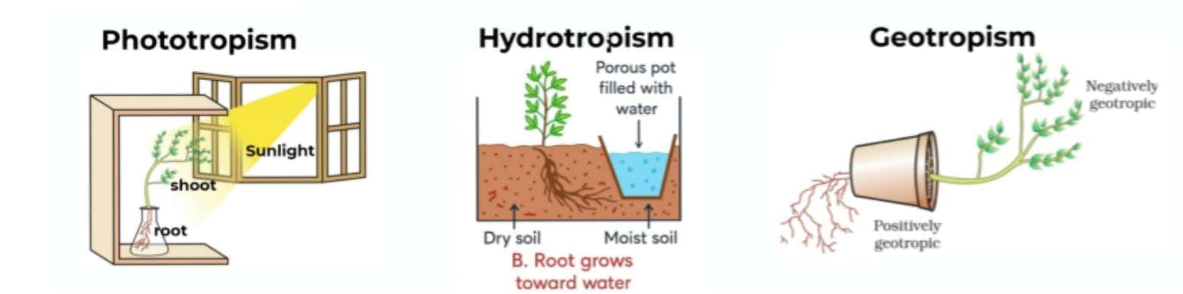
Tropic Movement (Growth-Dependent): Directional growth response to a stimulus.
-
Phototropism: Response to light (e.g., shoot grows towards light).
-
Geotropism: Response to gravity (e.g., roots grow downwards).
-
Hydrotropism: Response to water (e.g., roots grow towards water).
-
Chemotropism: Response to chemicals (e.g., pollen tube growth towards the ovule).
-
Thigmotropism: Response to touch (e.g., tendrils coiling around support).
-
Nastic Movement (Growth-Independent): Non-directional response to a stimulus. E.g., folding of Mimosa pudica (touch-me-not plant) leaves.
Plant Hormones
| Plant Hormone | Function |
|---|---|
| Auxin (GP) | Promotes cell elongation, phototropism |
| Gibberellins (GP) | Stimulates stem elongation, seed germination |
| Cytokinin (GP) | Promotes cell division, delays aging |
| Abscisic Acid (GI) | Inhibits growth, closes stomata, causes wilting |
Key Mechanisms of Control and Coordination
Reflex Action Pathway
The reflex action involves a rapid, involuntary response to a stimulus.
-
Stimulus: Detected by a receptor organ.
-
Receptor: Sensory neurons are activated.
-
Sensory Neuron: Transmits nerve impulse to the spinal cord.
-
Spinal Cord: Interneuron processes the signal.
-
Motor Neuron: Carries impulse from spinal cord to effector.
-
Effector (Muscle/Gland): Performs the response.
This quick action bypasses the brain, ensuring faster protection.
Hormone Feedback Loop
Hormone secretion is controlled by feedback loops.
-
Stimulus: Change in body condition (e.g., increased blood sugar).
-
Endocrine Gland: Releases hormones in response (e.g., pancreas releases insulin).
-
Target Cells: Respond to the hormone, causing a change (e.g., cells take up glucose).
-
Feedback: The change reduces the initial stimulus, signaling the gland to decrease hormone release. This maintains body balance.
Related Links
FAQs
What is the main function of control and coordination?
Which two systems are responsible for control and coordination in animals?
What is a neuron?
How do plants respond to stimuli without a nervous system?