NCERT Solutions for Class 9 Maths Chapter 15 Probability
 Ananya Gupta7 Aug, 2024
NCERT Solutions for Class 9 Maths Chapter 15: NCERT Solutions for Class 9 Maths Chapter 15, Probability provides a detailed guide to understanding and solving problems related to probability.
This chapter introduces the fundamental concepts of probability, including the calculation of probabilities of single and multiple events, and the use of probability formulas. The solutions cover a range of exercises with step-by-step explanations, making it easier for students to grasp the concepts and apply them to various problems. By working through these solutions students can build a strong foundation in probability, which is important for more advanced studies in mathematics.NCERT Solutions for Class 9 Maths Chapter 15 Probability Overview
NCERT Solutions for Class 9 Maths Chapter 15 Probability are prepared by subject experts of Physics Wallah. With step-by-step guidance students can effectively learn how to calculate the probability of different events and apply these principles to solve various problems. This resource is designed to support students in mastering the chapter and building a solid foundation in probability.NCERT Solutions for Class 9 Maths Chapter 15 Probability PDF
NCERT Solutions for Class 9 Maths Chapter 15 Probability
Below we have provided NCERT Solutions for Class 9 Maths Chapter 15 Probability-NCERT Solutions for Class 9 Maths Chapter 15 Probability Exercise 15.1 Page: 283
1. In a cricket match, a batswoman hits a boundary 6 times out of 30 balls she plays. Find the probability that she did not hit a boundary.
Solution: According to the question, Total number of balls = 30 Number of boundary = 6 Number of times batswoman didn’t hit boundary = 30 – 6 = 24 Probability she did not hit a boundary = 24/30 = 4/52. 1500 families with 2 children were selected randomly, and the following data were recorded:
| Number of girls in a family | 2 | 1 | 0 |
| Number of families | 475 | 814 | 211 |
Compute the probability of a family, chosen at random, having
(i) 2 girls (ii) 1 girl (iii) No girl Also check whether the sum of these probabilities is 1.
Solution: Total numbers of families = 1500 (i) Number of families having 2 girls = 475 Probability = Number of families having 2 girls/Total number of families = 475/1500 = 19/60 (ii) Number of families having 1 girl = 814 Probability = Number of families having 1 girl/Total number of families = 814/1500 = 407/750 (iii) Number of families having 0 girls = 211 Probability = Number of families having 0 girls/Total number of families = 211/1500 Sum of the probability = (19/60)+(407/750)+(211/1500) = (475+814+211)/1500 = 1500/1500 = 1 Yes, the sum of these probabilities is 1.3. Refer to Example 5, Section 14.4, Chapter 14. Find the probability that a student of the class was born in August.
Solution: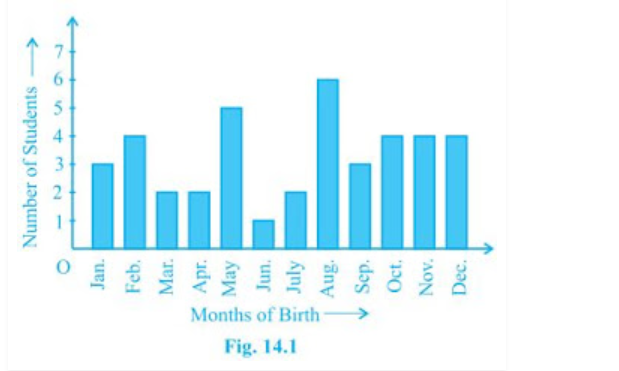 Total number of students in the class = 40
Number of students born in August = 6
The probability that a student of the class was born in August = 6/40 = 3/20
Total number of students in the class = 40
Number of students born in August = 6
The probability that a student of the class was born in August = 6/40 = 3/20
4. Three coins are tossed simultaneously 200 times with the following frequencies of different outcomes:
| Outcome | 3 heads | 2 heads | 1 head | No head |
| Frequency | 23 | 72 | 77 | 28 |
If the three coins are simultaneously tossed again, compute the probability of 2 heads coming up.
Solution: Number of times 2 heads come up = 72 Total number of times the coins were tossed = 200 ∴ , the probability of 2 heads coming up = 72/200 = 9/255. An organisation selected 2400 families at random and surveyed them to determine a relationship between income level and the number of vehicles in a family. The information gathered is listed in the table below:
| Monthly income (in ₹) | Vehicles per family | |||
| 0 | 1 | 2 | Above 2 | |
| Less than 7000 | 10 | 160 | 25 | 0 |
| 7000-10000 | 0 | 305 | 27 | 2 |
| 10000-13000 | 1 | 535 | 29 | 1 |
| 13000-16000 | 2 | 469 | 59 | 25 |
| 16000 or more | 1 | 579 | 82 | 88 |
Suppose a family is chosen. Find the probability that the family chosen is
(i) earning ₹10000 – 13000 per month and owning exactly 2 vehicles.
(ii) earning ₹16000 or more per month and owning exactly 1 vehicle.
(iii) earning less than ₹7000 per month and does not own any vehicle.
(iv) earning ₹13000 – 16000 per month and owning more than 2 vehicles.
(v) owning not more than 1 vehicle.
Solution: Total number of families = 2400 (i) Number of families earning ₹10000 –13000 per month and owning exactly 2 vehicles = 29 ∴ , the probability that the family chosen is earning ₹10000 – 13000 per month and owning exactly 2 vehicles = 29/2400 (ii) Number of families earning ₹16000 or more per month and owning exactly 1 vehicle = 579 ∴ , the probability that the family chosen is earning₹16000 or more per month and owning exactly 1 vehicle = 579/2400 (iii) Number of families earning less than ₹7000 per month and does not own any vehicle = 10 ∴ , the probability that the family chosen is earning less than ₹7000 per month and does not own any vehicle = 10/2400 = 1/240 (iv) Number of families earning ₹13000-16000 per month and owning more than 2 vehicles = 25 ∴ , the probability that the family chosen is earning ₹13000 – 16000 per month and owning more than 2 vehicles = 25/2400 = 1/96 (v) Number of families owning not more than 1 vehicle = 10+160+0+305+1+535+2+469+1+579 = 2062 ∴ , the probability that the family chosen owns not more than 1 vehicle = 2062/2400 = 1031/12006. Refer to Table 14.7, Chapter 14.
(i) Find the probability that a student obtained less than 20% in the mathematics test.
(ii) Find the probability that a student obtained marks 60 or above.
Solution:| Marks | Number of students |
| 0 – 20 | 7 |
| 20 – 30 | 10 |
| 30 – 40 | 10 |
| 40 – 50 | 20 |
| 50 – 60 | 20 |
| 60 – 70 | 15 |
| 70 – above | 8 |
| Total | 90 |
7. To know the opinion of the students about the subject statistics, a survey of 200 students was conducted. The data is recorded in the following table.
| Opinion | Number of students |
| like | 135 |
| dislike | 65 |
Find the probability that a student chosen at random (i) likes statistics, (ii) does not like it.
Solution: Total number of students = 135+65 = 200 (i) Number of students who like statistics = 135 , the probability that a student likes statistics = 135/200 = 27/40 (ii) Number of students who do not like statistics = 65 ∴ , the probability that a student does not like statistics = 65/200 = 13/408. Refer to Q.2, Exercise 14.2. What is the empirical probability that an engineer lives:
(i) less than 7 km from her place of work?
(ii) more than or equal to 7 km from her place of work?
(iii) Within ½ km from her place of work?
Solution: The distance (in km) of 40 engineers from their residence to their place of work were found as follows: 5 3 10 20 25 11 13 7 12 31 19 10 12 17 18 11 3 2 17 16 2 7 9 7 8 3 5 12 15 18 3 12 14 2 9 6 15 15 7 6 12 Total numbers of engineers = 40 (i) Number of engineers living less than 7 km from their place of work = 9 , the probability that an engineer lives less than 7 km from her place of work = 9/40 (ii) Number of engineers living more than or equal to 7 km from their place of work = 40-9 = 31 , probability that an engineer lives more than or equal to 7 km from her place of work = 31/40 (iii) Number of engineers living within ½ km from their place of work = 0 ∴ , the probability that an engineer lives within ½ km from her place of work = 0/40 = 09. Activity : Note the frequency of two-wheelers, three-wheelers and four-wheelers going past during a time interval, in front of your school gate. Find the probability that any one vehicle out of the total vehicles you have observed is a two-wheeler.
Solution: The question is an activity to be performed by the students. Hence, perform the activity by yourself and note down your inference.10. Activity : Ask all the students in your class to write a 3-digit number. Choose any student from the room at random. What is the probability that the number written by her/him is divisible by 3? Remember that a number is divisible by 3, if the sum of its digits is divisible by 3.
Solution: The question is an activity to be performed by the students. Hence, perform the activity by yourself and note down your inference.11. Eleven bags of wheat flour, each marked 5 kg, actually contained the following weights of flour (in kg):
4.97 5.05 5.08 5.03 5.00 5.06 5.08 4.98 5.04 5.07 5.00
Find the probability that any of these bags chosen at random contains more than 5 kg of flour.
Solution: Total number of bags present = 11 Number of bags containing more than 5 kg of flour = 7 ∴ , the probability that any of the bags chosen at random contains more than 5 kg of flour = 7/1112. In Q.5, Exercise 14.2, you were asked to prepare a frequency distribution table, regarding the concentration of sulphur dioxide in the air in parts per million of a certain city for 30 days. Using this table, find the probability of the concentration of sulphur dioxide in the interval 0.12-0.16 on any of these days.
The data obtained for 30 days is as follows: 0.03 0.08 0.08 0.09 0.04 0.17 0.16 0.05 0.02 0.06 0.18 0.20 0.11 0.08 0.12 0.13 0.22 0.07 0.08 0.01 0.10 0.06 0.09 0.18 0.11 0.07 0.05 0.07 0.01 0.04
Solution: Total number of days in which the data was recorded = 30 days Number of days in which sulphur dioxide was present in between the interval 0.12-0.16 = 2 ∴ , the probability of the concentration of sulphur dioxide in the interval 0.12-0.16 on any of these days = 2/30 = 1/1513. In Q.1, Exercise 14.2, you were asked to prepare a frequency distribution table regarding the blood groups of 30 students of a class. Use this table to determine the probability that a student of this class, selected at random, has blood group AB. The blood groups of 30 students of Class VIII are recorded as follows: A, B, O, O, AB, O, A, O, B, A, O, B, A, O, O, A, AB, O, A, A, O, O, AB, B, A, O, B, A, B, O.
Solution: Total numbers of students = 30 Number of students having blood group AB = 3 ∴ , the probability that a student of this class, selected at random, has blood group AB = 3/30 = 1/10Benefits of NCERT Solutions for Class 9 Maths Chapter 15 Probability
- Clear Understanding: Provides detailed explanations of probability concepts helping students grasp the fundamental principles and calculations.
- Step-by-Step Guidance: Provide step-by-step solutions to problems, making it easier to follow and understand each process involved in solving probability questions.
- Exam Preparation: Helps students prepare effectively for exams by offering well-structured answers and explanations that can improve problem-solving skills.
- Concept Reinforcement: Assists in reinforcing core concepts of probability through solved examples and exercises, ensuring a strong foundation in the topic.
- Confidence Building: Builds confidence in handling probability problems by providing clear solutions and explanations, reducing anxiety and uncertainty.
- Homework Help: Aids in completing homework and assignments accurately by providing reliable solutions and clarifications.
NCERT Solutions for Class 9 Maths Chapter 15 FAQs
What is probability?
What is a sample space?
What is an event in probability?
What is the difference between independent and dependent events?



 Live & recorded classes available at easeDashboard for progress trackingMillions of practice questions at your fingertips