






NCERT Solutions for Class 5 EVS Chapter 15 Blow Hot, Blow Cold
 Jasdeep Bhatia27 Dec, 2024
NCERT Solutions for Class 5 EVS Chapter 15
Delve into the enigmatic world of temperature with "Blow Hot, Blow Cold," Chapter 15 of the NCERT Class 5 EVS, brought to you by Physics Wallah. This chapter engages young learners in the physical phenomena of hot and cold air through the whimsical tale of a woodcutter and the curious Mian Balishtiye. Our enriching solutions, interactive activities, and quizzes are crafted to stimulate a hands-on understanding of temperature and its effects on our everyday lives. This chapter transcends typical classroom learning, inviting students to become investigators of nature's fascinating thermal properties. Through relatable narratives and experiments, children discover how their breath can both warm and cool, and why this happens. Embark on an exploratory journey to unravel how the same breath can blow hot and blow cold. Are you prepared to dive into the science behind these everyday wonders? Uncover the mysteries with "Blow Hot, Blow Cold" and see the natural world from a new perspective!
NCERT Solutions for Class 5 EVS Chapter 15 Overview
The tailored solutions by Physics Wallah for Chapter 15, "Blow Hot, Blow Cold," delve into the dual nature of our breath against different temperatures. The material is broken down into digestible segments, fostering a robust foundation for the students' growing knowledge base. Our commitment to an engaging learning journey is evident through the diverse set of solutions provided for Class 5 EVS. With "Blow Hot, Blow Cold," we invite students to engage in practical experiments that solidify their understanding of the subject matter. Physics Wallah's platform is designed to be interactive, allowing students to deepen their learning and apply it to their surroundings. [video width="1920" height="1080" mp4="https://www.pw.live/exams/wp-content/uploads/2024/12/Curious-Jr-Ad-3-1-1-1.mp4"][/video]Related Links -
NCERT Solutions for Class 5 EVS Chapter 15 Blow Hot, Blow Cold
Within Physics Wallah's NCERT Solutions, students will find clear, step-by-step guidance for the intriguing activities and questions in Chapter 15. These resources are invaluable for students to effectively complete their homework and excel in their exams. Every question and answer from the NCERT Book for Class 5 EVS Chapter 15 is available, giving students the tools they need to thrive academically while exploring the wonders of science.NCERT Solutions for Class 5 EVS Chapter 15 Do this:
Q1: Have you warmed your hands in winter by blowing on them when they are cold? How does it feel?
Answer: Yes, I've warmed my hands by blowing on them in winter. When I do that, it feels like a cozy, warm hug for my fingers, taking away the chilly bite of the cold air for a little while.Q2: Blow hard from your mouth onto your hands. How did you find the air from your mouth as compared to the air around you? Was it hotter or cooler?
Answer: When I blow onto my hands, the air from my mouth feels nice and toasty compared to the cooler air around me. It's like a little puff of warmth that makes my hands feel better in the cold.Q3: Now put your hands at some distance from your mouth, and blow again. Does the air from your mouth feel warm? Why?
Answer: When I blow on my hands from farther away, the warm feeling isn't as strong. It seems the air gets cooler the further it has to travel. I guess it's because the warm breath from my mouth mixes with the colder air around, and by the time it reaches my hands, it's not as warm anymore.NCERT Solutions for Class 5 EVS Chapter 15 Think and Tell:
Q1: Can you think of any other way in which you use the warmth from your breath?
Answer: Sure, sometimes in the winter, I'll use the warmth of my breath to warm up a cold spoon or my chilly spectacles before I put them on. It's like a quick warm-up trick!Q2: Fold a piece of cloth 3-4 times. Now bring it close to your mouth and blow hard on it. Did the cloth become warm?
Answer: Yep, when I blow on a folded cloth, it gets a bit warm. It’s like my breath is a mini heater for a moment. It doesn’t stay warm for long, but it’s nice and toasty at first!Q3: Balishtiye saw that the woodcutter was trying to cool the hot potatoes by blowing on them. What would have happened if he had eaten the potatoes without cooling them?
Answer: Ouch, that would’ve been hot! If Balishtiye ate those potatoes right away, he could’ve burnt his tongue or the inside of his mouth. That's why it's smart to cool them down a bit first.Q4: Have you ever burnt your tongue when you ate or drank something that was too hot? How do you cool some food when it is too hot?
Answer: I have, and it’s not fun! When my soup or pizza is too hot, I just blow on each spoonful or slice until it’s cool enough to eat. Sometimes I just wait a bit for it to cool down on its own.Q5: If you were to cool these three hot things – dal, roti, rice – in which ways would you do so?
Answer: For dal, I’d give it a good stir. For roti, I'd fan it a little in the air, and for rice, I'd spread it out on the plate. Blowing gently on each bite helps too.Q6: For what other things do you blow air from your mouth?
Answer: Apart from cooling food, I blow air to make bubbles, help dry my drawings faster, and sometimes to play a harmonica. It's pretty amazing all the things you can do with just your breath!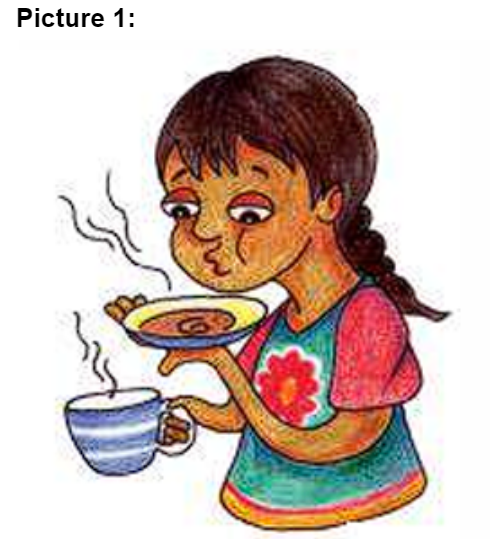
Q1: Mini tried to cool her tea by blowing on it. Which do you think will be hotter – Mini’s tea or the air she blew from her mouth?
Answer: Mini’s tea will definitely be hotter than the air she blew from her mouth. The air from her breath might feel warm, but compared to the steamy tea, it's cooler and helps bring the temperature down enough to drink.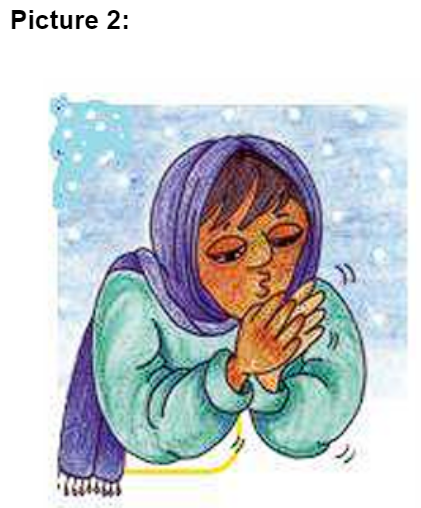
Q1: Sonu was feeling very cold. He kept blowing on to his hands. Now think and write, which will be cooler – Sonu’s hands or his breath?
Answer: Sonu’s hands will be cooler. That’s why he’s blowing on them, to feel the warmth of his breath. The air from his breath is warmer than the chilly air outside, so it helps make his hands feel a bit warmer.NCERT Solutions for Class 5 EVS Chapter 15 Blow in different ways
Q1: Make whistles of the things given below. Write in a sequence – from the loudest to the softest whistle.
– Wrapper of a toffee
– A leaf
– A balloon
– The cap of a pen
– Any other thing
Answer: Making whistles with different things is fun! If I had to guess, I'd say the loudest whistle might come from blowing into the cap of a pen because it's hard and has a small hole that can make a sharp sound. Next could be the balloon when the air is let out, making a funny, loud noise. Putting fingers in the mouth could be next; some people can make a really loud sound like that. Then maybe the toffee wrapper, if you can shape it just right. And the softest might be the leaf, as it's all natural and might not make such a sharp sound as the others.Q2: Have you seen people playing different musical instruments like flute, dholak, been, guitar, mridang, etc.? Can you recognize their sounds with your eyes closed? Find out more about these musical instruments. Collect their pictures too.
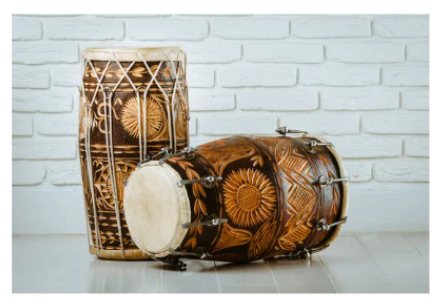
Answer: I sure have! When I close my eyes and listen, I can tell which instrument is playing because they each have a unique sound. Flute: A slender tube that makes music when you blow across the hole, creating a soft and melodious tune.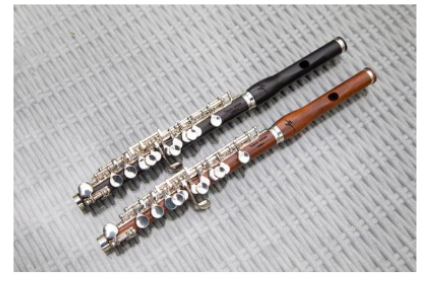 Dholak:
A traditional drum with two heads, played by hands, producing rhythmic beats that often accompany folk music.
Dholak:
A traditional drum with two heads, played by hands, producing rhythmic beats that often accompany folk music.
 Been:
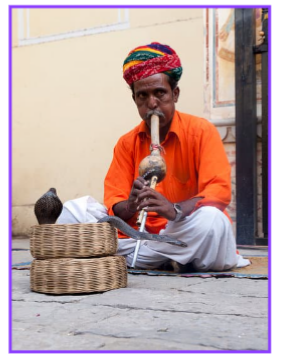
Known for its distinctive sound in snake charming, this wind instrument is played by blowing and requires skillful breath control.
Been:
Known for its distinctive sound in snake charming, this wind instrument is played by blowing and requires skillful breath control.
 Guitar:
A popular string instrument with a versatile range, capable of producing melodious chords and solos by strumming or plucking.
Guitar:
A popular string instrument with a versatile range, capable of producing melodious chords and solos by strumming or plucking.
 Mridang:
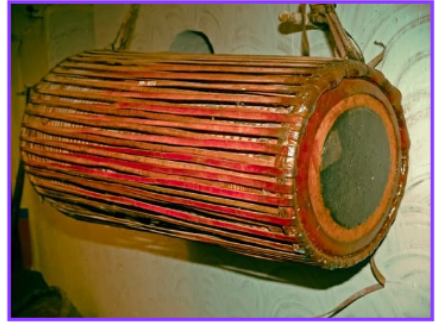
An ancient percussion instrument, barrel-shaped, usually made from jackfruit wood and played in classical music performances.
Mridang:
An ancient percussion instrument, barrel-shaped, usually made from jackfruit wood and played in classical music performances.
Q1: Can you name some things which produce melodious or pleasing sounds when we blow into them?
Answer: Yes, there are several things that make such beautiful sounds when we blow into them! A flute, for one, sings sweetly when we send a stream of air through it. Then there's the mouth organ, also known as a harmonica, which can play lots of different tunes. The been, with its deep and haunting sound, is really special too. And don't forget the whistling sound a banjo makes when its strings are paired with a good blowing technique! Each of these can create music that's a joy to listen to.
NCERT Solutions for Class 5 EVS Chapter 15 Write:
Q1: Can you name some things which produce melodious or pleasing sounds when we blow into them?
Answer: Yes, there are several things that make such beautiful sounds when we blow into them! A flute, for one, sings sweetly when we send a stream of air through it. Then there's the mouth organ, also known as a harmonica, which can play lots of different tunes. The been, with its deep and haunting sound, is really special too. And don't forget the whistling sound a banjo makes when its strings are paired with a good blowing technique! Each of these can create music that's a joy to listen to.NCERT Solutions for Class 5 EVS Chapter 15 Do this and discuss:
Q1: Have you seen someone blowing on their spectacles to wipe them clean? How does the air from the mouth help in cleaning the spectacles?
Answer: Yes, I've seen people do this. Blowing on spectacles adds a little moisture from our breath. This moisture can loosen any dirt or smudges, making it easier to wipe them away for a clear view.Q2: Take a glass. Bring it near your mouth and blow hard on it. Do this two or three times. Does the glass look hazy?
Answer: When you blow on a glass, your warm, moist breath coats the surface and makes it look foggy. It’s just like when windows steam up in a warm car on a cold day.Q3: Can you make a mirror hazy in the same way? Can you tell by touching the mirror what made it hazy? Is the air you blew from your mouth dry or wet?
Answer: Yes, mirrors get hazy too when you blow on them. If you touch it, you can feel the moisture that made it fog up. The air from our mouths is usually a bit moist, which is why it steams up the mirror.Q4: Put your hand on your chest. When you breathe in, does your chest come out or go in?
Answer: When you take a deep breath, your chest expands and moves out because your lungs are filling up with air.Q5: Measure your chest.
– Take a deep breath in, Ask your friend to measure your chest with a thread. Measurement ....
– Now breathe out. Again ask your friend to measure your chest. Measurement ....
– Was there any difference in the two measurements of your chest?
Answer: When I breathed in deeply, my chest expanded and was bigger - let's say it measured 26 inches. But when I breathed out, my chest got smaller, maybe 24 inches. So yes, there's a difference because my lungs fill up and empty out with air.NCERT Solutions for Class 5 EVS Chapter 15 How many breaths in one minute:
Q1: Put your finger under your nose. Can you feel any air when you breathe out from your nose?
Answer: Yes, when I place my finger under my nose, I can feel a stream of air each time I breathe out.Q2: Count how many times in one minute you breathe in and breathe out.
Answer: In one minute, I usually breathe in and out about 15 to 20 times. It's slow and steady when I'm sitting still.Q3: Jump 30 times. Did you feel breathless?
Answer: Definitely! After jumping 30 times, I felt a bit out of breath, like I needed to catch up on my breathing.Q4: Now again, count how many times in one minute you breathed in and out.
Answer: After jumping, my breathing got faster. I counted that I breathed in and out closer to 30 times in one minute.Q5: What was the difference in your count before and after jumping?
Answer: Before jumping, my breathing was calm, but afterwards, it sped up by about 10 to 15 breaths per minute because my body needed more oxygen after all that exercise.NCERT Solutions for Class 5 EVS Chapter 15 The clock inside you
Q1: You have all heard the ‘tick tick’ of the clock. Have you seen a doctor using a stethoscope to listen to your chest? What do you think she hears? Where is the sound coming from? Is there a clock inside your chest that keeps ticking away?
Answer: Yep, I've seen doctors do that. They're listening to the heart beating. It goes "lub-dub, lub-dub," which kind of sounds like a clock ticking. The sound comes from the heart as it works hard to pump blood all around the body. There isn't really a clock in there, but the heart has its own rhythm, like a natural timer keeping the beat of life.Q2: Do you want to listen to your heartbeat? Take a rubber tube as long as the distance from your shoulder to your elbow. At one end of the tube, fix a funnel. Place the funnel on the left side of your chest. Put the other end of the tube to your ear. Listen carefully. Did you hear a dhak-dhak sound?
Answer: When I tried that, I did hear something! It was the "dhak-dhak" of my own heartbeat. It's pretty amazing to hear it, like my heart was talking to me, saying "hello" with every beat.NCERT Solutions for Class 5 EVS Chapter 15 Snake tells the flow of air:
For this take a round paper 10-15 cms wide. Cut this paper in a spiral shape (as shown in picture 1). To hold this snake tie a thread on both sides. Tie a knot or a button to make it hang. Now the snake is ready to move. Hang this snake near a hot thing. For this you can take hot tea, water or a burning candle. Now see from the top, in which direction the snake moves.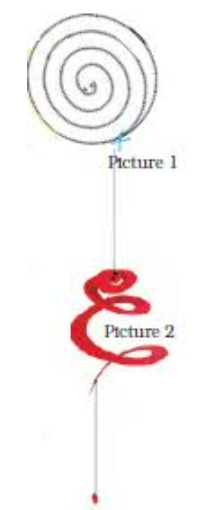
Q1: Stand with this snake below a fan. Look in which direction it moves. Take this paper snake to different places and observe its movement.
Answer: When I held the paper snake under a fan, it started to spin around. It was fun to watch! It went around in circles the opposite way the fan was turning because the fan blows air straight down.Q2: Can you understand from the movement of the snake – if the air is moving upwards or downwards?
Answer: Definitely! When the paper snake spins one way, it means the air is going up. But under the fan, it spun the other way, so that meant the air was pushing down. It's like being a detective, but for air.NCERT Solutions for Class 5 EVS Chapter 15 What we have learnt:
Q1: While playing, Amit hit a wall. His forehead was swollen. Didi immediately folded a scarf (4-5 times), blew on it, and kept it on Amit’s forehead. Why do you think Didi did this?
Answer: Didi was trying to soothe Amit's pain and reduce the swelling. By blowing on the scarf, she added a little warmth and moisture, which can feel comforting against a bump. The gentle pressure from the scarf might also help lessen the swelling.Q2: We blow to cool hot things as well as to warm them. Give examples of each.
Answer: For cooling, we often blow on a steaming cup of tea or a hot slice of pizza to make it a bit cooler and easier to eat. On the other hand, we blow into our hands or on a cold spoon to warm them up, using our breath's warmth to take the chill off.Importance of NCERT Solutions for Class 5 EVS Chapter 15 Blow Hot, Blow Cold
In the essential Chapter 15 of the Class 5 EVS curriculum, "Blow Hot, Blow Cold," students embark on a scientific journey to understand thermal dynamics through relatable scenarios. The chapter encourages learners to grasp the tangible aspects of temperature change and its applications. The NCERT solutions crafted for this chapter enable students to dissect and comprehend the principles of heat and cold. By providing a comprehensive guide through simple explanations, Physics Wallah ensures that students are well-equipped to tackle the complexities of thermal phenomena. These solutions broaden students' horizons, allowing them to experiment with and appreciate the underlying science of everyday experiences. As they build critical thinking and analytical skills, they also develop a deeper respect for the subtleties of nature's workings.Benefits of NCERT Solutions for Class 5 EVS Chapter 15
NCERT Solutions for Class 5 EVS Chapter 15, "Blow Hot, Blow Cold," provide students with the opportunity to:- Explore Thermal Phenomena: The chapter encourages students to experiment with temperature and understand how it influences various aspects of their environment.
- Develop Scientific Curiosity: By engaging in hands-on activities, students cultivate a love for scientific inquiry and a desire to learn through observation and experimentation.
- Enhance Problem-Solving Skills: The chapter's solutions promote critical thinking as students explore why and how temperature changes occur and how they can control them.
- Encourage Practical Learning: Through interactive learning, students apply scientific concepts to real-life situations, enhancing their educational journey.
- Align with Educational Standards: Tailored to meet the curriculum, the solutions prepare students academically while also fostering a practical understanding of the natural world.
NCERT Solutions for Class 5 EVS Chapter 15 FAQs
What is the central theme of "Blow Hot, Blow Cold"?
How does "Blow Hot, Blow Cold" explain the use of warm breath?
What activities are included in "Blow Hot, Blow Cold" to learn about air temperature?
Can "Blow Hot, Blow Cold" help understand weather patterns?










 Live & recorded classes available at easeDashboard for progress trackingMillions of practice questions at your fingertips

