Volume of Pyramid - Definition, Formula, Examples
 Nikita Aggarwal1 Apr, 2026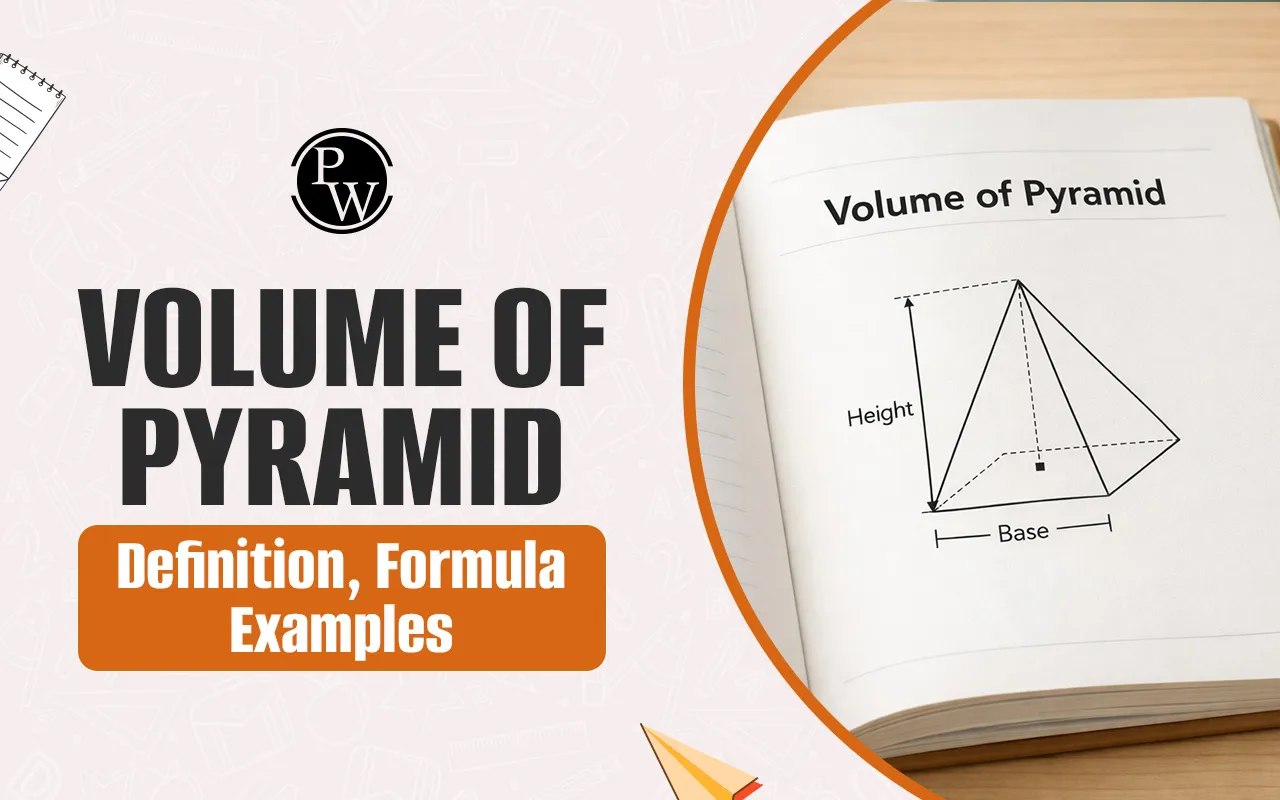
What is Volume of Pyramid in Maths?
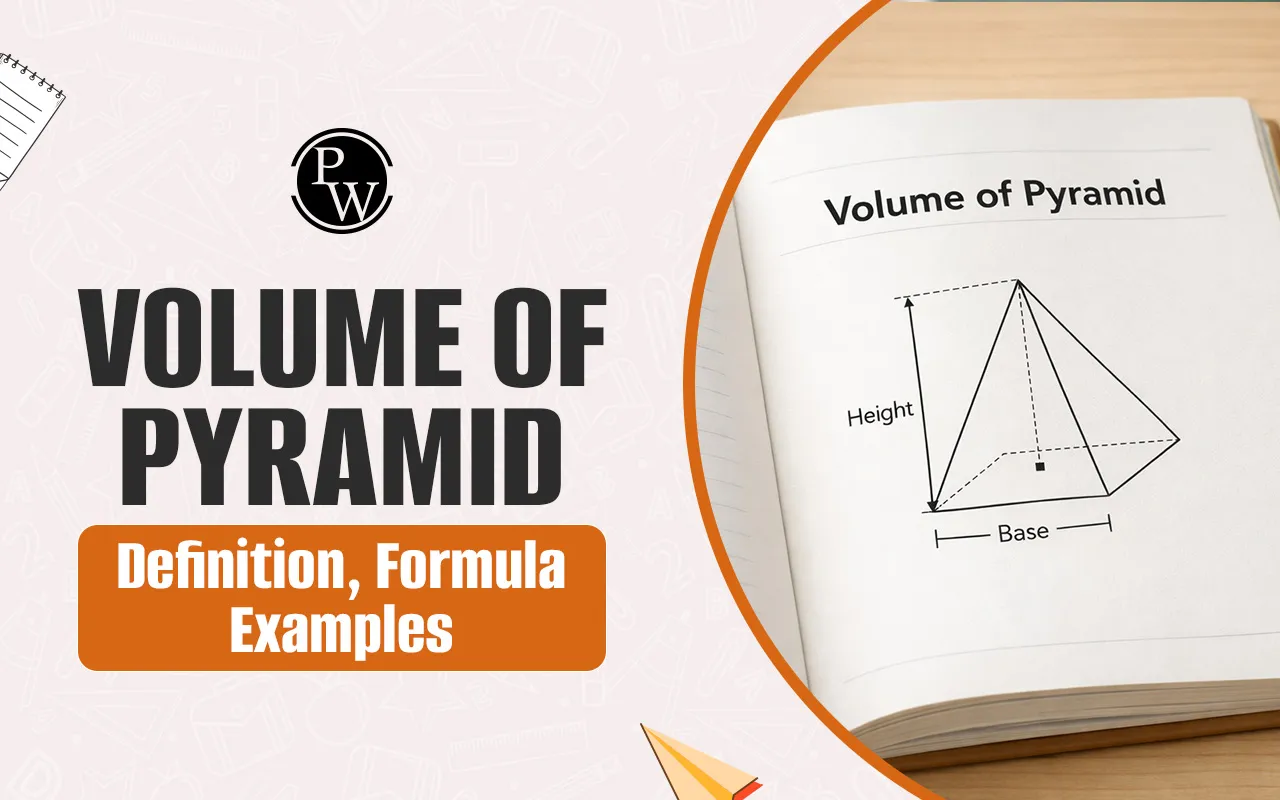
In geometry, volume is the amount of space that a three-dimensional object takes up. A pyramid is a solid shape with a polygon base (such as a square or triangle) and three sides that meet at a point called the apex.
It is specifically defined as the number of unit cubes that can fit inside the structure. A unique characteristic of this shape is its relationship with prisms. If a prism and a pyramid have the same base area and height, the pyramid will always have one-third the volume of the prism.
Key Components of a Pyramid
To use the formula, you need to identify three key parts:
-
The Base: The bottom face of the pyramid. It can take any shape with straight sides.
-
The Apex: The top point where all lateral triangular faces meet.
-
The Altitude (Height): The perpendicular distance from the apex straight down to the centre of the base.
Volume of Pyramid Formula
The best thing about figuring out the volume of a pyramid is that one method works for all types of pyramids. The relationship between the base area and the height stays the same, no matter if the base is a hexagon or a basic square.
The typical equation looks like this:
V = (1/3) × B × h
Where:
-
V represents the Volume.
-
B represents the Area of the Base.
-
h represents the perpendicular Height (altitude) of the pyramid.
Breaking Down the Base Area (B)
Because the base can change shape, the "B" in our formula changes depending on what you are looking at. Here is how you calculate "B" for common pyramids:
-
Square Base: Side × Side
-
Rectangular Base: Length × Width
-
Triangular Base: 1/2 × Base of triangle × Height of triangle
Types of Pyramids and Their Volume Formulas
We categorise these solids based on the shape of their base. While the "one-third" rule stays the same, finding the value of "B" requires different steps.
1. Square Pyramid
A square pyramid has a square base and four triangular sides. This is the most common type found in textbooks.
-
Base Area (B): s² (where s is the side length).
-
Volume: (1/3) × s² × h.
2. Rectangular Pyramid
If the base is a rectangle, the lengths of the sides will not be the same.
-
Base Area (B): l × w.
-
Volume: (1/3) × l × w × h.
3. Triangular Pyramid (Tetrahedron)
The base is a triangle in this case.
-
Base Area (B): 1/2 × b × a (where b is the triangle's base and a is its altitude).
-
Volume: (1/3) × (1/2 × b × a) × h.
|
Type of Pyramid |
Base Shape |
Base Area (B) |
Volume Formula |
|
Square Pyramid |
Square |
Side × Side |
V = 1/3 × s² × h |
|
Rectangular Pyramid |
Rectangle |
Length × Width |
V = 1/3 × (l × w) × h |
|
Triangular Pyramid |
Triangle |
1/2 × base × height |
V = 1/3 × (1/2 × b × a) × h |
|
Hexagonal Pyramid |
Hexagon |
(3√3 / 2) × side² |
V = 1/3 × Area of Hexagon × h |
Read More - Geometry: Overview, Branches, Formulas, Angles
Derivation of Pyramid Volume
Knowing the formula is just as crucial as knowing why it works.
Step 1: Compare the Shape with a Prism
You can understand a pyramid better by comparing it with a prism that has the same base area and the same height.
Step 2: Understand the Relationship
A pyramid occupies one-third of the volume of a prism with the same base and height.
Step 3: Apply the Prism Formula
The volume of a prism is:
Volume = Base Area × Height
So, the volume of a pyramid becomes:
V = (1/3) × Base Area × Height
Step 4: Final Formula
Therefore, the formula for the volume of a pyramid is:
V = (1/3) × B × h
This shows that the volume of a pyramid depends on the area of its base and its perpendicular height.
Volume of Pyramid Variations
The standard formula for the volume of a pyramid is:
V = (1/3) × B × h
However, depending on the type of base given in the question, this formula can be written in different forms:
1. Using a Square Base
If the base is a square with side s, then:
Base Area = s²
So,
V = (1/3) × s² × h
2. Using a Rectangular Base
If the base is a rectangle with length l and width w, then:
Base Area = l × w
So,
V = (1/3) × l × w × h
3. Using a Triangular Base
If the base is a triangle with base b and height a, then:
Base Area = (1/2) × b × a
So,
V = (1/3) × (1/2 × b × a) × h
These forms help in solving different pyramid volume problems based on the shape of the base.
Volume of Pyramid Examples
To master this concept, let’s look at some practical examples.
Example 1: Finding the Volume of a Square Pyramid
Problem: Calculate the pyramid volume with a square base of side 6 cm and a height of 10 cm.
Solution:
-
Identify the base: It is a square, so we use Side × Side.
-
Calculate Base Area (B): 6 cm × 6 cm = 36 cm².
-
Identify Height (h): 10 cm.
-
Apply the formula: V = 1/3 × B × h.
-
Calculate: V = 1/3 × 36 × 10.
-
Final Result: V = 12 × 10 = 120 cm³.
Example 2: Rectangular Pyramid Calculation
Problem: A rectangular pyramid has a base length of 8 m, a base width of 5 m, and a height of 9 m. Find its volume.
Solution:
-
Calculate Base Area (B): Length × Width = 8 m × 5 m = 40 m².
-
Apply the formula: V = 1/3 × 40 × 9.
-
Simplify: (1/3 of 9 is 3).
-
Calculate: 40 × 3 = 120 m³.
-
Final Result: The volume of the pyramid is 120 m³.
Example 3: Solving for a Triangular Pyramid
Problem: The base of a pyramid is a triangle with an area of 15 square inches. What is the volume if the pyramid is 4 inches tall?
Solution:
-
Base Area (B) is given: 15 in².
-
Height (h) is given: 4 in.
-
Apply the formula: V = 1/3 × 15 × 4.
-
Calculate: 1/3 × 15 = 5.
-
Final Result: 5 × 4 = 20 in³.
Read More - 3D Shapes in Maths – Definition, Types, and Properties with Examples
Important Notes on Units and Accuracy in Volume of Pyramid
Make sure all of your measurements are in the same unit when you find the volume of a pyramid. Before you start, you need to adjust one of the base or height measurements.
-
Volume is usually measured in cubic units, as cm³, m³, or in³.
-
Height vs. Slant Height: A typical mistake is using the "slant height" (the height of the side triangles) instead of the "perpendicular height" (the distance straight down from the apex to the base). Always utilise the height that is perpendicular to the base to find volume..
Common Mistakes to Avoid in Volume of Pyramid
-
One-third: A lot of students only multiply the base area by the height, which produces the volume of a prism, not a pyramid.
-
Using Slant Height: Keep in mind that volume needs the height from the ground up. Only the surface area uses slant height.
-
Mistakes in the base area calculation: Make sure you apply the right formula for the base shape. For example, don't forget to include the 1/2 in the area of the triangle base.
Pyramid Volume Practice Questions
-
Question 1: Find the volume of a square pyramid with base side 5 cm and height 10 cm.
-
Question 2: A rectangular pyramid has length 14 cm, width 8 cm, and height 12 cm. Calculate its volume.
-
Question 3: Find the height of a pyramid whose volume is 314 cm³ and base area is 47.1 cm².
-
Question 4: The height of a pyramid-shaped water tank is 3 m, and its base area is 2 m². Determine its volume in litres.
-
(Use 1 m³ = 1000 litres)
Make Maths Fun and Easy with CuriousJr
CuriousJr helps children build a strong foundation in maths by removing fear and boosting confidence. Our Mental Maths online classes for students from Classes 1 to 8 are designed to improve speed, accuracy, and logical thinking through simple methods and interactive learning.
With a dual-mentor system, students participate in engaging live classes and receive dedicated support for doubt-solving after every session. Animated lessons, fun activities, and exciting challenges make maths easy to grasp and enjoyable to learn.
Parents receive regular progress updates and review sessions, ensuring full transparency in their child’s learning journey.
Book a demo class today and discover how CuriousJr makes maths simple, engaging, and confidence-building for your child.
Volume of Pyramid FAQs
Can I use the same formula for all types?
What is the difference between height and slant height?
How do I find the volume if the base is a triangle?
What are some real-life volume examples?






 Live & recorded classes available at easeDashboard for progress trackingMillions of practice questions at your fingertips