






Chord of a Circle - Definition, Formula, Examples
 Nikita Aggarwal21 Mar, 2026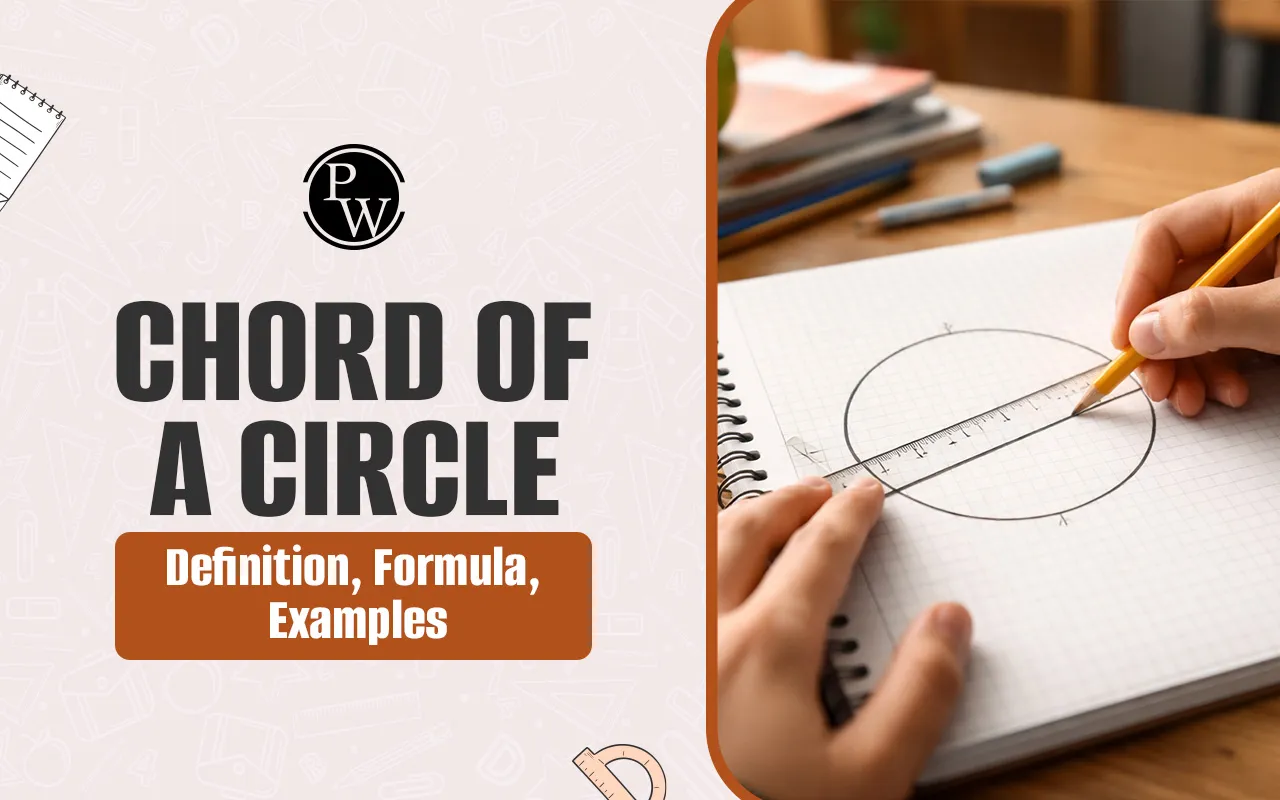
What is Chord of a Circle?
To define chord of a circle accurately, this is what you need to know: A chord of a circle is a straight line segment that joins any two points on the circumference of the circle. It does not have to pass through the centre.
A diameter is a form of chord that always goes through the center. This means that every diameter is a chord, but not every chord is a diameter. You can also think of a chord as a fold across a round sheet that joins two places on its edge.
Important Properties of the Chord of a Circle
Every chord of a circle follows specific geometric rules. These properties of chord help you solve theorems and find missing lengths in circle problems.
-
Perpendicular Bisector: A line drawn from the centre of the circle that is perpendicular to a chord always bisects (cuts in half) that chord.
-
Equal Chords: If two chords in a circle have the same length, they are at an equal distance from the centre of the circle.
-
Longest Chord: The diameter is always the longest chord in maths for any given circle.
-
Angle Subtended: Equal chords subtend (create) equal angles at the centre of the circle.
Formula of Chord of a Circle
To find the length of a chord of a circle, you can use trigonometry or the Pythagorean theorem if you know the radius and the distance from the centre. The most common chord of a circle formula is used when you know the radius (r) and the angle (\theta) created at the centre.
Length of Chord = 2r \sin(\theta/2)
What is chord in maths? Another way to look at this is by using the distance from the centre (d). If you know the radius (r) and the perpendicular distance (d) from the centre to the chord, the formula is:
Length of Chord = 2 \sqrt{r^2 - d^2}
Chord of a Circle Examples
We see chord of a circle examples in many everyday objects. These shapes are used by engineers and designers to create everything from bridges to architectural windows.
Example 1:
In a circle, the length of chord AB is 12 cm. A perpendicular from the centre O meets the chord at point M. Find the length of AM.
Solution:
The perpendicular from the centre to a chord bisects the chord.
So,
AM = AB ÷ 2 = 12 ÷ 2 = 6 cm
Example 2:
A circle has a radius of 10 cm, and the distance from the centre to a chord is 8 cm. Find the length of the chord.
Solution:
We can use the formula:
Chord length = 2√(r² − d²)
Substituting the values:
= 2√(10² − 8²)
= 2√(100 − 64)
= 2√36
Now, √36 = 6
So, chord length = 2 × 6 = 12 cm
Example 3:
In a circle, two chords are equal in length. What can you say about their distance from the centre?
Solution:
Equal chords of a circle are always equidistant from the centre.
So, both chords are at the same distance from the centre.
Example 4:
A chord subtends an angle of 60° at the centre of a circle with radius 14 cm. Find the length of the chord.
Solution:
Using formula:
Chord length = 2r sin(θ/2)
= 2 × 14 × sin(30°)
= 28 × ½
So answer is 14 cm.
Read More - Diameter of a Circle Definition, Formulas, and Steps
Theorems of Chord of a Circle
-
A perpendicular from the centre bisects the chord: when a line is drawn from the centre of the circle to a chord at a right angle, it divides the chord into two equal parts.
-
Equal chords are equally distant from the centre: if two chords have the same length, their perpendicular distance from the centre will also be the same.
-
Chords equally distant from the centre are equal: this is the reverse of the previous rule and helps compare chords inside the same circle.
-
Unequal chords theorem: if two chords are of different lengths, the longer chord lies nearer to the centre, while the shorter chord lies farther away.
Important Notes on Chord of a Circle
-
Two radii and a chord form an isosceles triangle: when the centre is joined to both endpoints of a chord, the two radii are equal, so the triangle formed is isosceles.
-
The diameter is the longest chord: every diameter is a chord, but it is also the biggest chord in the circle.
Read More - Circumference of a Circle: Meaning, Formulas, and Solved Examples
Practice Questions on Chord of a Circle
-
What happens to a chord when a perpendicular is drawn to it from the centre?
-
If two chords are equally distant from the centre, what can you say about their lengths?
-
Which chord lies closer to the centre: a longer chord or a shorter chord?
-
What kind of triangle is formed by two radii and a chord?
Make Maths Easy and Fun with CuriousJr
At CuriousJr, we help children overcome their fear of maths and develop strong confidence in numbers by building a clear foundation. Our Mental Maths Online Classes for students in Classes 1 to 8 are designed to improve speed, accuracy, and logical thinking through simple methods and interactive learning.
With our dual-mentor approach, students attend engaging live classes and get dedicated support for doubt-solving after every session. Animated lessons, fun activities, and exciting challenges make learning maths enjoyable and easy to understand.
Parents receive regular progress updates and can also join review sessions to stay involved in their child’s learning journey. Book a demo class today and see how CuriousJr makes maths simple, engaging, and confidence-building for your child.
Chord of a Circle FAQs
What is a chord of a circle in mathematics?
Does a chord have the ability to exceed the length of a diameter?
How do I find the length of a chord if I only have the radius?
Is a tangent considered a chord?











 Live & recorded classes available at easeDashboard for progress trackingMillions of practice questions at your fingertips

