






Volume of Hexagonal Prism: Definition, Formula, and Solved Examples
 Nikita Aggarwal20 Apr, 2026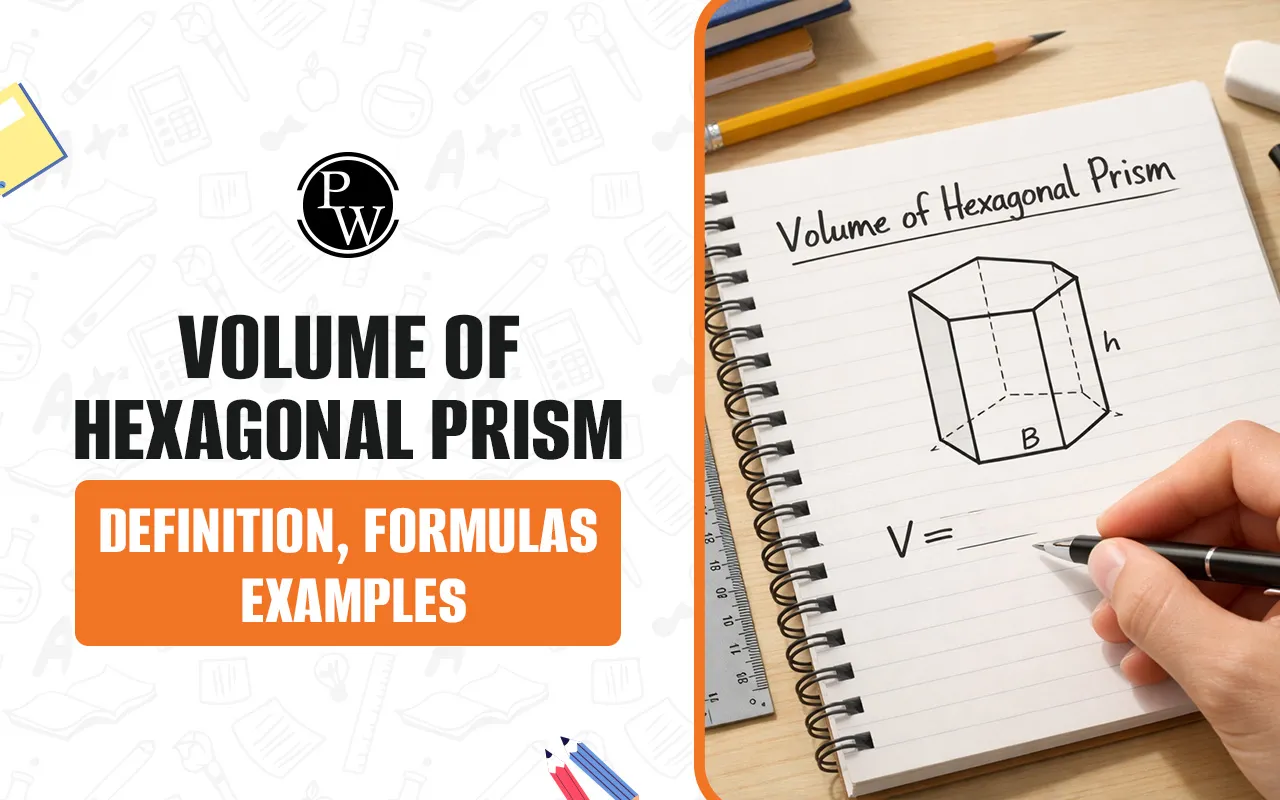
What is Volume of Hexagonal Prism in Maths?
First, we need to understand what the numbers mean. Simply put, volume tells you how much space a solid object occupies in three dimensions. Think of filling a hexagonal glass with water; the total amount it can hold is its volume.
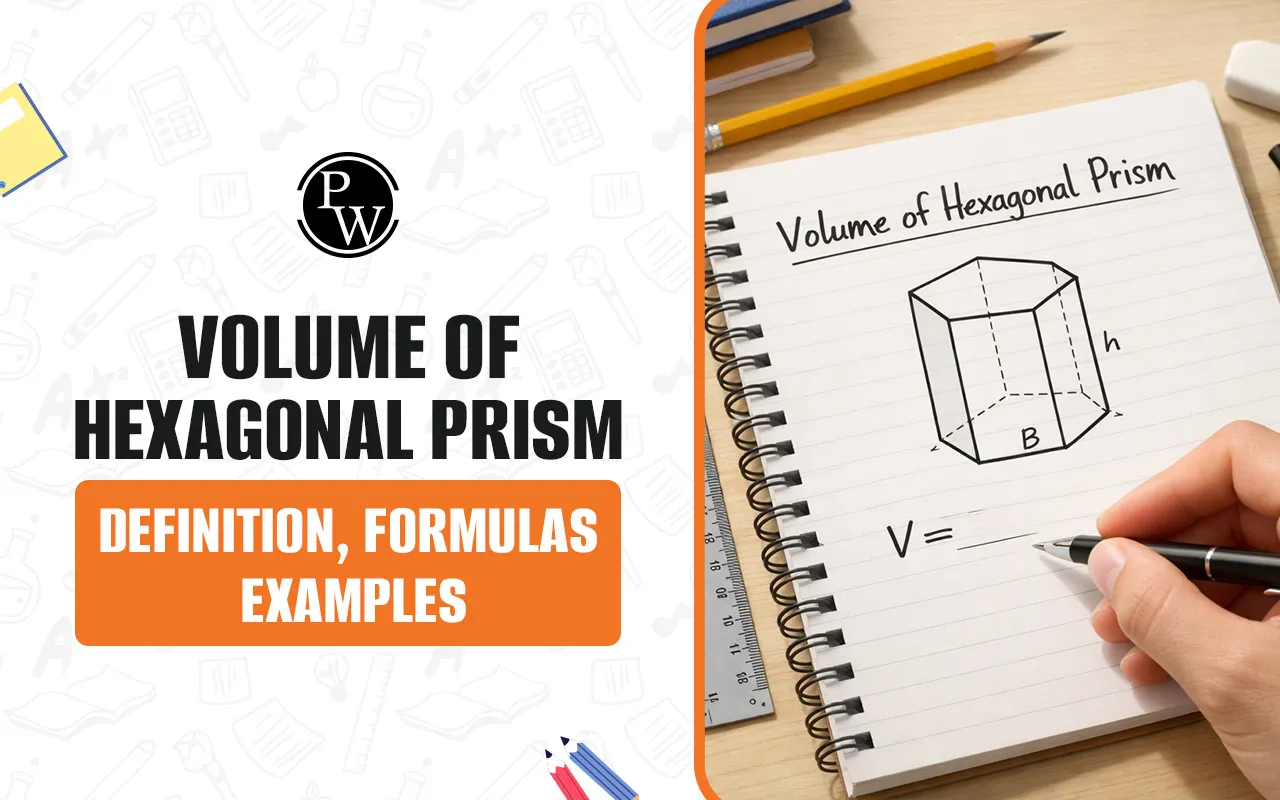
A hexagonal prism is a unique solid that features two identical hexagonal bases connected by six rectangular side faces. Because it is a "regular" prism, the cross-section remains the same from the bottom to the top. The volume depends only on two factors: the height of the object and the size of the hexagonal base.
Characteristics of a Hexagonal Prism
To accurately identify this shape in your geometry problems, look for these distinct features:
-
Bases: Two hexagons of equal size.
-
Faces: Six rectangular sides.
-
Vertices: There are 12 corners where the edges meet.
-
Edges: Eighteen straight lines connecting the corners.
Volume of Hexagonal Prism Formula
To find the volume, we follow the general method for any prism: Volume = Base Area × Height.. But we need a certain approach to find the area of the base first because it is a hexagon.
A regular hexagon is made up of six equilateral triangles. By calculating the area of these triangles, we derive the standard formula.
Derivation of Hexagonal Base Area Formula
We split the hexagon down into simpler shapes so we can see where the formula originates from.
Six equal equilateral triangles can be made from a normal hexagon.
-
The area of one equilateral triangle is (√3 / 4) × s².
-
The total area of the hexagon is 6 × (√3 / 4) × s².
-
To make it easier: = (6√3 / 4) × s² = (3√3 / 2) × s²
This is how we find the formula for the base area that we use to find the volume.
Volume of Regular Prism
If you know the height (h) and the length of the base (s), you can apply this formula:
The volume is equal to [(3√3 / 2) × s²] × h.
If you already know the Area of the Base (B), the formula becomes:
V = B × h
Volume of Hexagonal Prism Using Apothem
Sometimes, the apothem (a) is stated instead of the side length.
You can also find the area of a hexagon by using:
To find the area, multiply the perimeter by the apothem and divide by 2.
The area is (6s × a) / 2 = 3sa since the perimeter is 6s.
So, the volume is:
Volume = 3sa × h
When you have the apothem instead of the side length, this method works well.
Key Variables in Hexagonal Prism Formula
-
s (Side): The length of one side of the hexagonal base is one of the most important parts of the hexagonal prism formula.
-
h (Height): The distance between the two hexagonal bases in the vertical direction.
-
B (Base Area): The overall area of the hexagon's bottom surface.
Regular vs Irregular Hexagonal Prism
Not all hexagonal prisms are regular. It's crucial to know the difference.
-
Regular Hexagonal Prism:
You can use common formulas like (3√3 / 2) × s² directly because all sides of the hexagon are the same. -
Irregular Hexagonal Prism:
The sides of the hexagon are not the same length. When this happens, the base needs to be split into smaller shapes, such triangles or rectangles. Then, you need to get the area of each shape and multiply it by the height.
Students should be careful not to use the regular formula on shapes that aren't regular.
How to Calculate Volume of Hexagonal Prism?
If you follow a logical order, it's easy to find the volume. To fix any difficulty, do the following:
-
Find the size: Write down the height (h) and the length of the side (s) for each problem you have. Make sure that each of them are in the same units, like cm or m.
-
Find the area of the base: To get the solution, square the length of the side, multiply it by 3, then by the square root of 3 (which is about 1.732), and finally divide by 2.
-
Put the value from step 2 and the height of the prism together.
-
When you answer, always use cubic units, like cm³, m³, or in³.
Dimensions and Volume of Hexagonal Prism
This table quickly shows you how the volume of a hexagonal prism changes when the heights and side lengths change.
|
Base Side (s) |
Height (h) |
Base Area (approx) |
Total Volume (approx) |
|
2 cm |
5 cm |
10.39 cm² |
51.96 cm³ |
|
4 cm |
10 cm |
41.57 cm² |
415.70 cm³ |
|
6 cm |
12 cm |
93.53 cm² |
1,122.36 cm³ |
|
10 cm |
15 cm |
259.81 cm² |
3,897.15 cm³ |
Read More - Volume: Formula, Definition, Calculation, Examples
Volume of Hexagonal Prism Examples
Let's look at some examples to see how these numbers work in real life.
Example 1: Basic Calculation
Question: A pencil that looks like a normal hexagonal prism has a base side that is 1 cm long and a height that is 15 cm long. Calculate the volume of the hexagonal prism.
Solution:
-
Side (s) = 1 cm
-
Height (h) is 15 cm.
-
Base Area = (3√3 / 2) × s²
-
Base Area = (3 × 1.732 / 2) × (1)² = 2.598 cm²
-
Volume = Base Area × h Volume = 2.598 × 15 = 38.97 cm³
-
Final answer: The pencil's volume is 38.97 cm³.
Example 2: Finding Height from Volume
Question: The base of a hexagonal container is 40 cm² and the volume is 520 cm³. What is the height of the container?
Solution:
-
520 cm³ is the volume (V).
-
The area of the base (B) is 40 cm².
-
We know that V = B × h. 520 = 40 × h. h = 520 / 40.
-
h = 13 cm
-
Final answer: The container is 13 cm tall.
Example 3: Larger Scale Geometry
Question: A big stone pillar is a hexagonal prism with a base side of 2 m and a height of 8 m. Calculate the hexagonal prism's total volume.
Solution:
-
s = 2 m and h = 8 m
-
Base Area = (3√3 / 2) × (2)²
-
Base Area = 10.392 m², which is (3 × 1.732 / 2) × 4.
-
83.136 m³ is equal to 10.392 × 8.
-
Final answer: The stone pillar has a volume of 83.136 m³.
Read More - Volume of a Cylinder - How to Find Volume of Cylinder?
Example 4: Word Problem
Question: A honeycomb cell is a hexagonal prism that is 2 cm tall and 0.5 cm wide. Find the volume of the hexagonal prism.
-
Solution:
s = 0.5 cm and h = 2 cm -
Base Area = (3√3 / 2) × (0.5)² = (3 × 1.732 / 2) × 0.25 = 0.6495 cm²
-
The volume is 0.6495 × 2 = 1.299 cm³.
-
Final answer: 1.299 cm³.
Example 5: Using Apothem
Question: The apothem of a hexagonal base is 3 cm and each side is 4 cm. The height of the prism is 10 cm. Find the volume.
-
Solution:
a = 3 cm
s = 4 cm
h = 10 cm -
Volume = 3sa × h
= 3 × 4 × 3 × 10
= 360 cm³ -
Final Answer: 360 cm³
Make Maths Easy and Fun with CuriousJr
CuriousJr helps children develop a strong foundation in maths by removing fear and building confidence. Our Mental Maths online classes for students from Classes 1 to 8 focus on improving speed, accuracy, and logical thinking through simple techniques and interactive learning.
With our dual-mentor approach, students participate in engaging live sessions and get dedicated support for clearing doubts after every class. Animated lessons, fun activities, and exciting challenges make learning maths enjoyable and easy to grasp.
Parents receive regular progress reports along with review sessions, ensuring complete transparency in their child’s learning journey.
Book a demo class today and discover how CuriousJr makes maths simple, engaging, and confidence-boosting for your child.
Volume of Hexagonal Prism FAQs
A simple definition of the volume of a hexagonal prism
Can I use the same formula for the volume of an irregular hexagon?
What are the measurements for the volume of a hexagonal prism?
How do you figure out the volume if you only know the base area?














 Live & recorded classes available at easeDashboard for progress trackingMillions of practice questions at your fingertips

