Is 1001 a Prime Number?
 Nikita Aggarwal10 Apr, 2026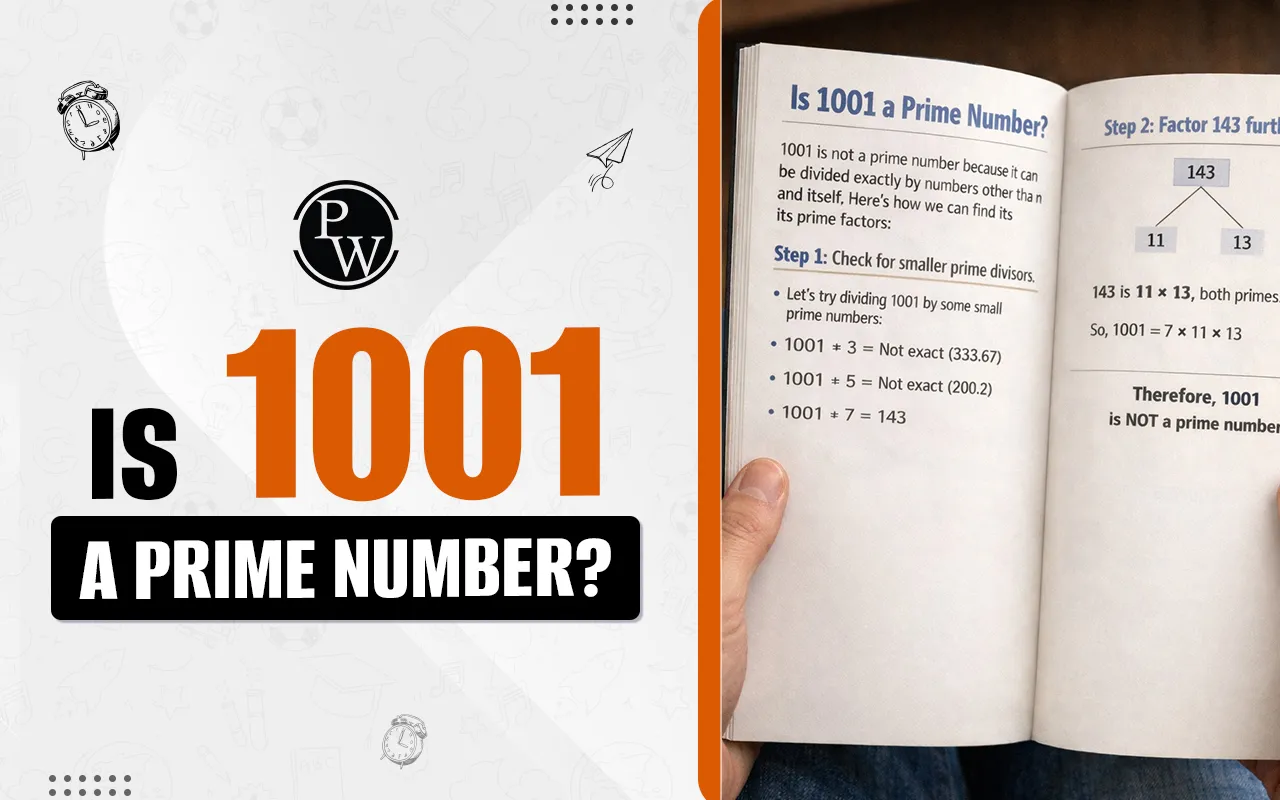
What are Prime Numbers?
Before we start talking about 1001, we need to understand what prime numbers are. So what are prime numbers?
Prime numbers are numbers in mathematics. A prime number is a number that's bigger than 1 and can only be divided by 1 and the prime number itself. This means you cannot obtain a number by multiplying two smaller numbers together. For example, the prime numbers 2, 3, 5, 7 and 11 are all numbers.
So we have numbers. Composite numbers are numbers bigger than 1 and can be divided by other numbers besides 1 and the composite number itself. For example, if we have a number and it can be divided by another number without leaving a remainder, then the composite number is not a prime number; it is a composite number. Composite numbers have factors; that is why they can be divided by other numbers.
Is 1001 a Prime Number?
To figure out if 1001 is a number, we need to determine if any prime numbers that are less than the square root of 1001 can divide 1001 perfectly. The square root of 1001 is approximately 31.6. The next step will be to confirm whether 1001 divides all of the following numbers: 2, 3, 5, 7, 11, 13, 17, 19, 23, 29, and 31, as they are all prime numbers and less than 31.6, which is the square root of 1001. This is why we use prime factors less than 31.6 to determine whether 1001 is prime.
Let's discuss the number 1001 and see if it can be divided by some numbers.
Divisibility by 2: the number 1001 is odd. The number 1001 is not divisible by 2.
Divisibility by 3: to verify this condition, we need to add up all the digits of the number 1001, which is 1 plus 0 plus 0 plus 1, and that gives us 2. Since 2 is not divisible by 3, the number 1001 is not divisible by 3.
Divisibility by 5: we can figure the answer out by looking at the digit of the number 1001. Because 1001 does not end in 0 or 5, it is indivisible by 5.
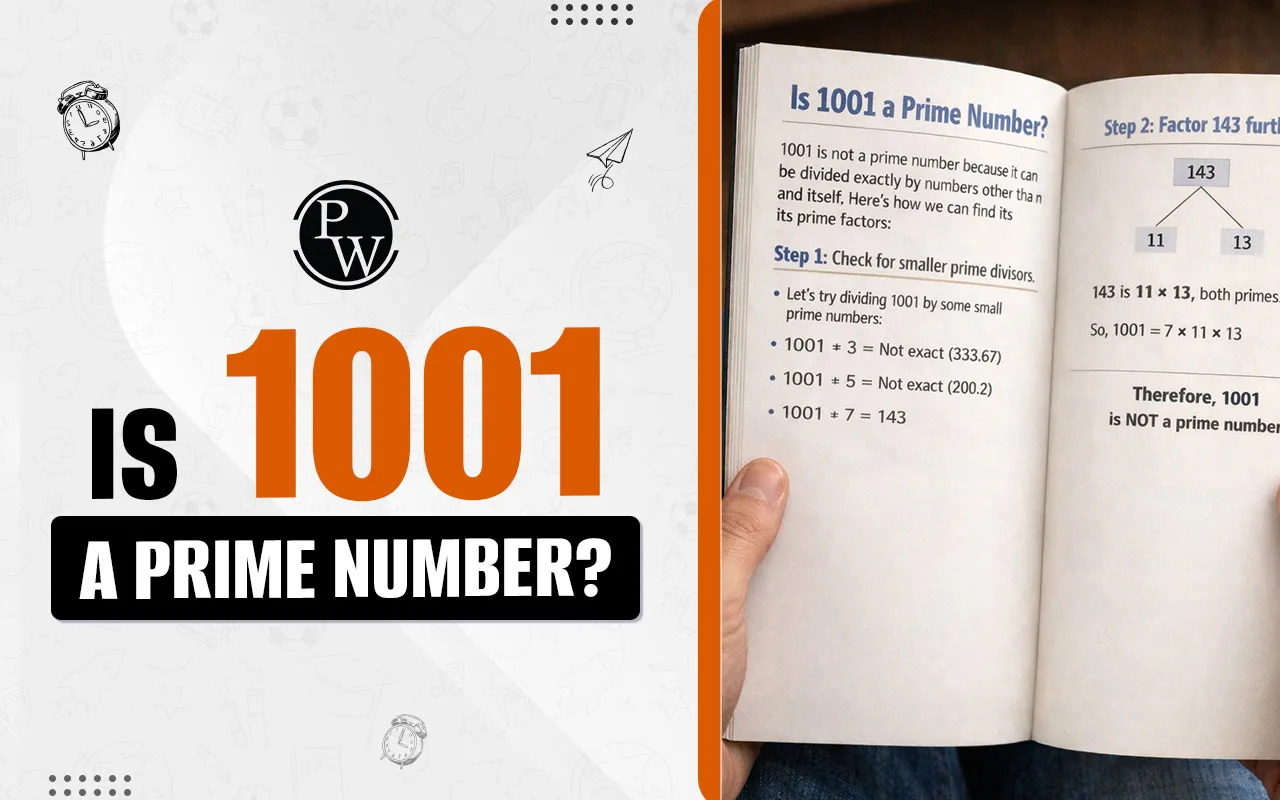
Divisibility by 7: if we try to divide the number 1001 by 7, we get 143, and that works out perfectly, so we found that the number 1001 is divisible by 7.
Because 1001 has factors apart from 1 and 1001, it is officially a composite number.
Why 1001 a Prime Number?
Many people mistakenly believe 1001 is a prime number because it passes the most common mental "quick checks". It isn't even, so it’s not divisible by 2. Since it doesn't end in 5, it is not divisible by 5. Its digits don't add up to a multiple of 3.
However, the 1001 prime number status is debunked the moment you apply the divisibility rule for 7 or 11. The number 1001 is actually an exceptional product in mathematics. It is the result of multiplying three consecutive prime numbers: 7, 11, and 13.
-
7 x 11 = 77
-
77 x 13 = 1001
This specific property makes 1001 a "sphenic number" (a product of three distinct primes) and a common feature in mathematical puzzles.
1001 prime number Derivation
Before understanding the relationships between prime numbers, a person would have to figure out what the factors of the number 1001 are. A factor is a number that has no remainder when it is used to multiply another number to create a product of 1001. In this case, there are only three prime numbers that are factors of 1001, and these three primes are 7, 11, and 13. After figuring out all of the different combinations for each of the three primes for multiplying together, this process will allow a person to develop all of the different combinations of factors that exist for the number 1001.
-
1 (Every number is divisible by 1)
-
7 (Prime factor)
-
11 (Prime factor)
-
13 (Prime factor)
-
77 (7 x 11)
-
91 (7 x 13)
-
143 (11 x 13)
-
1001 (The number itself)
Since there are 8 distinct factors, it is impossible for 1001 to be prime.
Read More - Is 47 a Prime Number?
Divisibility Test for 1001
If you are taking an exam to prove why 1001 a prime number, you can apply the following easy methods.
The Rule of 7:
Take the last digit, double it, and subtract it from the remaining part of the number.
- The last digit of 1001 is 1, which is doubled: 1 x 2 = 2.
- The remaining part of the number is 100.
- 100 - 2 = 98
- 98 can be divided evenly by 7 (7 x 14 = 98). Therefore, 1001 can also be divided evenly by 7.
The Rule of 11:
Determine the difference between the sum of digits in even positions and the sum of digits in odd positions.
- Odd Positions: 1 (1st Position) + 0 (3rd Position) = 1
- Even Positions: 0 (2nd Position) + 1 (4th Position) = 1
- Difference 1 - 1 = 0
- If the difference is equal to 0 or a multiple of 11, then the number is divisible by 11. Therefore, the above calculation shows that 1001 is divisible by 11.
Read More - List of Prime Numbers Upto 100
1001 At a Glance
|
Property |
Value |
|
Is 1001 a prime number? |
No |
|
Number Type |
Composite |
|
Factors |
1, 7, 11, 13, 77, 91, 143, 1001 |
|
Prime Factorization |
7 x 11 x 13 |
|
Square Root |
~31.63 |
Make Maths Simple and Fun with CuriousJr
CuriousJr helps children develop a strong foundation in maths by reducing fear and building confidence. Our Mental Maths online classes for students from Classes 1 to 8 focus on improving speed, accuracy, and logical thinking through easy methods and interactive learning.
With our dual-mentor approach, students attend engaging live classes and get personalised support to clear doubts after every session. Animated lessons, fun activities, and exciting challenges make maths easier to understand and more enjoyable.
Parents receive regular progress updates and review sessions, giving complete visibility into their child’s learning journey.
Book a demo class today and see how CuriousJr makes maths simple, fun, and confidence-building for your child.
Is 1001 a Prime Number FAQs
Is 1001 a prime number or a composite?
What are the prime factors of 1001?
Why is 1001 not a prime number?
How do you determine the 1001 prime number derivation?






 Live & recorded classes available at easeDashboard for progress trackingMillions of practice questions at your fingertips