






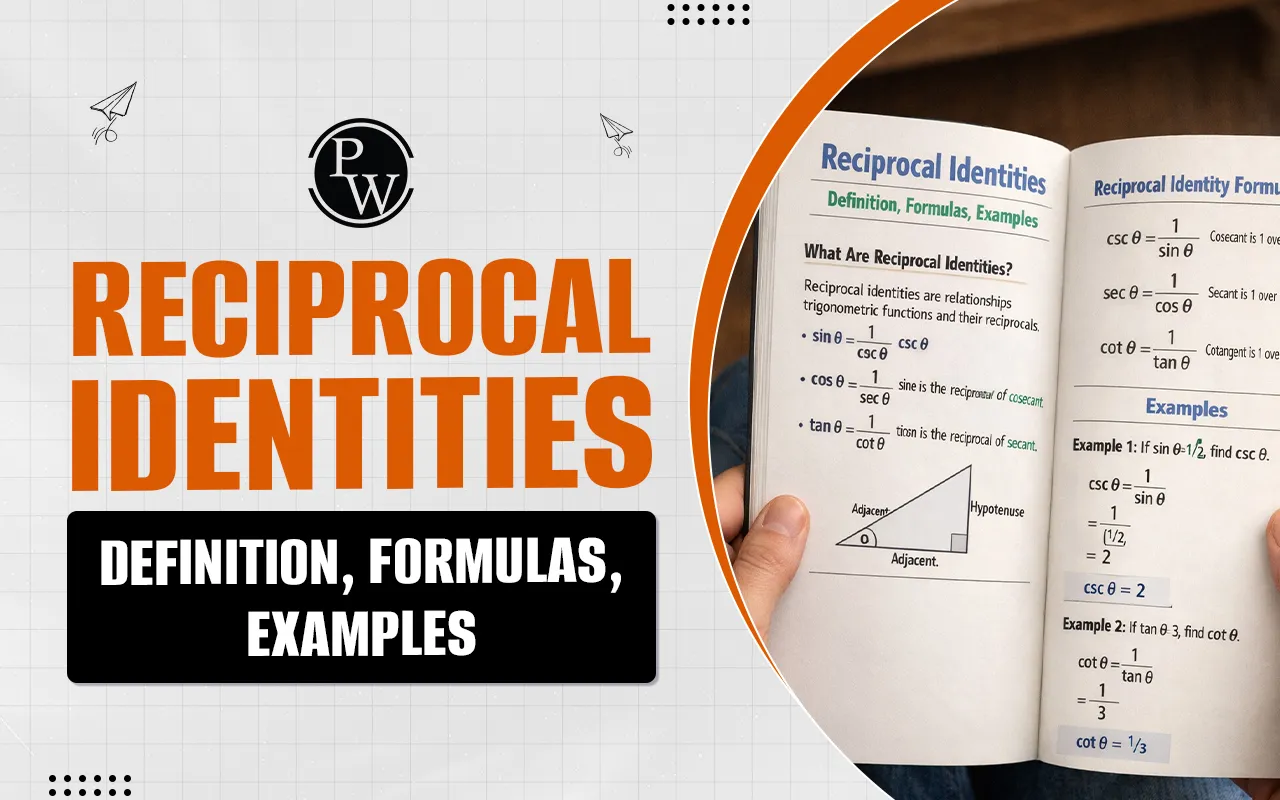
Reciprocal Identities - Definition, Formulas, Examples
 Nikita Aggarwal8 Apr, 2026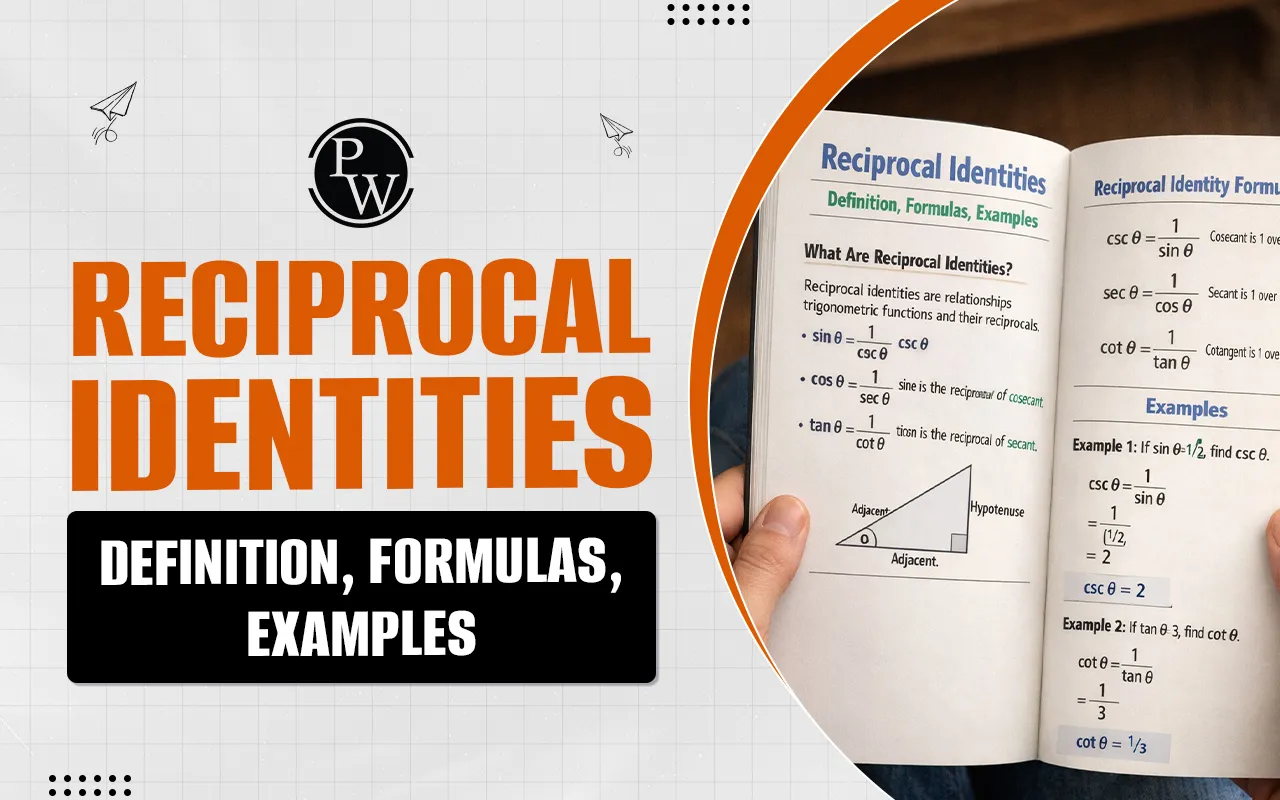
What are Reciprocal Identities?
In maths, a reciprocal identities definition is what you get when you divide 1 by a number. For example, the reciprocal of 2 is 1 divided by 2. When we use this idea in trigonometry, we obtain the identities. These are equations that say one trigonometry function is the same as another function's reciprocal.
Think of it like this: when you multiply a trigonometry function by its reciprocal, you always obtain 1. These identities aren't made-up rules. They are the trigonometric ratios of the sides of a triangle with one angle. The opposite side, the adjacent side, and the hypotenuse. The reciprocal identities are based on the idea that two functions multiplied together equal 1.
Reciprocal Identities Formulas
To solve problems efficiently, you need to have the reciprocal identities formulas memorised. There are six primary ratios in trigonometry, and they exist in three specific pairs.
1. Cosecant and Sine
The cosecant function (cosec) is the reciprocal of the sine function (sin).
-
Cosec θ = 1 / Sin θ
-
Sin θ = 1 / Cosec θ
-
Sin θ × Cosec θ = 1
2. Secant and Cosine
The secant function (sec) is the reciprocal of the cosine function (cos).
-
Sec θ = 1 / Cos θ
-
Cos θ = 1 / Sec θ
-
Cos θ × Sec θ = 1
3. Cotangent and Tangent
The cotangent function (cot) is the reciprocal of the tangent function (tan).
-
Cot θ = 1 / Tan θ
-
Tan θ = 1 / Cot θ
-
Tan θ × Cot θ = 1
Reciprocal Identities in Maths
Understanding reciprocal identities in maths is really not that challenging when you consider the sides of a right-angled triangle. We have a triangle with an angle θ. This triangle has the opposite side, the adjacent side, and a hypotenuse. When we look at identities in mathematics, it is helpful to consider the opposite side, the adjacent side, and the hypotenuse of this triangle. Reciprocal identities in math are fairly simple once you get to know the side, the adjacent side, and the hypotenuse of the right-angled triangle.
-
Sine (sin) is O/H. Its reciprocal, cosecant (cosec), is H/O.
-
Cosine (cos) is A/H. Its reciprocal, Secant (Sec), is H/A.
-
Tangent (tan) is O/A. Its reciprocal, Cotangent (Cot), is A/O.
Read More - Half Angle Formula with Examples
Reciprocal Identities uses
Using this identity effectively requires recognising when an expression can be simplified. In most cases, you will want to convert "complex" functions like cosec, sec, or cot back into sin, cos, and tan. This makes it much easier to use a standard calculator or apply the Pythagorean theorem.
Steps to simplify expressions:
-
Identify any reciprocal functions (cosec, sec, cot) in the equation.
-
Replace them with their 1/x equivalents using the reciprocal identities formulas.
-
Cancel terms where possible (e.g., if you see Sin multiplied by 1/Sin).
-
Solve the remaining simplified equation.
Reciprocal Identities Examples
Let’s look at a few reciprocal identities examples to see how these rules work in practice.
Example 1: Finding Cosecant
If the value of Sin θ is 3/5, determine the value of Cosec θ.
-
We know that cosec θ = 1 / sin θ.
-
Substitute the value: cosec θ = 1/(3/5).
-
When you divide by a fraction, you multiply by its reciprocal.
-
Result: Cosec θ = 5/3.
Example 2: Simplifying an Expression
Simplify the expression: cos θ × sec θ.
-
From our identity list, we know Sec θ = 1 / Cos θ.
-
The expression becomes cos θ × (1 / cos θ).
-
The cos(θ) terms cancel each other out.
-
Result: 1.
Example 3: Using Tangent and Cotangent
If Tan θ = 1, find Cot θ.
-
Cot θ = 1 / Tan θ.
-
Cot θ = 1 / 1.
-
Result: 1.
Read More - Function Formulas – List of Key Function Formulas
Things not to do in Reciprocal Identities
Even though the concept is simple, many students make mistakes in the heat of an exam.
-
Mixing up Sec and Cosec: A common error is thinking Secant goes with Sine because they both start with "S". Remember: sine goes with cosecant, and cosine goes with secant. They pair with their opposite starting letter.
-
Forgetting the Square: If you have sinθ = 1 / cosecθ so sin²θ = 1 / cosec²θ . The reciprocal relationship still holds even when the functions are squared or cubed.
-
Confusing Inverse with Reciprocal: Reciprocal identities (1/x) are not the same as inverse trigonometric functions (like arcsin). Inverse functions determine the angle, while reciprocal identities identify the ratio.
Trigonometric Pairs in Reciprocal Identities
|
Primary Function |
Reciprocal Function |
Ratio Identity |
|
Sine (Sin) |
Cosecant (Cosec) |
1 / Sin θ |
|
Cosine (Cos) |
Secant (Sec) |
1 / Cos θ |
|
Tangent (Tan) |
Cotangent (Cot) |
1 / Tan θ |
Make Maths Easy and Enjoyable with CuriousJr
CuriousJr helps children build a strong foundation in maths by removing fear and boosting confidence. Our Mental Maths online classes for students from Classes 1 to 8 are designed to improve speed, accuracy, and logical thinking through simple techniques and interactive learning methods.
With our dual-mentor approach, students join engaging live sessions and get dedicated support to clear doubts after every class. Animated lessons, fun activities, and exciting challenges make maths easy to grasp and enjoyable to learn.
Parents stay informed with regular progress updates and review sessions, ensuring full transparency in their child’s learning journey.
Book a demo class today and discover how CuriousJr makes maths simple, engaging, and confidence-building for your child.
Reciprocal Identities FAQs
Is there a trick for remembering the reciprocal identity formulas?
How do examples of reciprocal identities help in real life?
Can I use the reciprocal identities definition for any angle?
What is the difference between reciprocal and quotient identities?








 Live & recorded classes available at easeDashboard for progress trackingMillions of practice questions at your fingertips

