







Top 10 Most Repeated Topics in Physics for JEE Mains

Top 10 Most Repeated Topics in Physics for JEE Mains: Preparing for JEE Main Physics often feels overwhelming due to its vast syllabus and conceptual depth. However, a strategic approach can make a significant difference. Instead of studying everything with equal intensity, focusing on important physics topics for JEE Main 2026 helps optimize time and improve accuracy.
Over the years, JEE Main has shown a clear pattern—certain topics and concepts are repeatedly asked. By identifying the Top 10 Most Repeated Topics in Physics for JEE Mains and high-frequency areas, students can prioritize their preparation and improve performance.
Top 10 Most Repeated Topics in Physics for JEE Mains
Physics combines theoretical concepts with numerical problems in the JEE Main exam. Understanding which topics appear most frequently helps students allocate their study time wisely. Analyzing past question papers reveals patterns in repeated physics questions in JEE Mains. This approach ensures you spend effort on the most impactful areas, leading to better results for JEE Main 2026.
Most Repeated Physics Topics for JEE Main 2026
Our experts analyzed JEE Main question papers from the last 10 years to identify the most asked physics questions JEE Main. This analysis provides valuable data on important physics topics for JEE Main 2026. Prioritizing these topics can significantly improve your performance. Avoid skipping these frequently asked physics concepts JEE to gain an advantage.
|
Topic Name |
Number of Questions
|
|---|---|
|
Projectile Motion |
43 |
|
Hooke’s Law |
39 |
|
Kinetic Energy |
37 |
|
Adiabatic Process |
34 |
|
Newton’s Second and Third Laws |
34 |
|
Ray Optics |
32 |
|
Electrostatics |
29 |
|
Elasticity |
27 |
|
Electric Charges and Field |
25 |
|
Rotational Motion |
23 |
Projectile Motion has been the most repeated topic, appearing 43 times. Rotational Motion also consistently features in the exams.
Understanding Most Asked Physics Questions in JEE Main
To perform well, students must go beyond theory and understand the nature of questions asked in exams.
Example-Based Learning
1. Projectile Motion Concept
At the highest point of a projectile, the vertical velocity becomes zero. As a result, the rate of change of speed also becomes zero. This type of conceptual question is frequently asked.
2. Elasticity / Hooke’s Law
Questions often test proportional relationships like extension depending on length and cross-sectional area. These are formula-based but require conceptual clarity.
3. Kinetic Energy in Thermodynamics
Problems may involve equating kinetic energy expressions from different systems (like gas molecules and electrons). These require combining formulas logically.
Key Takeaway
-
Questions are concept-driven, not memory-based
-
Numerical application is equally important
-
Interlinking topics is common
This is why practicing most asked physics questions JEE Main is essential.
High Weightage Physics Chapters JEE Mains
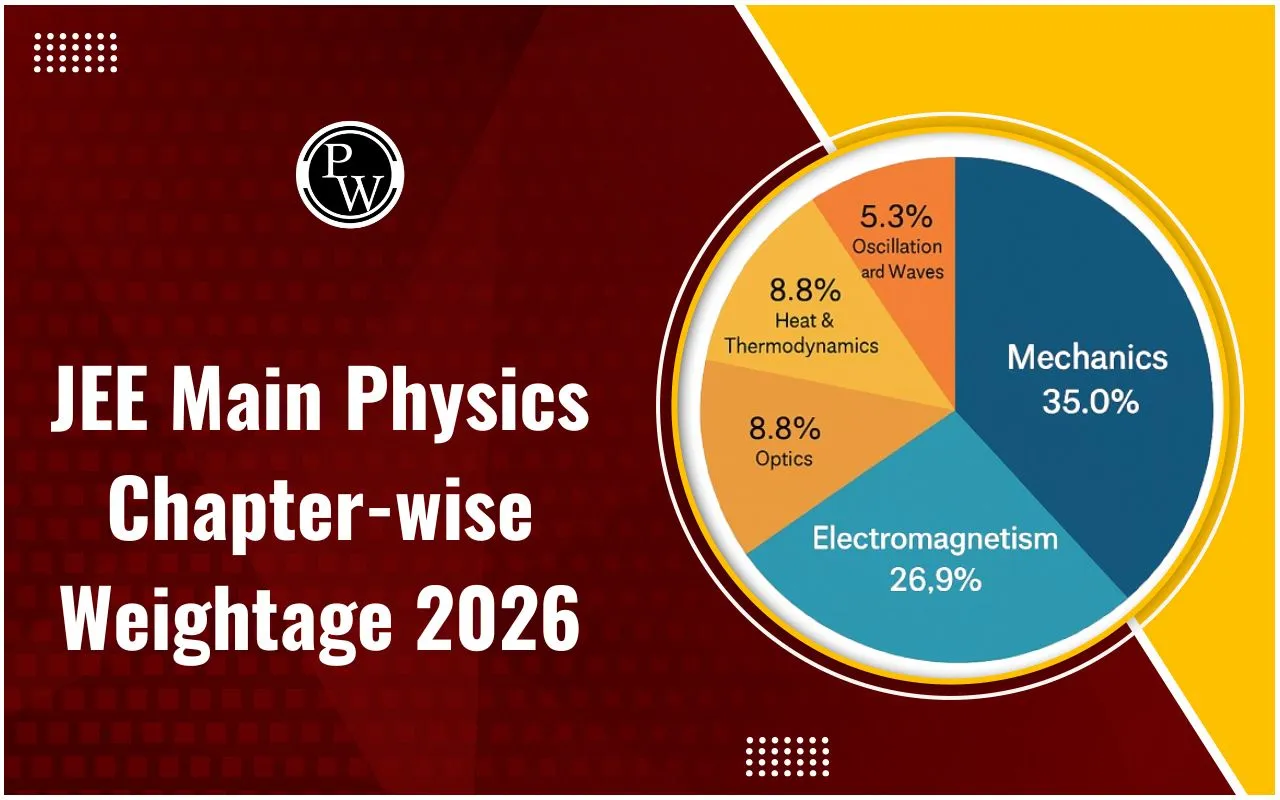
Apart from individual topics, entire chapters contribute significantly to the exam. Understanding JEE Main physics chapter wise weightage helps in long-term planning.
|
Chapter |
Number of Questions
|
|---|---|
|
Optics |
211 |
|
Electrostatics |
205 |
|
Properties of Solids and Liquids |
184 |
|
Current Electricity |
180 |
|
Electromagnetic Induction and Alternating Currents |
164 |
|
Oscillations and Waves |
162 |
|
Kinematics |
156 |
|
Magnetic Effects of Current and Magnetism |
155 |
|
Atoms and Nuclei |
146 |
|
Rotational Motion |
128 |
Optics and Electrostatics are consistently among the highest-weightage chapters. While focusing on these physics important topics list JEE 2026 helps, comprehensive coverage of the syllabus is always the best approach for securing a top rank.
Physics Important Topics List for JEE 2026
To simplify your preparation, here’s a structured physics important topics list JEE 2026 based on frequency and weightage.
Mechanics
-
Kinematics
-
Laws of Motion
-
Work, Energy & Power
-
Rotational Motion
Thermodynamics
-
Kinetic Theory of Gases
-
Thermodynamic Processes (especially adiabatic)
Electrodynamics
-
Electrostatics
-
Current Electricity
-
Magnetic Effects
Optics & Modern Physics
-
Ray Optics
-
Wave Optics
-
Atoms & Nuclei
This list covers the best physics topics to revise for JEE, ensuring balanced preparation.
Physics Preparation Strategy for JEE Main 2026
A good strategy is vital for preparing for Physics. Follow these steps for an effective first.
- NCERT First: Start with NCERT textbooks, then move to reference books. physics preparation strategy JEE Main 2026:
-
Focus on Concepts: Build a strong understanding of fundamental concepts
-
Practice Previous Year Questions: Solve questions from past papers to understand exam patterns and difficulty.
-
Regular Numerical Practice: Physics needs consistent practice of numerical problems.
Top 10 Most Repeated Topics in Physics for JEE Mains FAQs
Q1: How are the most important Physics topics determined for JEE Main?
Q2: Should I only study the Top 10 Physics topics for JEE Main?
Q3: Which Physics chapters have the highest weightage in JEE Main?
Q3: Which Physics chapters have the highest weightage in JEE Main?
Q4: Can NCERT books cover these important Physics topics sufficiently?





 Live & recorded classes available at easeDashboard for progress trackingMillions of practice questions at your fingertips

