Concentric Circles - Definition, Formula, Examples
 Nikita Aggarwal23 Apr, 2026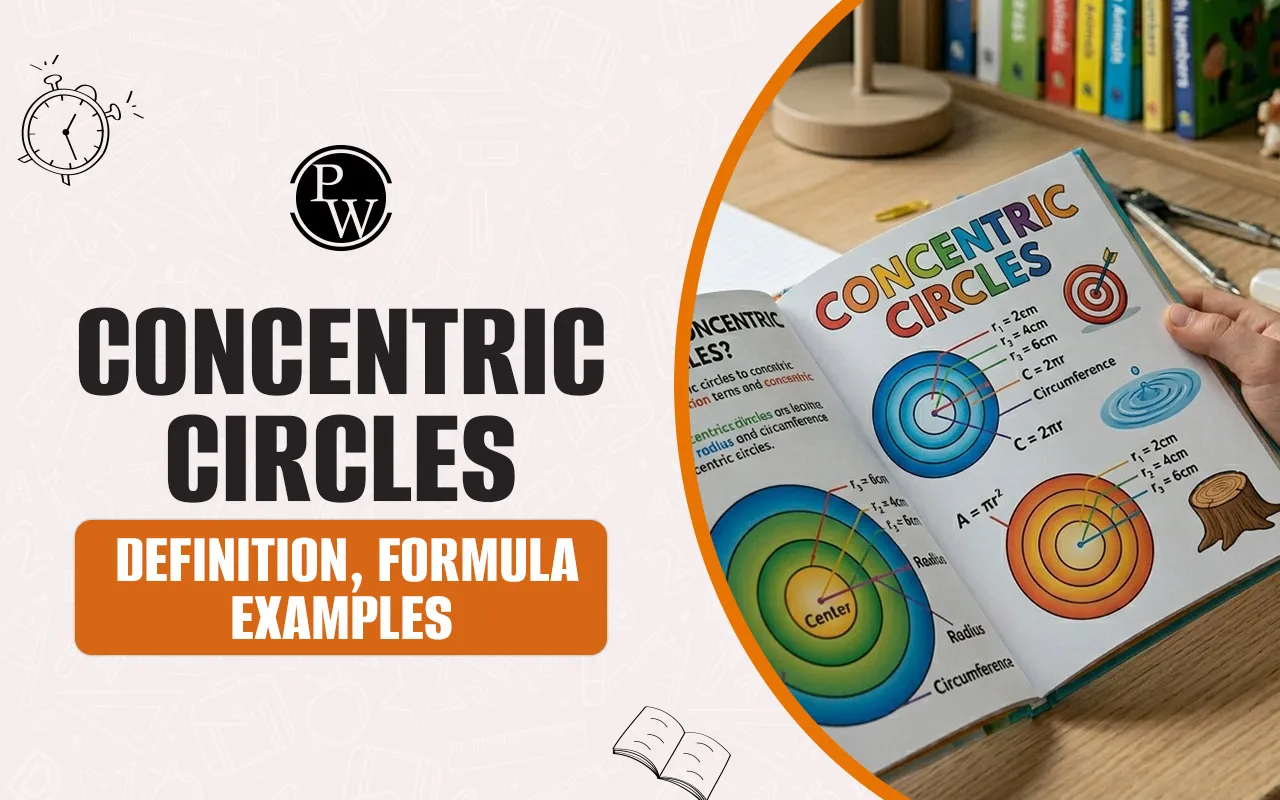
What are Concentric Circles in Maths?
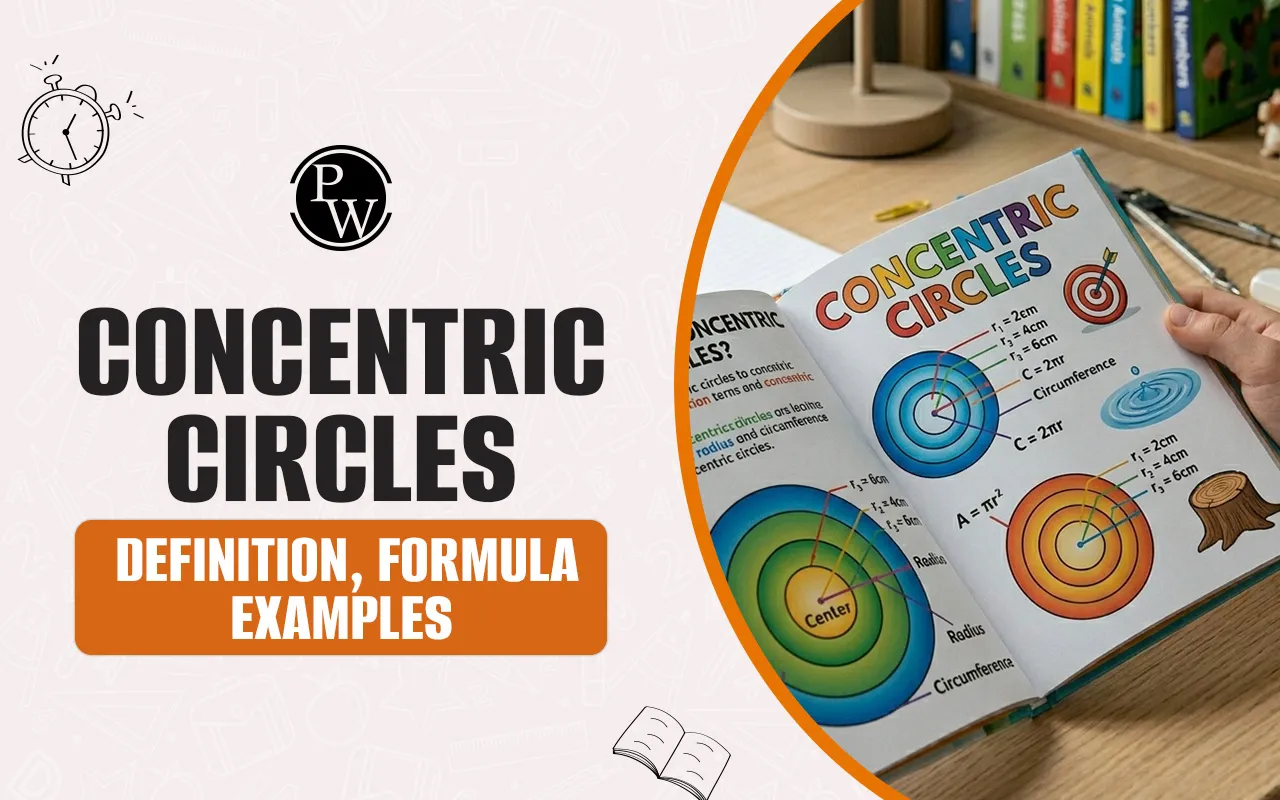
Concentric circles definition says that they are a group of circles with the same centre point. Even though they all have this central "anchor," they don’t intersect or overlap since each circle has a distinct radius.
Imagine placing a compass on a piece of paper. You draw a small circle with a radius of 2 cm. You make another circle by extending the pencil to 5 cm without altering the sharp point of the compass. You made a pair of circles with a common centre since the "point" stayed in the same place.
Key Characteristics
-
Shared Centre: The centre of each circle in the set is at the same point.
-
Different Radii: Each circle must have a different radius; otherwise, they would be the same circle.
-
No Intersections: These circles will never cross or touch each other because they have different sizes yet share a centre.
Concentric Circles Examples
Understanding this concept becomes much easier when you look at the world around you. It's not just in books; geometry is also in nature and engineering.
-
Tree Rings: When a tree trunk is cut horizontally, the growth rings are circular layers with the same centre. Each ring represents a year of growth, sharing the same central core.
-
Archery Targets: A typical sports target has many coloured rings of the same size.
-
Water Ripples: When anything disturbs the water, the kinetic energy creates waves that flow out in perfect circles.
-
Car Tyres: The metal rim and the rubber edge on the outside of a tyre make circular rings around a common centre.
-
Onion Layers: When you cut an onion in half, the layers inside reveal this geometric phenomenon naturally.
Let's look at some real-world problems to show how the formulas function.
Read More - Diameter of a Circle Definition, Formulas, and Steps
Example 1: Finding the Shaded Area
The radius of a round park is 10 meters. There is a jogging track around the periphery of the park, which makes the whole radius from the centre 12 meters. How big is the jogging track? (Use 3.14 for π)
Solution:
-
Outer radius (R) = 12 m
-
Inner radius (r) = 10 m
-
Area = π(R^2 - r^2)
-
Area = 3.14 × (12^2 - 10^2)
-
Area = 3.14 × (144 - 100)
-
Area = 3.14 × 44
-
Area = 138.16 square metres.
Example 2: Working with Diameter
Find the breadth of the ring between two circles that share a centre and have diameters of 20 cm and 10 cm.
Solution:
-
Outer Radius (R) = 20 / 2 = 10 cm
-
Inner Radius (r) = 10 / 2 = 5 cm
-
Width of the ring = R - r
-
Width = 10 - 5 = 5 cm.
Concentric Circles in Coordinate Geometry
In the coordinate plane, we describe these circles using specific equations. If the centre of the circles is at the origin (0, 0), the equation for any circle is x^2 + y^2 = r^2. For circles with the same centre, the x and y parts of the equation remain identical, while the value of r (the radius) changes.
For example:
-
Circle A: x^2 + y^2 = 9 (Radius = 3)
-
Circle B: x^2 + y^2 = 16 (Radius = 4)
-
Circle C: x^2 + y^2 = 25 (Radius = 5)
All three of these represent circles with a common centre because their centres are consistently at (0, 0).
What is an Annulus in Concentric Circles?
The annulus is the ring-shaped region formed between two circles with a common centre. It represents the space that lies inside the larger circle but outside the smaller one.
This is the shaded area you usually see in geometry problems that have circular rings or layers. It's crucial to know what the annulus is because most real-world uses, such as tracks, rings, or borders, are based on this area instead of the whole circle.
Concentric Circles Formula
Finding the area of the shaded area between the inner and outer circles is the most usual thing to do with these forms. The annulus is the ring-shaped area. You need the area formula to figure this out.
Area of the Annulus
To get the area between two circles, you take the area of the larger circle and subtract the area of the smaller circle.
-
Let R be the radius of the outer (larger) circle.
-
Let r be the radius of the inner (smaller) circle.
-
The Area of the outer circle = πR^2
-
The Area of the inner circle = πr^2
The Formula:
Area of Annulus = π(R^2 - r^2)
Alternatively, you can write this as:
Area = π(R + r)(R - r)
Length of the Chord
Another thing about geometry is that a chord of the outer circle touches the inner circle. You can use the Pythagorean theorem to find the length of such a chord:
Length of Chord = 2 × Square Root of (R^2 - r^2)
Read More - Area of a Circle Definition, Formula, Examples, Real Life Application
How to Draw Circles with the Same Centre
It's easy to draw circles with a common centre if you follow these steps:
-
Put the compass needle firmly at a spot on the paper that won't move (this will be the centre).
-
Draw the first circle with a short radius.
-
Increase the compass's radius without altering the centre point.
-
Draw another circle around the first one.
You can simply make a lot of nested circles by keeping the centre the same and adjusting the radius.
Concentric Circles vs Other Circles
It is easy to confuse different types of circle pairings. The following table helps distinguish circles sharing a centre from other common geometric arrangements.
|
Feature |
Concentric |
Congruent |
Intersecting |
|
Centre Point |
Always the same |
Usually different |
Always different |
|
Radius Length |
Always different |
Always the same |
Can be same or different |
|
Intersection |
Never touch |
Can touch or be separate |
Cross at two points |
|
Visual Look |
A "Bullseye" or target |
Two identical circles |
A Venn diagram shape |
Practise Questions
-
Do two circles with the same radius become concentric?
-
Can circles with a common centre ever intersect each other?
-
If two circles have different centres, can they be concentric?
-
What happens to the annulus if the inner and outer radii are equal?
Theorems of Concentric Circles
There are specific geometric rules that only apply when circles share a centre.
-
Tangent Property: A chord of the larger circle that touches (is tangent to) the smaller circle is bisected at the point of contact. This means the point of touch is the exact midpoint of that chord.
-
Perpendicularity: The radius of the inner circle drawn to the point of tangency is always perpendicular to the chord of the outer circle.
Concentric Circles Key Concepts
Understanding this specific concept involves three main steps:
-
Identifying that the centre point is identical for all circles in the set.
-
Using the radii to determine the distance between the boundaries.
-
Applying the area formula π(R² − r²) to find the space within the annulus.
-
The distance between the circles is found using R − r.
-
The area of the annulus is calculated using the formula π(R² − r²)
These rules stay the same whether you're making a wheel, figuring out the area of a pipe's cross-section, or just doing your geometry homework. Because they are symmetrical, these shapes are some of the most stable and beautiful structures in both math and the real world.
Make Maths Simple and Fun with CuriousJr
CuriousJr helps children build a strong maths foundation by overcoming fear and boosting confidence. Our Mental Maths online classes for students from Classes 1 to 8 are designed to enhance speed, accuracy, and logical thinking through simple techniques and interactive learning methods.
With our dual-mentor approach, students join engaging live sessions and receive dedicated support to clear doubts after every class. Animated lessons, fun activities, and exciting challenges make maths learning more engaging and enjoyable.
Parents are regularly updated with progress reports and review sessions, ensuring complete transparency in their child’s learning journey.
Book a demo class today and discover how CuriousJr makes maths simple, engaging, and confidence-building for your child.
Concentric Circles FAQs
Can circles that share a common centre ever touch or cross each other?
How do I use the formula for area?
How do you find the width of the ring between two circles?





 Live & recorded classes available at easeDashboard for progress trackingMillions of practice questions at your fingertips