






Incenter of a Triangle - Definition, Properties, Examples
 Nikita Aggarwal23 Apr, 2026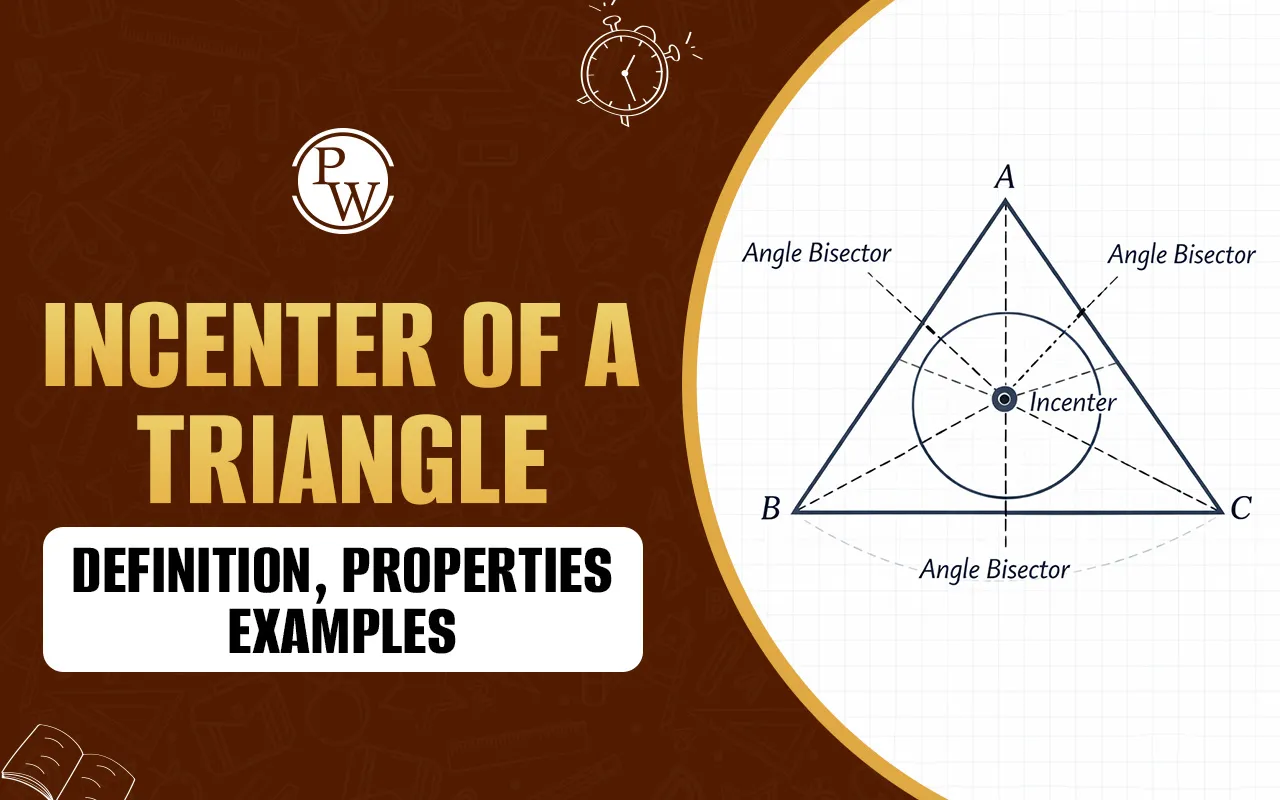
Incenter of a Triangle Definition
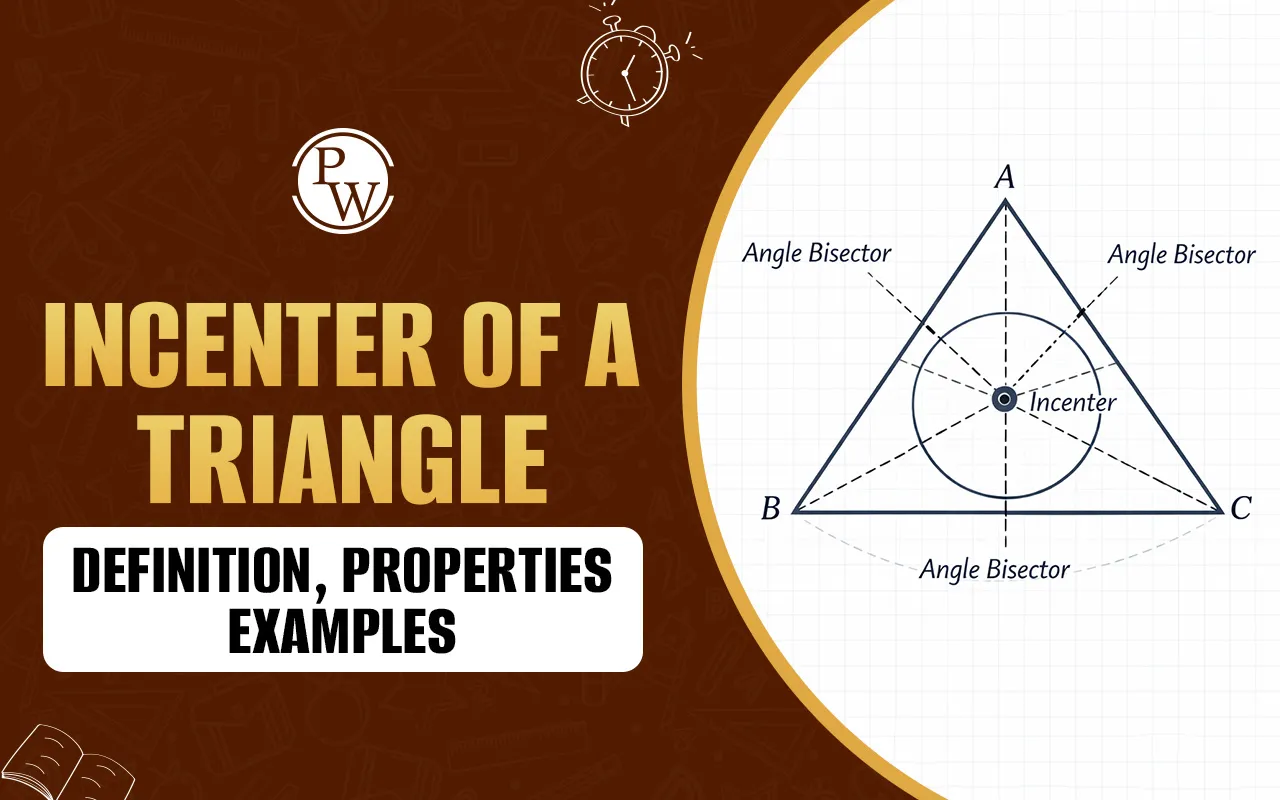
There are several "centres" in geometry, but the incenter is different because of how it relates to the angles of a triangle. The incenter is where the angle bisectors of the triangle's inside angles meet.
To visualise this, imagine drawing a line that cuts Angle A exactly in half, another for Angle B, and a third for Angle C. These three lines will always meet at one specific point inside the triangle. This position is called the incenter.
The incenter is usually denoted by the letter “I” in geometric diagrams.
The definition can be simplified as the intersection point of the three internal angle bisectors.
The incenter is always inside the triangle, no matter what kind of triangle it is: acute, obtuse, or right-angled. The orthocenter and circumcenter might sometimes be outside the shape.
Incenter of a Triangle Properties
To solve difficult sums, it is important to know its properties. These are the most important traits:
-
Equidistance: The incenter is always the same distance from each of the three sides of the triangle. This is the distance of the inradius.
-
Interior LocationIt is always inside the triangle. In an obtuse triangle, the incenter stays inside, even when other centers would "fall out."
-
Angle Bisectors: It is the meeting point of the three internal angle bisectors.
-
Angle Calculations: The angle formed at the incenter by two sides is related to the opposite vertex angle. For instance, the angle BIC (where I is the incenter) is equal to 90 degrees + (Angle A/2).
-
Tangent Segment Property: The tangents drawn from each vertex to the incircle are equal in length. For example, if the incircle touches the sides at points D, E, and F, then the tangent segments from a vertex are equal (e.g., AE = AF, BD = BE, etc.).
-
Area Connection: The area of the triangle is equal to the inradius times the semi-perimeter (Area = rs).
Incenter of a Triangle Angle Formula
The angles that meet at the incenter have essential relationships:
-
Angle BIC equals 90° plus half of Angle A.
-
Angle BIC = 90° + (Angle A/2)
These formulas are very helpful for figuring out angles in geometry.
Incenter of a Triangle Formula in Coordinate Geometry
You can find the incenter by utilizing the coordinates of the vertices and the lengths of the opposite sides if you are working with coordinates in a Cartesian plane.
Let the vertices be (x1, y1), (x2, y2), and (x3, y3).
Let the lengths of the sides opposite these vertices be a, b, and c.
The coordinates of the Incenter (I) are:
x = (ax1 + bx2 + cx3) / (a + b + c)
y = (ay1 + by2 + cy3) / (a + b + c)
How to Construct the Incenter of a Triangle
If someone asks you to find the incenter with a compass and ruler, do these things:
-
To bisect angle A, put the compass on vertex A and draw an arc that goes across both sides that are next to it. Draw two arcs that cross each other inside the triangle from those spots. From point A, draw a line through the intersection.
-
Do the same thing for vertex B to bisect angle B.
-
Find the intersection: The incenter is the location where the bisectors from A and B meet.
-
Check: The line will go through point C if you bisect it.
-
Draw the Incircle: Use your compass to find the distance from this point to any side that is perpendicular to it.
Read More - Area of Triangle: Definition, Formula, Examples
Incircle and Inradius of an Incenter of a Triangle
The incenter is the middle point of the "incircle". This is the largest possible circle that can be drawn inside a triangle such that it touches (but does not cross) all three sides.
-
Incircle: The circle that fits within the triangle.
-
Inradius: The radius of this incircle, which is shown as "r," is called the inradius. The incenter is the point where the angle bisectors meet.
You may also find the inradius by utilizing the sides of the triangle, in addition to the area relation (Area = rs):
r = √[(s − a)(s − b)(s − c) / s] where s is the semi-perimeter and a, b, and c are the sides.
Incenter of a Triangle vs Other Triangle Centres
You may easily mix up the centers of different triangles. The table below shows the differences in a quick way.
|
Centre Type |
Formed by the Intersection of |
Location |
|
Incenter |
Internal Angle Bisectors |
Always inside the triangle |
|
Centroid |
Medians (lines to midpoints) |
Always inside the triangle |
|
Circumcenter |
Perpendicular Bisectors |
Inside, outside, or on the triangle |
|
Orthocenter |
Altitudes (perpendiculars) |
Inside, outside, or on the triangle |
Read More - Perimeter of a Triangle: Definition, Formulas, and Solved Examples
Incenter of a Triangle Examples
Let’s look at some examples to see how these theories work in practice.
Example 1: Finding the Angle at the Incenter
In a triangle ABC, the angle at vertex A is 60 degrees. Find the angle BIC, where I is the incenter.
Solution:
Using the property of the incenter:
Angle BIC = 90 + (Angle A / 2)
Angle BIC = 90 + (60 / 2)
Angle BIC = 90 + 30
Angle BIC = 120 degrees.
Example 2: Finding the Inradius
Suppose a triangle has sides of 3 cm, 4 cm, and 5 cm. What is the inradius of this triangle?
Solution:
-
Find the Area: This is a right-angled triangle. Area = (1/2) * base * height = (1/2) * 3 * 4 = 6 square cm.
-
Find the Semi-perimeter (s): s = (3 + 4 + 5) / 2 = 12 / 2 = 6 cm.
-
Use the Formula (Area = rs): 6 = r * 6
r = 1 cm.
Why the Incenter of a Triangle is Important
The incenter is commonly connected to the idea of "Inscribed Circles" in math competitions and Olympiads. Most of the time, the questions are about how to obtain the incenter's coordinates or how to use the inradius to find the area of the triangle.
The incenter is related to angle bisectors, thus it can help you comprehend the Angle Bisector Theorem. This theorem says that an angle bisector divides the opposing side into segments that are proportional to the other two sides.
Incenter of a Triangle in Maths Summary
These three formulas will help you do well in geometry:
-
Angle BIC = 90 + (Angle A/2) is the angle property.
-
The formula for the alternate angle is ∠AIB = 180 − (A + B)/2.
-
The inradius area property says that Area = rs, where s is the semi-perimeter.
-
The formula for the inradius is r = √[(s − a)(s − b)(s − c) / s].
-
The formula for coordinates is I = [(ax1+bx2+cx3)/(a+b+c), (ay1+by2+cy3)/(a+b+c)]
Make Maths Simple and Enjoyable with CuriousJr
CuriousJr helps children develop a strong foundation in maths by reducing fear and building confidence. Our Mental Maths online classes for students from Classes 1 to 8 focus on improving speed, accuracy, and logical thinking through easy techniques and interactive learning methods.
With our dual-mentor approach, students attend engaging live sessions and receive dedicated support for doubt clarification after every class. Animated lessons, fun activities, and exciting challenges make maths learning more engaging and enjoyable.
Parents are kept informed with regular progress reports and review sessions, ensuring complete transparency in their child’s learning journey.
Book a demo class today and discover how CuriousJr makes maths simple, engaging, and confidence-building for your child.
Incenter of a Triangle FAQs
What is incenter of a triangle in simple terms?
Can the incenter lie outside the triangle?
How do you find the incenter in coordinate geometry?
What is the relationship between the incenter and the sides of the triangle?











 Live & recorded classes available at easeDashboard for progress trackingMillions of practice questions at your fingertips

