






NVM – Full Form, Uses, Examples
 Nikita Aggarwal29 May, 2026
What is NVM and its Full Form?
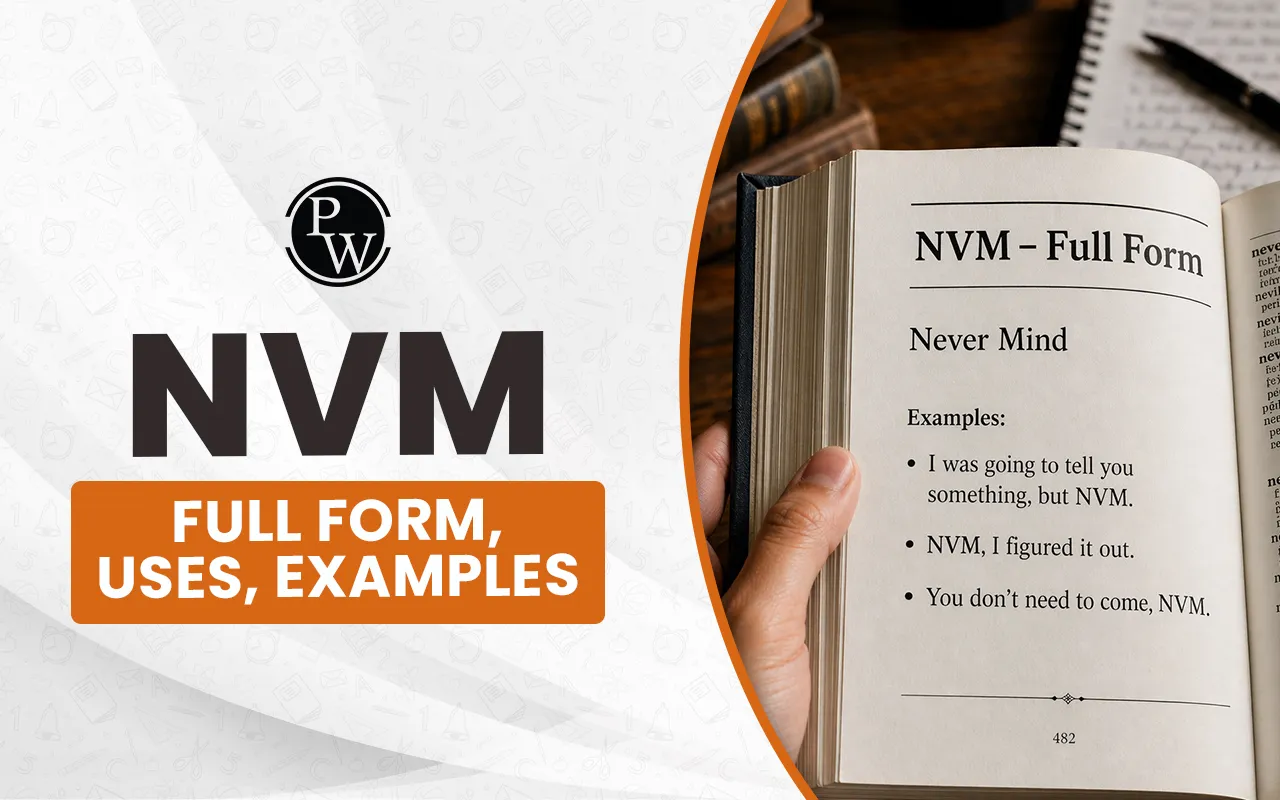
When someone asks what nvm is, they are usually looking for its meaning, full form, and origin all in one go. Essentially, NVM stands for "Never Mind".
This term serves as a verbal eraser, allowing the sender to retract a statement or indicate that a topic is no longer worth discussing.
Whether you found your lost keys or realised you messaged the wrong person, this acronym handles the situation with just three letters.
The origin of the term dates back to the early days of Internet Relay Chat (IRC) and SMS messaging. During that era, character limits were strict, and typing on numeric keypads was slow.
Users needed a way to quickly say "ignore that", and thus the term became widely used for saving time and keystrokes. Today, it remains one of the most frequently used acronyms across all digital platforms.
NVM Uses in Daily Conversation
Knowing the full form is just the start; you also need to know where it fits. Most nvm use is found in informal settings. It is rarely appropriate for formal business reports or academic essays.
1. Correcting an Instant Mistake
This is the most common way people use the acronym. If you send a message to the wrong person or ask for the time just after you saw a clock, you might follow up with "NVM".
2. Dropping a Topic
Sometimes, explaining something becomes too complicated. If the person you are chatting with isn't understanding your point, you might use 'nvm' in English to stop the conversation gracefully. It means, "Let’s just move on."
3. When a Request is No Longer Needed
If you ask a friend to pick up milk on their way home but then realise you already have some in the fridge, you will text, "Hey, can you get it?" Oh, wait, I see some. Nvm!"
Examples of NVM
To see how "nvm" stands for "Never Mind" in real life, look at these scenarios:
-
Scenario A (The Quick Find):
-
User 1: "Do you know where the TV remote is?"
-
User 2: "nvm, I found it under the cushion."
-
Scenario B (The Change of Heart):
-
User 1: "Do you want to go to the park?"
-
User 2: "It might rain later."
-
User 1: "Good point, nvm then."
-
Scenario C (The Accidental Text):
-
User 1: "Can you send me the homework?"
-
User 2: "Wait, wrong person! nvm."
Read More - AM PM Full Form, Meaning, Difference & Time Explained
NVM in Formal and Informal English
One of the most important aspects of nvm in English is knowing when to use it. Language changes based on your audience, and "Never Mind" is no exception.
NVM in Informal English
In casual settings, nvm is the king of convenience. You will see it constantly in:
-
Instant Messaging: WhatsApp, Snapchat, and iMessage.
-
Gaming: Quick chat commands during fast-paced matches.
-
Social Media: Comments on Instagram, TikTok, or X (Twitter).
In these contexts, using the full form is considered efficient and friendly. It shows you are comfortable with the person you are talking to.
Read More - List of Three Letter Words in English
NVM in Formal English
In professional or formal environments, using the acronym 'nvm' is generally discouraged. It can come across as lazy or even dismissive to a boss, teacher, or client. Instead of the acronym, you should use the full phrase or a professional alternative:
-
Professional Alternative 1: "Please disregard my prior message."
-
Professional Alternative 2: "I have resolved the issue, so no further action is needed."
-
Professional Alternative 3: "Kindly ignore my last request."
NVM at a Glance
|
Feature |
Description |
|
Primary Meaning |
Never mind. |
|
Tone |
Casual / Informal |
|
Common Platforms |
WhatsApp, Discord, Gaming Chats, iMessage |
|
Alternative |
"Forget it" or "Don't worry about it." |
Writing Rules for NVM
To use the term 'nvm' correctly without seeming confused, there are simple writing rules for 'nvm' that you should follow. The thing about internet slang is that it is pretty flexible. These rules help people understand what nvm means.
-
Case Sensitivity: You can write 'NVM' in capital letters or small letters. Small letters are what people usually use when they are talking to friends. If you want to really get your point across or fix something, you can use big letters, for NVM.
-
Avoid Punctuation: You do not need to put periods between the letters (like N.V.M.). The simple three-letter string is the accepted format in digital spaces.
-
Placement: It is best used as a standalone message or at the very end of a sentence. For example: "Are you coming tonight? Nvm, I see you're busy."
-
Sentence Structure: Since it is a contraction of a verb phrase, it acts as a sentence most of the time. You don't need to add a subject before it.
Boost Your Child’s Spoken English Confidence with CuriousJr
Does your child feel shy while speaking English or struggle to form sentences? This can affect their confidence, participation in class, and overall communication skills. CuriousJr’s online English classes are designed to make learning easy, engaging, and effective.
The program covers key areas such as grammar, pronunciation, vocabulary, and basic writing. Through interactive live sessions, children get plenty of opportunities to practice speaking under the guidance of experienced mentors. Activities like games, storytelling, and writing tasks make the learning process fun and impactful.
Parents receive regular progress updates to stay informed about their child’s improvement. With well-structured levels suited to different learning paces, CuriousJr supports children in building a strong foundation in English step by step.
Book a demo class today and help your child grow into a confident English speaker.
NVM Full Form FAQs
What is the NVM full form in texting?
Is 'nvm' rude to use?
Can I use nvm in a professional email?
What are some 'nvm' examples in a sentence?














 Live & recorded classes available at easeDashboard for progress trackingMillions of practice questions at your fingertips

