






Central Angle - Definition, Properties, Formula, Examples
 Nikita Aggarwal6 May, 2026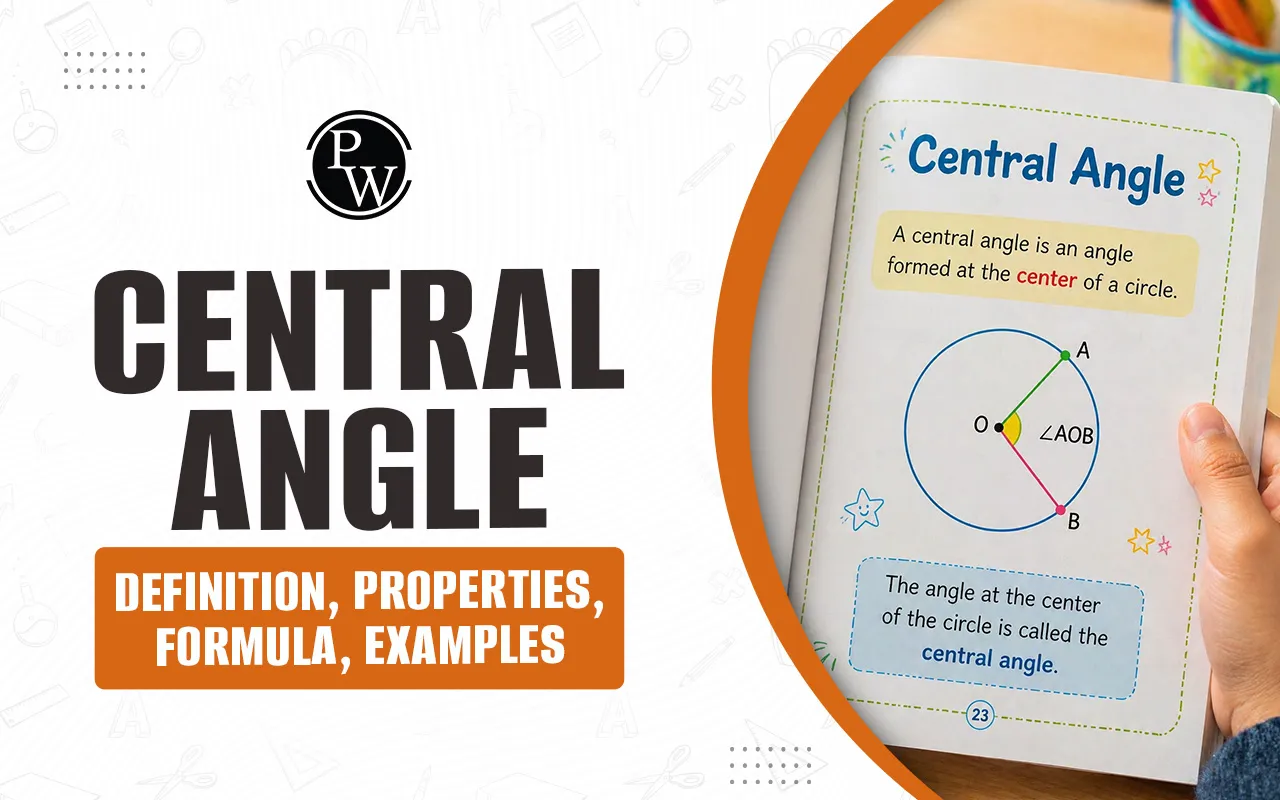
What is Central Angle?
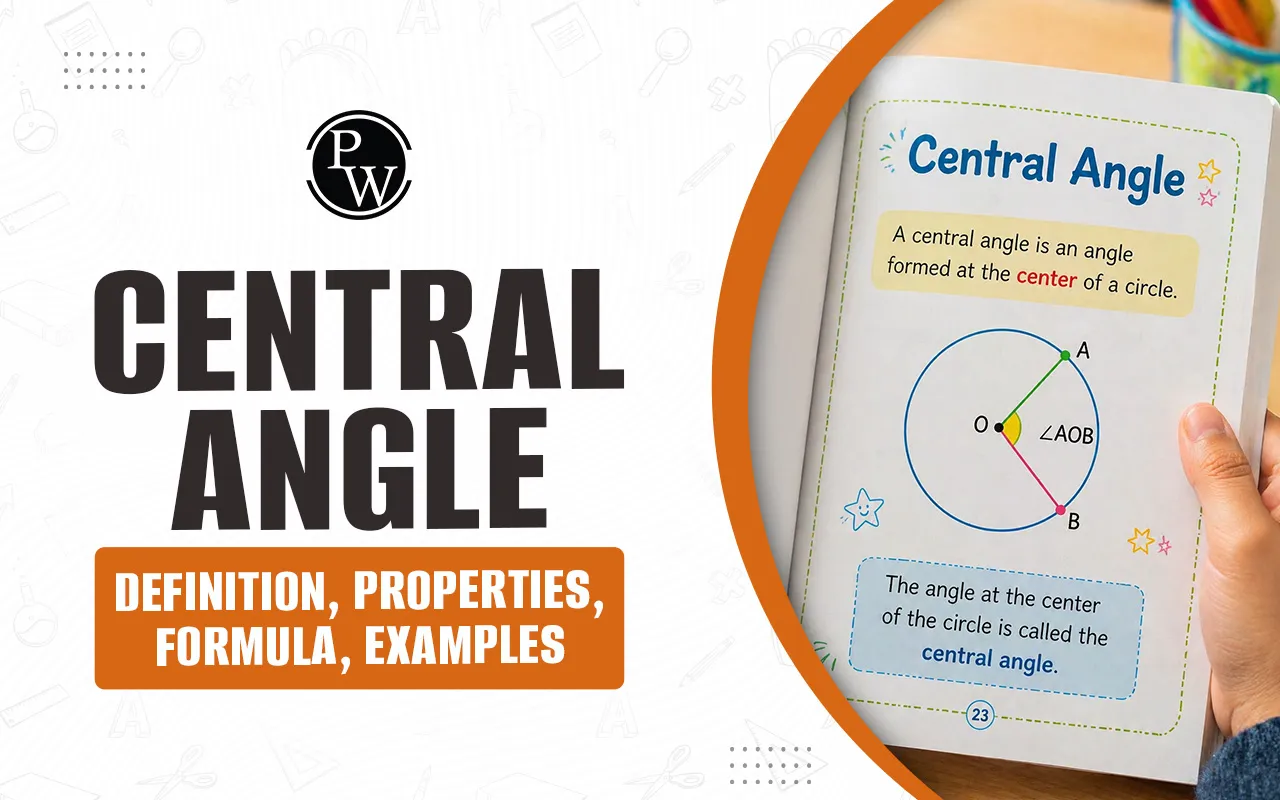
In the study of central angle in maths, the definition is quite straightforward. A central angle is an angle whose vertex is the exact centre point of a circle, and whose sides (legs) are two radii that extend to the circle's circumference.
Think of a clock face. If the hour hand is at 12 and the minute hand is at 3, the point where they meet in the middle is the vertex. The space between these two hands creates a central angle. The part of the circle's edge that lies between the two radii is called the intercepted arc.
Key components of this setup include:
-
The Vertex: Always located at the centre point of the circle (usually denoted as 'O').
-
The Arms: Two radii connecting the centre to any two points on the boundary.
-
The Intercepted Arc: The portion of the circumference carved out by the angle.
Central Angle Formula
Calculating the size of a central angle depends on the information you already have. There are two primary ways to determine its value: using the arc length or using the area of the sector.
Using Arc Length
If you know the length of the arc and the radius of the circle, you can find the angle in radians or degrees. The basic relationship is:
Arc Length = Radius × Central Angle (in radians)
To find the angle specifically:
-
Central Angle (Radians) = Arc Length / Radius
-
Central Angle (Degrees) = (Arc Length × 360) / (2 × π × Radius)
Using Sector Area
A sector is the "pie slice" created by the central angle. If you have the area of this slice:
-
Central Angle = (Sector Area × 360) / (π × Radius squared)
By applying the correct central angle formula, you can solve most geometry problems involving circular motion or circular segments.
Central Angle Properties
To master this topic, you must understand the rules that govern how these angles behave. Here are the essential central angle properties:
-
Arc Equality: The measure of a central angle is exactly equal to the measure of its intercepted minor arc in degrees. If the arc is 70 degrees, the angle at the centre is 70 degrees.
-
Sum of Angles: The sum of all non-overlapping central angles in a single circle is always 360 degrees.
-
Relationship with Inscribed Angles: A central angle is always twice the size of an inscribed angle that subtends the same arc. For instance, if an inscribed angle touching the edge of the circle is 30 degrees, the central angle for that same arc will be 60 degrees.
-
Congruent Arcs: In the same circle (or congruent circles), if two central angles are equal, the arcs they intercept are also equal in length.
-
Diameter Influence: If the central angle is 180 degrees, the radii form a straight line, which is the diameter of the circle, and the intercepted arc is a semicircle.
Difference Between Inscribed and Central Angles
It is easy to confuse a central angle with an inscribed angle. The main distinction lies in the location of the vertex.
-
In a central angle, the vertex is at the centre.
-
In an inscribed angle, the vertex is on the boundary (circumference) of the circle.
While both involve arcs and radii/chords, the central angle provides a direct 1:1 measurement of the arc, whereas the inscribed angle is always half that value.
Steps to Calculate Central Angle
When faced with central angle examples in a textbook, follow these logical steps to find the solution:
-
Identify the Givens: Determine if the problem provides the radius, arc length, or sector area.
-
Check the Units: Ensure the radius and arc length are in the same units (cm, m, inches).
-
Select the Formula: Use the arc length formula for linear distances or the sector area formula for surface measurements.
-
Perform the Calculation: Plug the numbers into the central angle formula.
-
Final Unit Check: Decide if the answer needs to be in degrees or radians. (To convert radians to degrees, multiply by 180 divided by π).
Read More - Angles in Maths: Definition, Parts, Types, Measurement and Construction
Central Angle Examples
Let’s look at some practical central angle examples to see these formulas in action.
Example 1: Finding Angle from Arc Length
Suppose a circle has a radius of 10 cm and an arc length of 5 cm. What is the central angle?
-
Using the formula: Angle (radians) = 5 / 10.
-
The result is 0.5 radians.
-
To get degrees: 0.5 × (180 / 3.14) = approximately 28.6 degrees.
Example 2: Finding Angle from Sector Area
If a pizza with a radius of 6 inches has a slice (sector) with an area of 18 square inches, what is the angle of that slice?
-
Using the area formula: Angle = (18 × 360) / (3.14 × 6 × 6).
-
Angle = 6480 / 113.04.
-
The result is approximately 57.3 degrees.
Read More - Acute Angle: Meaning, Definition, Degree, Formula & Examples
Importance of Central Angles
The concept of the central angle isn't just for classrooms. It is used daily in various fields:
-
Architecture: Designing circular windows, domes, and arches.
-
Navigation: Calculating distances between coordinates on a globe (which is a sphere).
-
Engineering: Designing gears, wheels, and mechanical parts that rotate.
-
Data Science: Creating pie charts to represent percentages accurately.
Understanding what is central angle logic allows professionals to divide circular spaces with mathematical precision.
Make Maths Easy and Fun with CuriousJr
CuriousJr helps children develop a strong foundation in mathematics by removing fear and building confidence. Our online Mental Maths classes for students from Classes 1 to 8 are designed to enhance speed, accuracy, and logical thinking through simple techniques and engaging learning methods.
With a dual-mentor approach, students participate in interactive live sessions and receive personalized support to clear their doubts after each class. Animated lessons, fun activities, and exciting challenges make learning maths both enjoyable and effective.
Parents receive regular progress updates and take part in review sessions, ensuring complete visibility into their child’s progress.
Book a demo class today and discover how CuriousJr makes maths simple, engaging, and confidence-boosting for your child.
Central Angle FAQs
What is central angle in a circle?
What is the central angle formula using arc length?
What are the main central angle properties?
How do you find the central angle in maths if the area is known?










 Live & recorded classes available at easeDashboard for progress trackingMillions of practice questions at your fingertips

