Diagonal of Cube - Definition, Formula, Examples
 Nikita Aggarwal6 May, 2026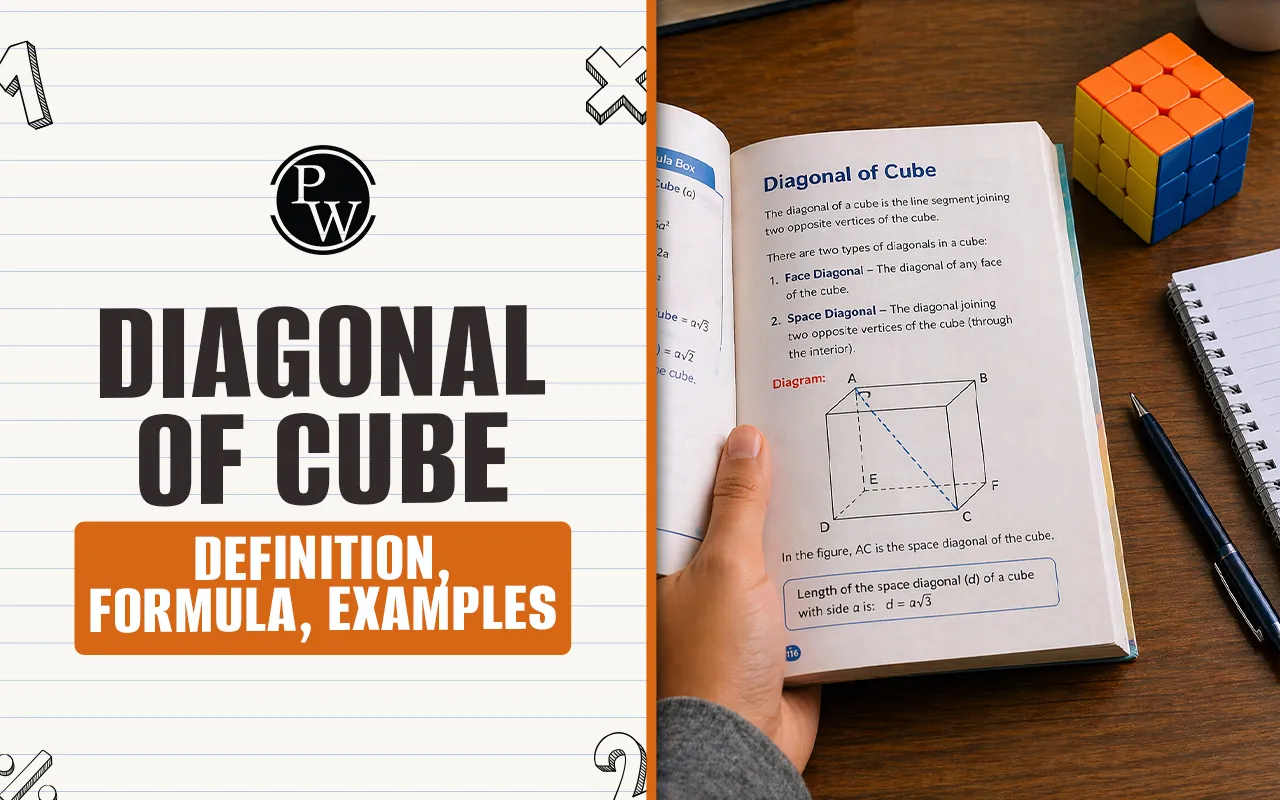
What is Diagonal of Cube?
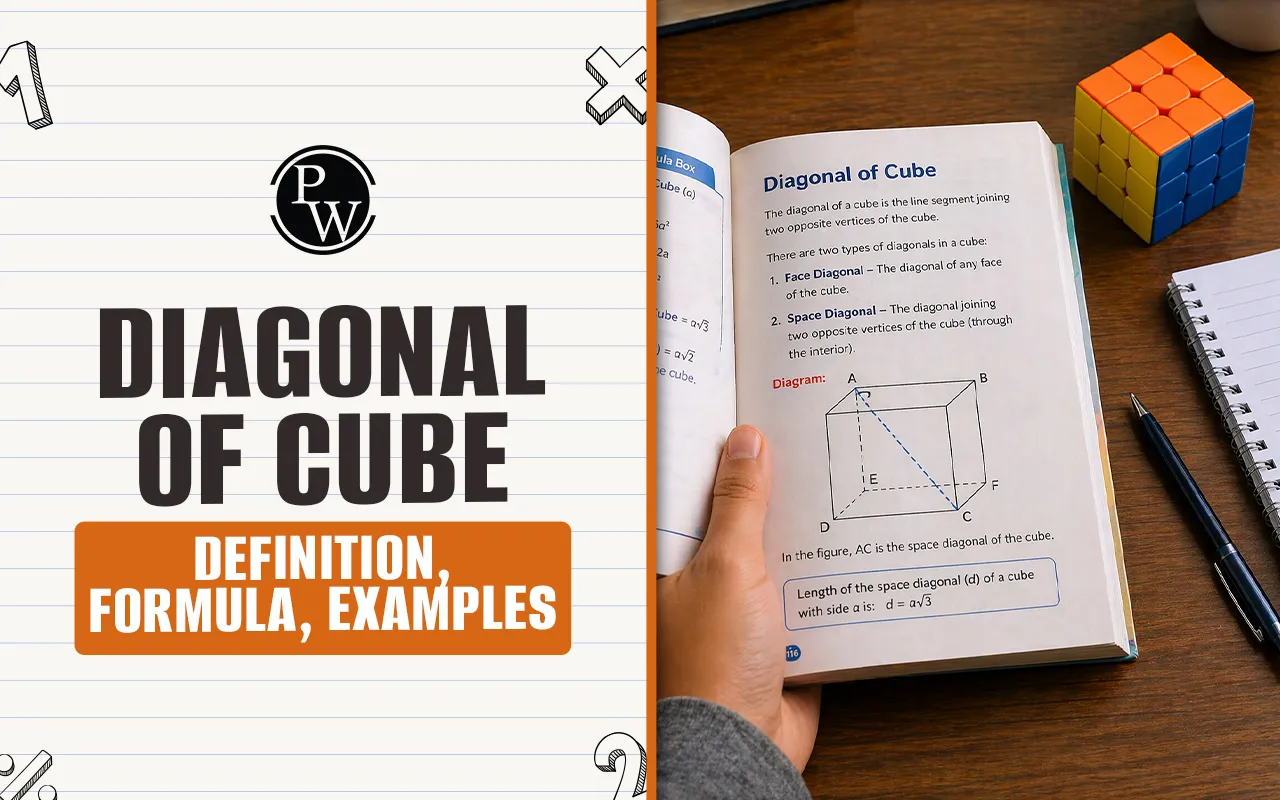
The term "diagonal of a cube" usually refers to the line that goes from one corner of the cube to the other corner inside the cube. A cube is a solid with six faces, and all edges are the same.
-
Face Diagonals: These lines go from one corner to another corner on the face of a cube. You can find 12 of these face diagonals on each cube.
-
Space Diagonals: This is what we usually mean when we talk about the length of a cube's diagonal. It connects two points that aren't on the same face and goes straight through the solid's inside. In any cube, there are four of these space diagonals, and they are all the same length.
If you want to know what the diagonal of cube is in real life, picture holding a cardboard box. The space diagonal is the wire that goes from the top left front corner to the bottom right back corner.
The Diagonal of Cube Formula
To figure out how far it is from one point to another inside a cube, we use the Pythagorean theorem.
A cube is a shape where every side is the same length, which we call the 'side length', often denoted by 's'. So when we talk about a cube, every dimension is related to its side length.
The standard formula is
d = s × √3
In this equation:
-
d represents the space diagonal
-
s represents the side (or edge) length of the cube
-
√3 is approximately 1.732
Derivation of the Formula for the Diagonal of Cube
To really get the formula for diagonal of a cube, we need to understand where it comes from. First, we examine a single face of the cube, which is a 2D representation, and then we consider the entire cube, which is 3D.
Step 1: Find the Face Diagonal
Consider the base of the cube, which is a square with side s. A right-angled triangle is made when we draw a line across the base.
According to the Pythagorean Theorem: (Hypotenuse)² = (Side)² + (Side)²
-
Face Diagonal² = s² + s²
-
Face Diagonal² = 2s²
-
Face Diagonal = s√2
Step 2: Find the Space Diagonal
Now, picture a triangle inside the cube that is standing up. The face diagonal we just found is the base of this triangle, and the vertical edge of the cube (s) is the height. The space diagonal (d) is the hypotenuse of this new triangle.
-
d² = (Face Diagonal)² + (Side)²
-
d² = (s√2)² + s²
-
d² = 2s² + s²
-
d² = 3s²
By taking the square root of both sides, we get:
d = s × √3
Read More - Cube: Definition, Properties, Formulas, and Solved Examples
Properties of the Diagonal of Cube
So you want to understand this idea, remember these things about maths properties:
-
The four space diagonals of a cube all meet at one point. This point is the centre of the cube.
-
The diagonals cut each other in half.
-
The longest distance between any two points in the cube is the diagonal.
-
To find the volume, first determine the side length: Volume = (d / √3)^3.
Recision of Diagonal of Cube Formula
|
Feature |
Formula |
Purpose |
|
Side Length |
s |
The basic edge of the cube |
|
Face Diagonal |
s√2 |
Distance across one square face |
|
Space Diagonal |
s√3 |
Distance through the cube centre |
|
Volume |
s^3 |
Total space inside the cube |
Read More - Cube Root: Definition, Symbol, Methods to Calculate, and Solved Examples
Importance of the Formula of the Diagonal of Cube
The diagonal of a cube is more than just a line in a book. It has many uses in real life and in maths. Some of them are listed below:
-
Finding the Maximum Capacity: This information is useful because it helps you figure out what object, like a rod or a pipe, can fit inside a cube-shaped container.
-
Vector Analysis: In physics and various topics, the diagonal line represents the vector obtained by combining three equal components that are at right angles to each other.
-
Spheres and Cubes: The space diagonal of a cube is equal to the diameter of a sphere that surrounds it and touches all eight corners of the cube.
Diagonal of Cube Examples
Here are some examples for better understanding:
Example 1: Finding the Diagonal from a Given Side
Problem: A wooden cube has an edge length of 5 cm. Calculate the length of its diagonal.
Solution:
-
Given side (s) = 5 cm
-
Formula: d = s × √3
-
Calculation: d = 5 × 1.732
-
Result: d = 8.66 cm
The length of diagonal of cube is 8.66 cm
Example 2: Working Backwards from the Diagonal
Problem: If the internal diagonal of a cubical room is 12√3 metres, what is the length of one side of the room?
Solution:
-
Given diagonal (d) = 12√3 m
-
We know that d = s × √3.
-
Set up the equation: 12√3 = s√3
-
Cancel √3 from both sides: s = 12
The side length of the room is 12 metres.
Example 3: Finding the Diagonal using Surface Area
Problem: The total surface area of a cube is 150 square cm. Find the diagonal.
Solution:
-
Total Surface Area = 6s²
-
150 = 6s²
-
s² = 150 / 6 = 25
-
s = √25 = 5 cm
-
Now find the diagonal: d = 5 x √3
The diagonal is approximately 8.66 cm
Make Maths Simple and Enjoyable with CuriousJr
CuriousJr is committed to helping children build a strong foundation in mathematics by removing fear and boosting confidence. Our online Mental Maths classes for students from Classes 1 to 8 are designed to enhance speed, accuracy, and logical thinking through easy techniques and interactive learning methods.
With our dual-mentor system, students engage in interactive live sessions and receive personalized support to resolve their doubts after every class. Animated lessons, fun activities, and exciting challenges make the learning experience more interesting and enjoyable.
Parents stay informed through regular progress updates and review sessions, ensuring full transparency in their child’s learning journey.
Book a demo class today and discover how CuriousJr makes maths simple, engaging, and confidence-building for your child.
Diagonal of Cube FAQs
Can I use the cube formula for a cuboid?
How to find diagonal of cube if only the volume is known?
Is the diagonal of a cube always longer than the side?






 Live & recorded classes available at easeDashboard for progress trackingMillions of practice questions at your fingertips