






Perfect Numbers: Definition, Fun Facts & Examples
 Vanita Mishra30 Jul, 2026

Student are you ready for a secret mission? Today, we are going into a perfectly amazing world to meet some numbers very particular to themselves.
Not just numbers, but perfect numbers! They have a super-secret superpower that makes them great. Learning about perfect numbers is so much fun and very easy. Get ready for discovering magic, history, and rules of secrecy.
To the World of Perfect Numbers
Have you ever thought that a number could be 'perfect'? In math as understood by most, perfect numbers are not those numbers that don't make mistakes but are numbers that are in perfect harmony. This harmony can be observed in their 'helped' or divisors.
So, what are perfect numbers? They are positive whole numbers. By definition, that number is exactly equal to the sum of all of its proper divisors. No fear on what 'proper divisors' are; they will be explained next!
One of the most interesting topics in all of mathematics, this has puzzled clever people for thousands of years!
The Secret Life of Numbers: Divisors
To understand perfect numbers, we must first understand what they are. A number is a divisor of another if it can exactly divide it, leaving no leftover or remainder.
Let's use the number 6 for our example.
What is a Divisor?
Think of divisors as even friends who can share a number with others.
-
Does 1 divide 6 evenly? Yes! (6÷1=6)
-
Does 2 divide 6 evenly? Yes! (6÷2=3)
-
Does 3 divide 6 evenly? Yes! (6÷3=2)
-
Does 4 divide 6 evenly? No! (6÷4=1 remainder 2)
-
Does 5 divide 6 evenly? No! (6÷5=1 remainder 1)
-
Does 6 divide 6 evenly? Yes! (6÷6=1)
Thus, the divisors of 6 are 1, 2, 3, and 6.
What is a Proper Divisor?
This is where the proper comes in. Proper divisors are all the divisors of a number, except the number itself. It's like leaving out the big boss (the number itself) from the list.
Proper divisors of the number 6 are 1, 2, and 3, leaving out the number 6 itself.
What are Perfect Numbers?
Now, we are all set to blend! A number is said to be perfect if the sum of its proper divisors equals the number itself. Simple and beautiful rules.
The proper divisors add up to the original number. Let's take a look at the first and most popular example of perfect numbers.
Example 1: The Number 6 (The Smallest Perfect Number )
The proper divisors of 6 are 1, 2, 3.
Sum of Proper Divisors: 1+2+3=6
Perfect? Yes! 6=6, therefore 6 is a perfect number!
Isn't it neat? Number 6 is like a superhero where the total power of its helpers is exactly equal to its own power!
Example 2: The Number 28
Let's try with a bigger number: Is the number 28 perfect?
Divisors of 28: 1, 2, 4, 7, 14, 28
Proper Divisors of 28: 1, 2, 4, 7, 14
Sum of Proper Divisors: 1+2+4+7+14=28
Perfect? Yes! 28=28, so 28 also qualifies as a perfect number!
Perfect Numbers List: First Four
Narrow, narrow indeed is the first several perfect numbers list. Perfect numbers are super rare! Only 4 perfect numbers exist under 10,000.
6
28
496
8,128
Be sure to find the time to check if 496 is perfect! (Hint: Its proper divisors are 1, 2, 4, 8, 16, 31, 62, 124, and 248).
A Passage Into the Past: History of Perfect Numbers
Study of the perfect number is not anything new. People have been thinking and pondering them for thousands of years! A bit like a secret history of the perfect number.
The Ancient Greeks
The Ancient Greeks were masters of math. They were fond of their numbers as much as they were their shapes.
- A famous Greek mathematician named Pythagore, yes, the one with the triangle theorem, was one of the first to study them. He thought these numbers had special meanings in magic or in religion.
- The mathematician who formally gave the rule for finding them was Euclid. He lived about 300 years before the famous inventor Archimedes. In his famous book, Elements, Euclid wrote down a special formula. It is a very formula still in use today to find newer ones!
For the Greeks, those were beauty and perfection. They are truly special.
The Ultimate Quest: How to Find a Perfect Number?
Finding a perfect number is akin to finding super-rare treasure. They're so rare that one can't merely guess them. Instead, one needs a secret formula!
The Secret Formula
The finding of a perfect number depends upon a thing called a Mersenne Prime; don't be fooled by the name-this is not what it sounds like!
A prime number is a number that is divisible only by 1 and itself (such as 2, 3, 5, 7, 11...).
A Mersenne Prime is a prime number of a most special kind and is equal to one less than some power of 2.
If (2 p−1) is a prime number, then the perfect number is 2 p−1×(2p−1), states Euclid's amazing formula.
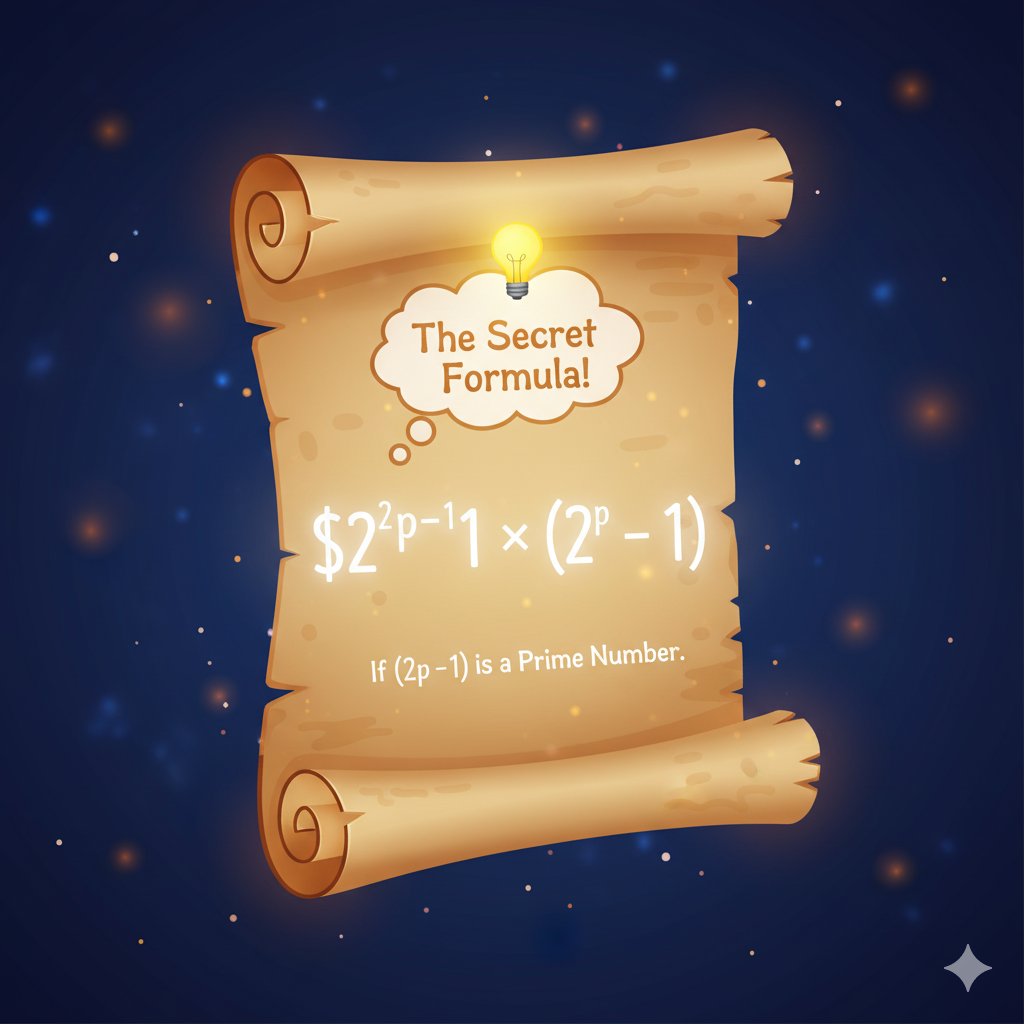
This seems quite complicated, so let's have a simpler example-the first one using this formula-to illustrate perfect numbers.
Example: Finding the Number 6
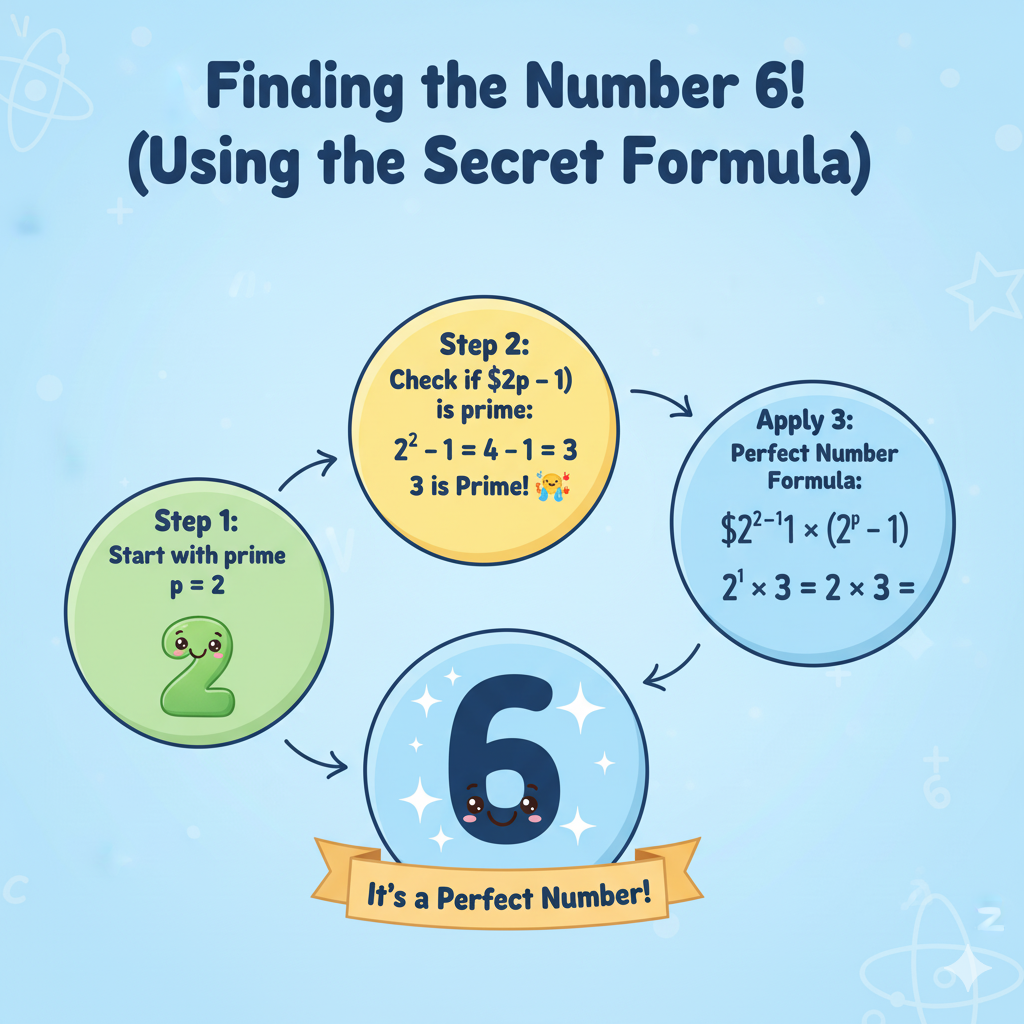
Perfectly Fun Facts & The Mystery Continues
A search for subsequent perfect numbers is still on! Here are some cool facts about these extraordinary numbers.
Amazing Fun Facts
They are all Even! So far, every single perfect number ever found has been an even number, which they can all be evenly divided by 2.
- The Odd Mystery: Proof of an even perfect number is still under research by mathematicians. None has been successful so far! The biggest unsolved mystery in math!
- A Special Ending: All known perfect numbers end in either the digit 6 or the digit 8. They cycle: 6, 8, 6, 8...
- Getting HUGE: That's how huge the largest known perfect number is! More than 49 million digits make up it! In its quest, a computer worked for years. The very rarity of perfect numbers is shown.
The Challenge
Now you know what perfect numbers are and the secrets of their divisors. Whenever you see the figure 6 or 28 again, you will know they are special. They are really perfect!
Keep practicing with the divisors, and maybe someday you will be the one to crack the mystery of the odd perfect number!
Start exploring Mental Maths and share this fun math fact with your mates.
Practice Questions for Students
Question 1: Find the Proper Divisors!
Can you list all the proper divisors for the number 10? (Remember: don't include 10 itself!)
Answer: The divisors of 10 are 1, 2, 5, and 10. The proper divisors are 1, 2, and 5.
Question 2: Is 12 a Perfect Number?
Check on the number 12. Add up all its proper divisors (1, 2, 3, 4, and 6). Is the total equal to 12? Is 12 a perfect number, or is it too big (abundant) or too small (deficient)?
Answer: The sum of the proper divisors is 1+2+3+4+6=16. Since 16 is greater than 12, the number 12 is NOT a perfect number. (It's an abundant number!)
Question 3: Fill in the Blank!
The name of the ancient Greek mathematician who wrote down the secret rule for finding perfect numbers was __ .
Answer: The mathematician was Euclid. (Bonus: Pythagoras was also one of the first to study them!)
Unlock the Secrets of Numbers and Make Math Exciting
Every child deserves to see wonders in mathematics. At CuriousJr, we believe that learning those complex concepts like Perfect Numbers should be easy, visual, and engaging, not torturous. This post puts perfect numbers under the microscope, defining them, teaching their history, and giving examples.
All in a fun, simple language packed with interesting factoids and useful coherent steps. It's designed to capture interest, build confidence with numbers, and lay a solid foundation for future learning. Read on to make it easy and fun for your child today to understand the magic of perfect numbers.





Coordinating Conjunction FAQs
What is a deficient number?
What is an abundant number?
Who is the last person to discover a new perfect number?
Do perfect numbers have something to do with geometry or shapes?








 Live & recorded classes available at easeDashboard for progress trackingMillions of practice questions at your fingertips

