







NCERT Solutions for Class 12 Maths Chapter 9 Exercise 9.3 (Differential Equations)
NCERT Solutions for Class 12 Maths Chapter 9 Exercise 9.3 contains all the questions with detailed solutions. Students are advised to solve these questions for better understanding of the concepts in exercise 9.3.
 Krati Saraswat18 Sept, 2024
NCERT Solutions for Class 12 Maths Chapter 9 Exercise 9.3 (Differential Equations)
NCERT solutions for class 12 maths Chapter 9 Differential Equations are prepared by the academic team of PW. We have prepared NCERT Solutions for all exercise of Chapter 9. Given below is step by step solutions of all questions given in the NCERT Solutions for Class 12 Maths Chapter 9 Exercise 9.3 of Differential Equations.
NCERT Solutions for Class 12 Maths Chapter 9 Miscellaneous Exercise
NCERT Solutions for Class 12 Maths Chapter 9 Exercise 9.3 Overview
NCERT Solutions for Class 12 Maths Chapter 9 Exercise 9.3 cover several important topics. It is highly recommended for students to review each topic thoroughly in order to gain a comprehensive understanding of the concepts taught in the chapter and make optimal use of the provided solutions. These solutions are the result of dedicated efforts by the Physics Wallah teachers aimed at assisting students in grasping the concepts covered in this chapter. By going through and practicing these solutions, the objective is for students to achieve excellent results in their exams effortlesslyNCERT Solutions for Class 12 Maths Chapter 9 Exercise 9.3
Solve The Following Questions of NCERT Solutions for Class 12 Maths Chapter 9 Exercise 9.3: In each of the questions 1 to 5, form a differential equation representing the given family of curves by eliminating arbitrary constants a and b Question 1..png) Solution : Given: Equation of the family of curves ….(i) Differentiating both sides of the given equation with respect to x , we get:
Solution : Given: Equation of the family of curves ….(i) Differentiating both sides of the given equation with respect to x , we get:  Hence, the required differential equation of the given curve is y'' = 0.
NCERT Solutions for Class 12 Maths Chapter 9 Exercise 9.2
Question 2.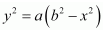 Solution : Given: Equation of the family of curves Differentiating both sides with respect to x , we get:
  This is the required differential equation of the given curve.
NCERT Solutions for Class 12 Maths Chapter 9 Exercise 9.4
Question 3.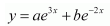 Solution : Given: Equation of the family of curves ….(i) Differentiating both sides with respect to x , we get:
  This is the required differential equation of the given curve.
NCERT Solutions for Class 12 Maths Chapter 9 Exercise 9.5
Question 4.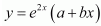 Solution : Given: Equation of the family of curves Differentiating both sides with respect to x , we get:
  This is the required differential equation of the given curve.
NCERT Solutions for Class 12 Maths Chapter 9 Exercise 9.6
Question 5. Solution : Given: Equation of the family of curves….(i) Differentiating both sides with respect to x , we get:
  This is the required differential equation of the given curve. Question 6. Form the differential equation of the family of circles touching the y -axis at the origin. Solution : The centre of the circle touching the y -axis at origin lies on the x -axis. Let ( a , 0) be the centre of the circle. Since it touches the y -axis at origin, its radius is a . Now, the equation of the circle with centre ( a , 0) and radius ( a) is
  This is the required differential equation.
Question 7. Find the differential equation of the family of parabolas having vertex at origin and axis along positive y -axis. Solution : The equation of the parabola having the vertex at origin and the axis along the positive y -axis is: x 2 = 4ay
 Differentiating equation (1) with respect to x , we get: 2x = 4ay' Dividing equation (2) by equation (1), we get:
  This is the required differential equation. Question 8. Form the differential equation of family of ellipse having foci on y -axis and centre at the origin. Solution : The equation of the family of ellipses having foci on the y -axis and the centre at origin is as follows:
  This is the required differential equation. Question 9. Form the differential equation of the family of hyperbolas having foci on x -axis and centre at the origin. Solution : The equation of the family of hyperbolas with the centre at origin and foci along the x -axis is: ….(i)
 .png)
 This is the required differential equation. Question 10. Form the differential equation of the family of circles having centres on y -axis and radius 3 units. Solution : Let the centre of the circle on y -axis be (0, b ). The differential equation of the family of circles with centre at (0, b ) and radius 3 is as follows:
  This is the required differential equation. Question 11. Which of the following differential equation has as the general solution:
 Solution : Given: ….(i) Differentiating with respect to x , we get:
  This is the required differential equation of the given equation of curve. Hence, the correct answer is B. Question 12. Which of the following differential equations has y = x as one of its particular solutions:
  Solution : The given equation of curve is y = x . Differentiating with respect to x , we get: dy/dx = 1 ...(1) Again, differentiating with respect to x , we get: d 2 y/dx 2 = 0 ....(2) Now, on substituting the values of y , d 2 y/dx2 and dy/dx from equation (1) and (2) in each of the given alternatives, we find that only the differential equation given in alternative C is correct.
  Therefore, option (C) is correct.
NCERT Solutions For Class 12 Maths Chapter 9 Exercise 9.3 FAQs
How many exercises are there in differential equations?
There are a total of 113 questions in the NCERT Solutions Class 12 Maths Chapter 9 Differential Equations that are divided among 7 exercises.
Why is it called differential equation?
An equation that contains the derivative of a function is called a differential function. A differential equation is an equation that involves the derivative (derivatives) of the dependent variable with respect to the independent variable (variables) is called a differential equation.
What is the role of differential equation in daily life?
Ordinary differential equations applications in real life are used to calculate the movement or flow of electricity, motion of an object to and fro like a pendulum, to explain thermodynamics concepts. Also, in medical terms, they are used to check the growth of diseases in graphical representation.
What is first order equation?
A first-order differential equation is defined by an equation: dy/dx =f (x,y) of two variables x and y with its function f(x,y) defined on a region in the xy-plane. It has only the first derivative dy/dx so that the equation is of the first order and no higher-order derivatives exist.

🔥 Trending Blogs



Check out these Related Articles








Join 15 Million students on the app today!
 Live & recorded classes available at easeDashboard for progress trackingMillions of practice questions at your fingertips


Free Learning Resources
PW Books
Notes (Class 10-12)
PW Study Materials
Notes (Class 6-9)
Ncert Solutions
Govt Exams
Our Other Websites
Class 6th to 12th Online Courses
Govt Job Exams Courses
UPSC Coaching
Defence Exam Coaching
Gate Exam Coaching
Other Exams
Know about Physics Wallah
Physics Wallah is an Indian edtech platform that provides accessible & comprehensive learning experiences to students from Class 6th to postgraduate level. We also provide extensive NCERT solutions, sample paper, NEET, JEE Mains, BITSAT previous year papers & more such resources to students. Physics Wallah also caters to over 3.5 million registered students and over 78 lakh+ Youtube subscribers with 4.8 rating on its app.
We Stand Out because
We provide students with intensive courses with India’s qualified & experienced faculties & mentors. PW strives to make the learning experience comprehensive and accessible for students of all sections of society. We believe in empowering every single student who couldn't dream of a good career in engineering and medical field earlier.
Our Key Focus Areas
Physics Wallah's main focus is to make the learning experience as economical as possible for all students. With our affordable courses like Lakshya, Udaan and Arjuna and many others, we have been able to provide a platform for lakhs of aspirants. From providing Chemistry, Maths, Physics formula to giving e-books of eminent authors like RD Sharma, RS Aggarwal and Lakhmir Singh, PW focuses on every single student's need for preparation.
What Makes Us Different
Physics Wallah strives to develop a comprehensive pedagogical structure for students, where they get a state-of-the-art learning experience with study material and resources. Apart from catering students preparing for JEE Mains and NEET, PW also provides study material for each state board like Uttar Pradesh, Bihar, and others
Copyright © 2026 Physicswallah Limited All rights reserved.