Complete Angle
Geometry exists in our daily lives because it appears through different shapes which include pizza slices and Ferris wheel designs that rotate smoothly. Students have difficulty understanding the transition from linear measurements to circular measurements because the process needs more practice to master. The concept of a complete angle becomes essential for every student because it serves as a fundamental learning tool. The maximum rotation between two points in a plane reaches its limit when the two points return to their original starting positions.
By understanding the complete angle definition, you can better grasp how shapes and rotations work in the physical world. Whether you are looking at the moving hands of a clock or In this article, we will break down the complete angle formation and explore why this 360-degree measurement is such a vital part of your studies.
Complete Angle Definition
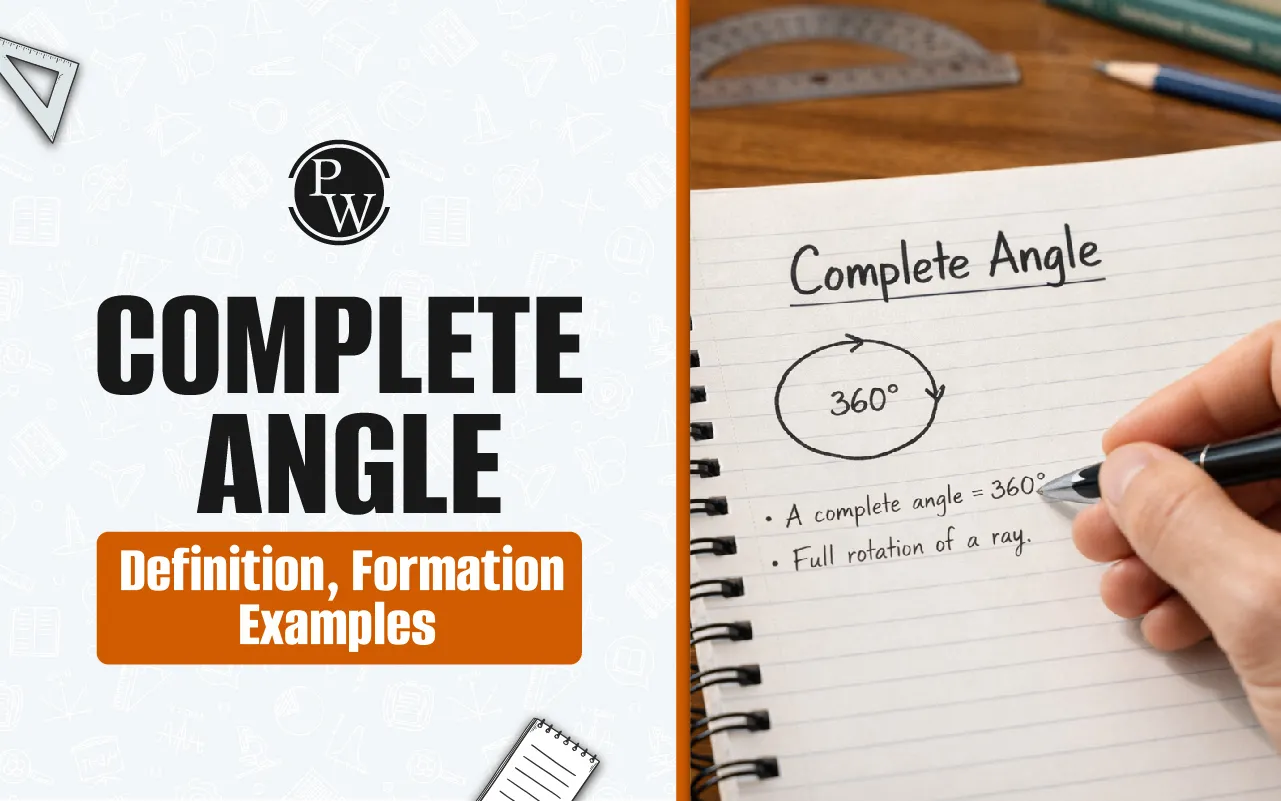
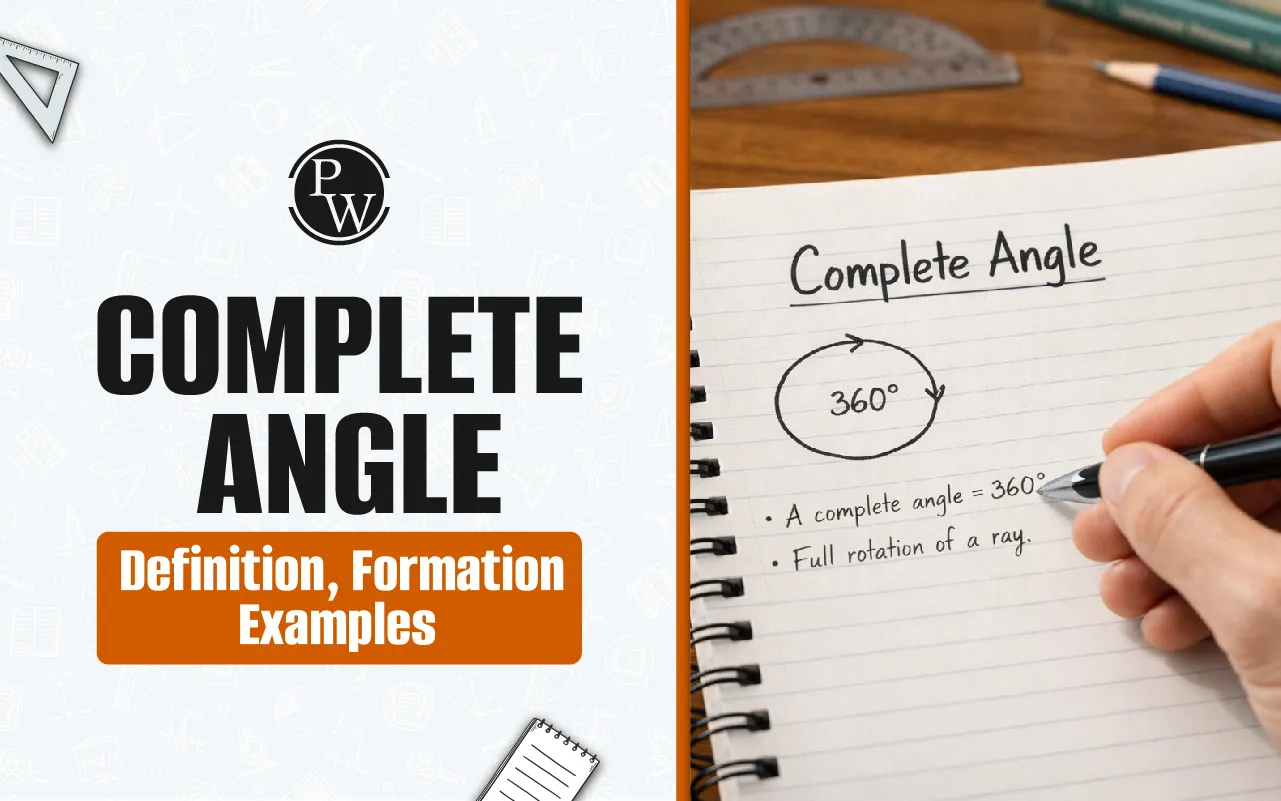
To move from the concept to the technical side, we must look at how mathematicians define this full rotation. A complete angle is an angle that measures exactly 360 degrees. It is created when one arm of an angle makes a full trip around the vertex and comes back to overlap perfectly with the starting arm. This means the initial and final positions look the same, even though a full rotation has occurred.
Many students ask, "what is complete angle notation?" In geometry, it is often represented as a small circle around a vertex point to show the path taken. While it might look like a zero-degree angle because the arms overlap, the distinction is in the movement. A zero angle has had no movement at all, while this specific angle has travelled through every possible degree to finish exactly where it began.
Read More - Angles in Maths: Definition, Parts, Types, Measurement and Construction
How Does a Complete Angle Degree Measure Compare to Others?
The complete angle degree is fixed at 360°. To understand its significance, it helps to see how it relates to other common angles you learn in class. Think of it as the ultimate destination in the world of rotations. Every other angle is essentially just a fraction of this total measurement.
Relationship with Other Angles
-
Acute Angle: Measures less than 90°.
-
Right Angle: Exactly 90°, which is 1/4th of a full rotation.
-
Straight Angle: Exactly 180°, which is 1/2 of a full rotation.
-
Reflex Angle: Measures more than 180° but less than 360°.
-
Complete Angle: Exactly 360°, representing a 1/1 full rotation.
This hierarchy shows that a full rotation is the sum of two straight angles or four right angles. Understanding this complete angle in maths helps you solve complex geometry problems involving circles and polygons more efficiently.
Step-by-Step Complete Angle Formation
Visualising the complete angle formation is the best way to remember how it works. Imagine you have two rays joined at a common endpoint called the vertex. Let one ray stay fixed (the initial arm) while the other ray (the terminal arm) starts to rotate in an anti-clockwise direction.
|
Stage of Rotation
|
Angle Name
|
Degree Measure
|
|
Start
|
Zero Angle
|
0°
|
|
Quarter Turn
|
Right Angle
|
90°
|
|
Half Turn
|
Straight Angle
|
180°
|
|
Full Turn
|
Complete Angle
|
360°
|
Once the terminal arm completes the circle and rests perfectly on top of the initial arm, the rotation is finished. This process is a fundamental part of the complete angle in maths, used to calculate everything from satellite orbits to the design of circular playgrounds and stadiums.
Complete Angle Examples
To make this concept stick, let’s look at a complete angle example from everyday life. You don't need a protractor to see these in action; they are happening right in front of you.
The Wall Clock
Look at the second hand of a clock. When it moves from the 12 all the way around and back to the 12, it has performed a full rotation. This is a perfect complete angle example. In exactly 60 seconds, the hand covers 360 degrees.
The Bicycle Wheel
When you are cycling, every time the valve of the tyre makes one full loop and returns to the bottom, the wheel has turned through 360°. Engineers use this complete angle formation logic to calculate distance and speed, ensuring your bike runs smoothly.
Complete Angle Properties
Every geometric figure has specific traits that define it. For a complete angle, these properties are unique because they involve total circularity. Recognising these traits will help you identify them instantly in exams and practice worksheets.
-
Fixed Measure: It can never be 359° or 361°; it must be exactly 360°.
-
Overlapping Arms: The initial and terminal rays are coincident (they lie on top of each other).
-
Circular Symbol: It is denoted by a small circle around the vertex point.
-
Full Revolution: It is often referred to as a "perigon" in higher-level geometry.
These properties ensure that the complete angle degree remains a constant standard in mathematics. Whether you are in a small classroom or working at NASA, 360 degrees always represents a full, finished loop.
Read More - Acute Angle: Meaning, Definition, Degree, Formula & Examples
How to Draw a Complete Angle Correctly
The procedure to create this angle requires different techniques than the methods used to create 45° and 60° angles. You must use an additional symbol because the arms of the figure overlap which shows that you have completed a rotational movement. You need to follow these essential steps when you want to draw a complete angle from your notebook.
-
Mark the Vertex: Start by placing a dot on your paper. Label this point 'O'.
-
Draw the Initial Arm: From point O draw a straight line which extends horizontally towards the right direction.
-
Indicate Rotation: You should create a circular arrow which starts from the ray and moves through to complete a full circle before returning to the starting point.
-
Label the Degree: Write "360°" near the circular arrow to confirm it is a full rotation.
The visual representation shows the complete angle example that serves as the standard geometry example for this concept.
Make Maths Simple and Fun with CuriousJr
At CuriousJr, we help children overcome their fear of maths and develop strong number skills with confidence. Our Mental Maths Online Classes for students from Classes 1 to 8 focus on improving speed, accuracy, and logical thinking using easy methods and interactive lessons.
Through our dual-mentor system, students attend live classes and also receive dedicated doubt-solving support after each session. Animated explanations, engaging activities, and fun challenges make maths learning more interesting and effective.
Parents receive regular progress reports and can also join review sessions to stay involved in their child’s academic progress.
Book a demo class today and experience how CuriousJr makes maths easy, enjoyable, and confidence-building for your child.