






How to Calculate the Angle between Two Planes
 Nikita Aggarwal13 Mar, 2026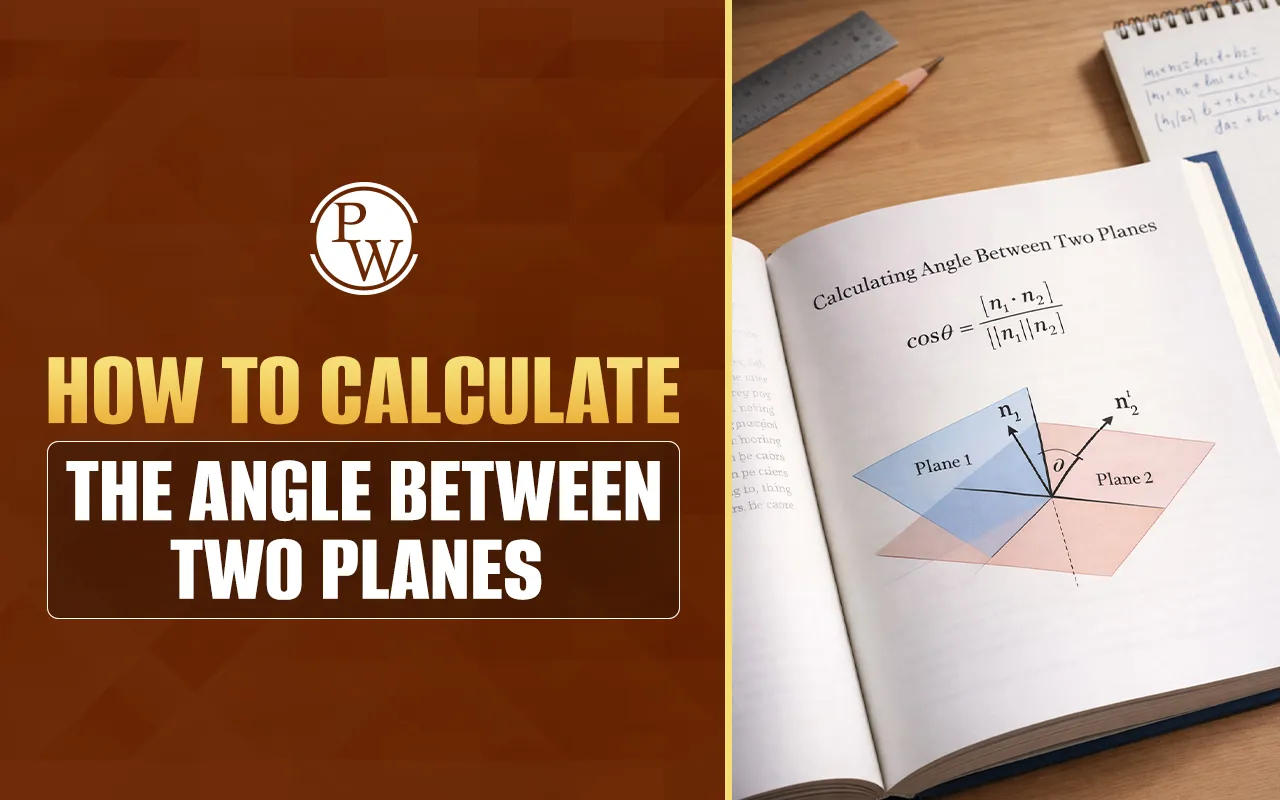
What is the Angle Between Two Planes in Geometry?
Planes in 3D Geometry
In three-dimensional space, a plane is a flat, two-dimensional surface. In 3D geometry, a "normal vector" tells us how a plane is orientated. This line sticks straight up from the plane at a right angle. It works like a handle that shows us which way the plane is pointing.
Meaning of Angle between Intersecting Planes
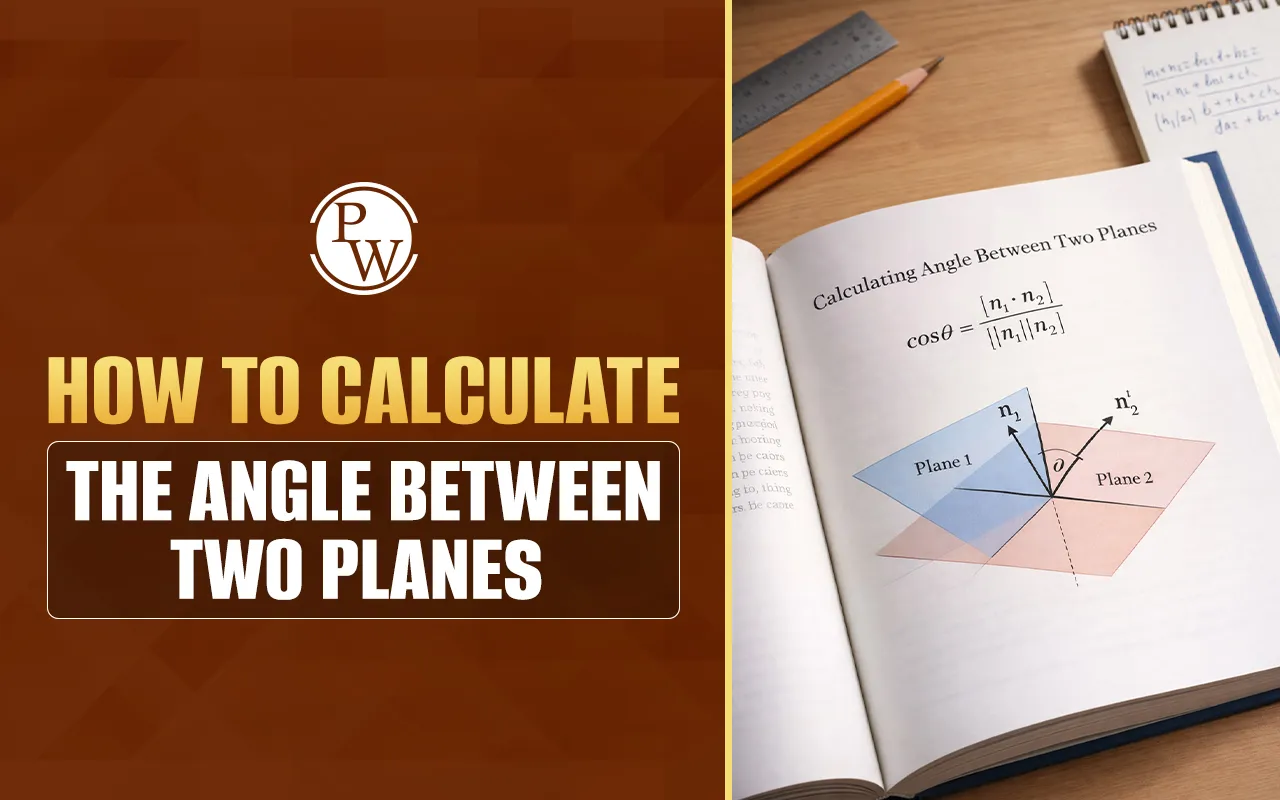
When two planes intersect, they form two pairs of angles. We usually mean the sharp angle. The angle between the flat surfaces is the same as the angle between their normal vectors, which is interesting. We can utilise vector algebra directly, which makes the maths much easier.
Importance of Angles in Three-Dimensional Geometry
It is important for many fields to know how planes work together. Architects use these numbers to figure out how to tilt roofs, while engineers use them to figure out how to make aeroplane wings. In 3D computer graphics, knowing how surfaces are orientated helps to make shadows and reflections seem right. We wouldn't be able to create sturdy skyscrapers or develop cars that go through the air without this computation.
Angle Between Two Planes Formula
Standard Formula
The cosine of the angle theta between two planes with normal vectors n1 and n2 is: cos theta = |n1 . n2| / (|n1| |n2|)
To find the real angle, you take the inverse cosine:
theta = cos-1 [ |n1 . n2| / (|n1| |n2|) ]
Understanding the Components of the Formula
The dot product (n1 . n2) shows us how much the two vectors point in the same direction. The lengths or strengths of these vectors are shown by their magnitudes (|n1| and |n2|). We get the cosine value by dividing the dot product by the product of the magnitudes. This technique makes sure that the angle result doesn't change based on the size of the vectors; only their direction does.
Relationship Between Normal Vectors and Plane Angles
Since the normal vector is perpendicular to the plane, any change in the plane's tilt is reflected in the vector. If planes are parallel, their normal vectors are parallel. If planes are perpendicular (at 90 degrees), their normal vectors are perpendicular too. This is the fundamental link between 3d geometry and linear algebra.
Angle Between Two Planes in 3D Geometry
Vector vs. Cartesian Form
The following table explains the main features of vector form and Cartesian form in an easy way:
|
Feature |
Vector Form |
Cartesian Form |
|
Normal Vector |
n = (n1, n2, n3) |
n = (A, B, C) |
|
Dot Product |
n1 . n2 |
A1A2 + B1B2 + C1C2 |
|
Magnitude |
sqrt(n1^2 + n2^2 + n3^2) |
sqrt(A^2 + B^2 + C^2) |
|
Perpendicular |
Dot Product = 0 |
A1A2 + B1B2 + C1C2 = 0 |
Finding the Angle Using Direction Ratios
For two planes:
-
A1x + B1y + C1z + D1 = 0
-
A2x + B2y + C2z + D2 = 0
The direction ratios are (A1, B1, C1) and (A2, B2, C2). These numbers are simply the coefficients of the x, y, and z variables. We can obtain the angle between the surfaces without having to draw them by inserting these into the formula.
Visual Understanding of Angles Between Planes
Think of a door that is just half open. The door itself is one plane, and the wall is another. The hinge represents the line of intersection. The angle varies when the door opens. In geometry, we use a vector that sticks out horizontally from the wall and another that sticks out from the door to measure this. The angle between these "sticks" is the same as the angle between the door and the wall.
Read More - Straight Angle (180°) – Definition, Degree, Properties, Examples
Angle Between Two Planes in Cartesian Form
General Equation of a Plane in Cartesian Form
The standard equation is Ax + By + Cz + D = 0. While D tells us where the plane is located in space, only A, B, and C determine its tilt. This is why we don't use D when we figure out the angle between intersecting planes that cross each other.
Steps to Calculate the Angle between Intersecting Planes
To solve any problem by hand or using a calculator, do these things:
-
Find the coefficients: From the two equations, write down A1, B1, C1, A2, B2, and C2.
-
To find the dot product, multiply the coefficients that go together and sum them up (A1A2 + B1B2 + C1C2).
-
To find the magnitudes for both planes, square each coefficient, add them up, and then calculate the square root.
-
Take the dot product and divide it by the product of the two magnitudes.
-
Use the last value to find the angle in degrees with the inverse cosine.
Example Using Cartesian Equations
-
Plane 1: 2x - y + z = 6
-
Plane 2: x + y + 2z = 3
Normals are n1 = (2, -1, 1) and n2 = (1, 1, 2).
-
Dot Product: (2)(1) + (-1)(1) + (1)(2) = 2 - 1 + 2 = 3.
-
Magnitudes: sqrt(2^2 + (-1)^2 + 1^2) = sqrt(6) and sqrt(1^2 + 1^2 + 2^2) = sqrt(6).
-
cos theta: 3 / (sqrt(6) x sqrt(6)) = 3/6 = 0.5.
-
Angle: cos-1(0.5) = 60 degrees.
Angle Between Two Planes Examples
Solved Example
Find the angle between x + 2y + 2z = 5 and 3x + 3y + 2z = 8.
-
Normals: n1 = (1, 2, 2), n2 = (3, 3, 2).
-
Dot Product: (1x3) + (2x3) + (2x2) = 13.
-
Magnitudes: |n1| = 3 and |n2| = sqrt(22).
-
Result: theta = cos-1(13 / (3 x sqrt(22))).
Practice Problem with Step-by-Step Solution
Suppose you have two planes: 4x + 4y - 2z = 9 and x - y + z = 0.
-
Step 1: Vectors are (4, 4, -2) and (1, -1, 1).
-
Step 2: Dot Product = (4)(1) + (4)(-1) + (-2)(1) = 4 - 4 - 2 = -2. Use absolute value = 2.
-
Step 3: Magnitudes = sqrt(16+16+4) = 6 and sqrt(1+1+1) = sqrt(3).
-
Step 4: cos theta = 2 / (6 x sqrt(3)) = 1 / (3 x sqrt(3)).
-
Step 5: theta = cos-1(0.192) approx 78.9 degrees.
Common Mistakes While Solving
-
Ignoring Absolute Value: Dot products can be negative. If you don't use the absolute value, you might get an obtuse angle. Always aim for the acute angle.
-
Calculation Errors in Squares: A common mistake is forgetting that a negative coefficient, like (-3), becomes positive (9) when squared.
-
Including 'D': Never use the constant 'D' in the vector formula; it will lead to the wrong answer.
Read More - Complementary Angles- Definition, Types, Examples
Angle Between Two Planes Calculator and Methods
Using a Calculator
An online calculator provides the dot product, magnitudes, and final angle instantly. It is excellent for verifying manual work, especially when square roots do not result in whole numbers.
Manual Method to Verify the Result
If you don't have a calculator, you can estimate the angle. If the dot product is nearly equal to the product of magnitudes, the angle is very small. If the dot product is close to zero, the angle is close to 90 degrees. This "estimation" helps you catch major calculation errors.
Tips for Faster Calculations
-
Identify Parallelism: If A1/A2 = B1/B2 = C1/C2, the angle is 0.
-
Check Perpendicularity: If the sum of products of coefficients is 0, the angle is 90.
-
Simplify Early: If an equation is 2x + 4y + 6z = 10, simplify it to x + 2y + 3z = 5 before starting.
Make Maths Easy and Fun with CuriousJr
At CuriousJr, we help children overcome their fear of maths and build strong confidence in numbers. Our Mental Maths Online Classes for students in Classes 1 to 8 are designed to improve speed, accuracy, and logical thinking through simple techniques and interactive learning.
Our unique dual-mentor system ensures that students attend engaging live classes while also receiving dedicated support for clearing doubts after every session. With animated explanations, fun activities, and exciting challenges, maths concepts become easier to understand and more enjoyable for children.
Parents also receive regular progress updates and can participate in review sessions to stay involved in their child’s learning journey. Book a demo class today and discover how CuriousJr makes maths learning simple, engaging, and confidence-building for your child.
How to Calculate the Angle between Two Planes FAQs
Why are normal vectors used to find the angle between planes?
Can two planes have an angle of 90 degrees?
What does vector algebra have to do with the angle between planes?
In which fields is the angle formed by two planes commonly used?














 Live & recorded classes available at easeDashboard for progress trackingMillions of practice questions at your fingertips

