








JIPMAT Syllabus 2027: Section-Wise Topics, Exam Pattern & Important Topics
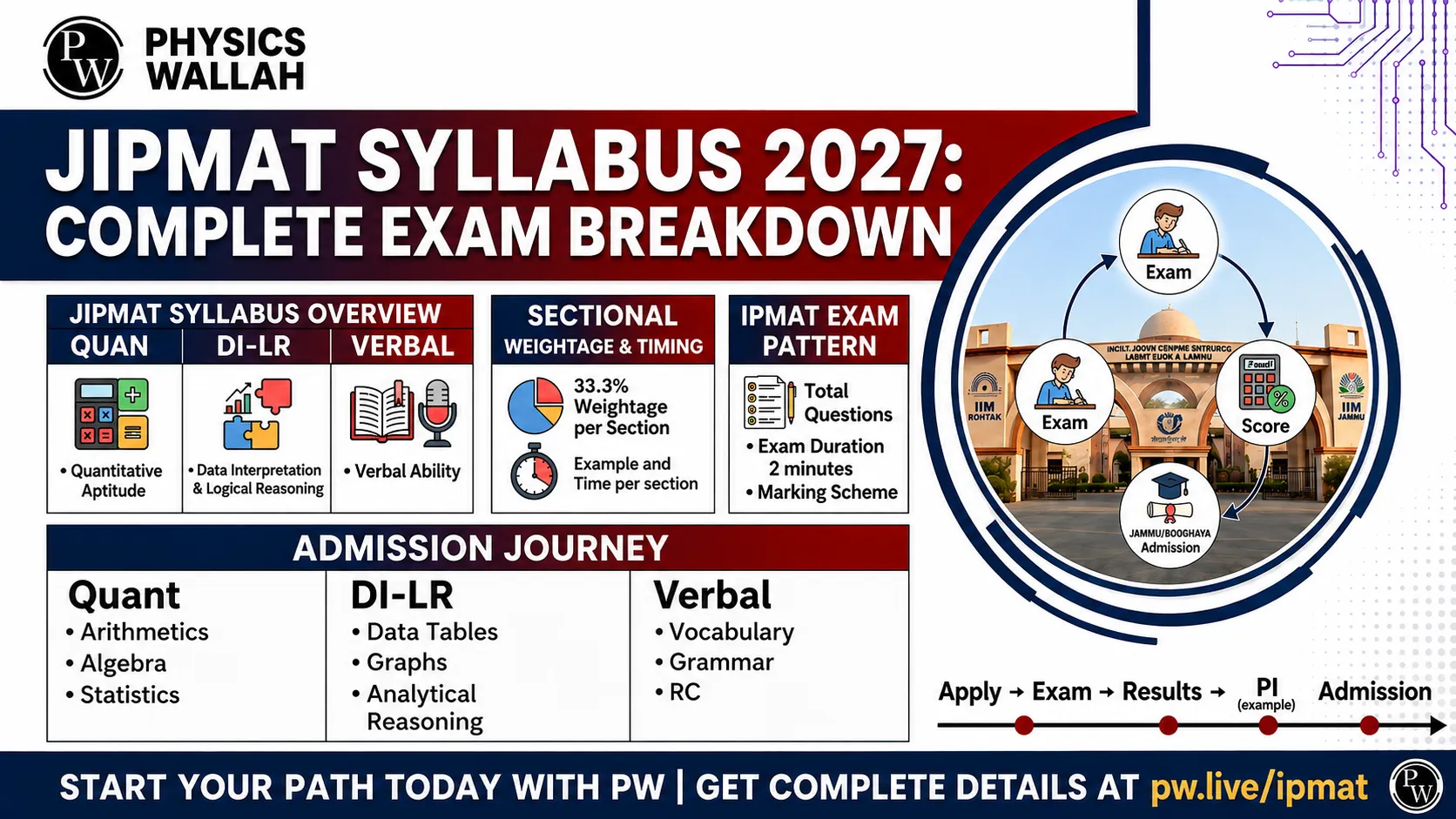
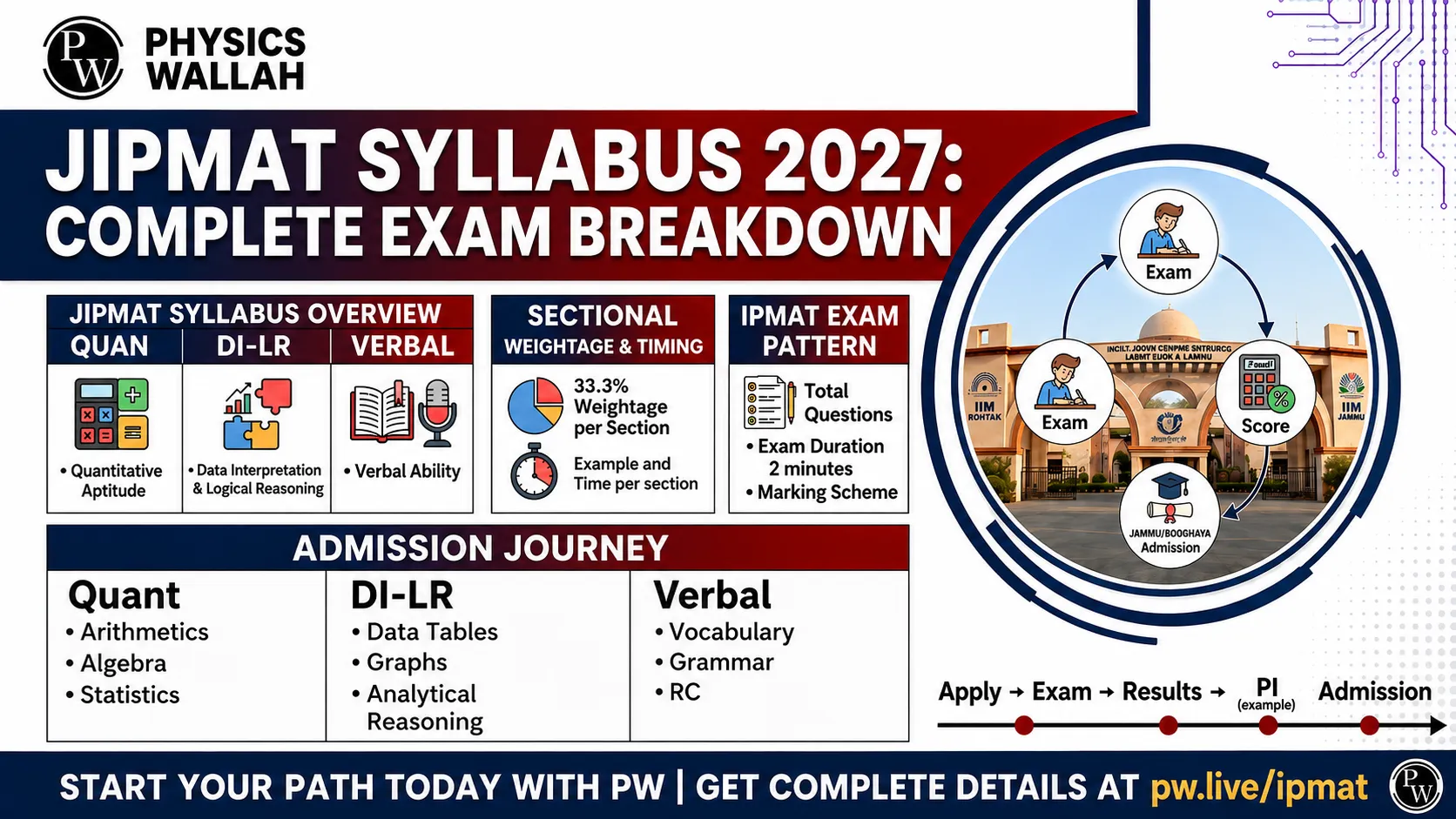
The JIPMAT Syllabus 2027 covers three sections: Quantitative Aptitude (QA), Data Interpretation & Logical Reasoning (DILR), and Verbal Ability & Reading Comprehension (VARC). Key topics include Arithmetic, Algebra, Logical Reasoning, Grammar and Reading Comprehension. The official 2027 syllabus is yet to be released.

Preparing for JIPMAT 2027? Before choosing books or starting mock tests, get familiar with the syllabus. Knowing what each section covers will help you plan your preparation, identify weaker areas and avoid spending too much time on topics that need less attention.
The JIPMAT syllabus covers three broad areas: Quantitative Aptitude (QA), Data Interpretation & Logical Reasoning (DILR), and Verbal Ability & Reading Comprehension (VARC). The topics listed in this guide are based on the available syllabus and previous exam patterns. The official JIPMAT 2027 notification has not yet been released, so candidates should check the latest NTA announcement for any changes.
This guide covers the section-wise JIPMAT syllabus, important topics, exam pattern and practical ways to prepare. You can also use the topic lists as a checklist while studying.
JIPMAT Syllabus 2027: Overview
JIPMAT is an entrance examination for admission to the five-year Integrated Programme in Management (IPM) at IIM Jammu and IIM Bodh Gaya. The examination assesses candidates' mathematical fundamentals, reasoning skills and command of English.
Here is a quick overview of the syllabus.
| Section | What it covers |
|---|---|
| Quantitative Aptitude (QA) | Arithmetic, number systems, algebra, geometry and other mathematical concepts |
| Data Interpretation & Logical Reasoning (DILR) | Tables, graphs, arrangements, puzzles, patterns and logical deductions |
| Verbal Ability & Reading Comprehension (VARC) | Vocabulary, grammar, reading comprehension and verbal reasoning |
Is the JIPMAT syllabus for 2027 released?
The official JIPMAT 2027 syllabus has not been confirmed in the information currently available. Until NTA releases the relevant notification, candidates can use the latest available syllabus and previous-year question papers as preparation references.
JIPMAT Exam Pattern 2027
Understanding the exam pattern alongside the syllabus helps you plan both your preparation and time management. The latest available pattern reflected in the material reviewed for this guide is summarised below. Verify these details against the official notification before relying on them for the 2027 examination.
| Exam detail | Latest available pattern |
|---|---|
| Number of sections | 3 |
| Total questions | 100 |
| Maximum marks | 400 |
| Examination duration | 150 minutes |
| Correct answer | +4 marks |
| Incorrect answer | -1 mark |
| Unattempted question | 0 marks |
The section-wise distribution reported in the available pattern is:
| Section | Questions | Maximum marks |
|---|---|---|
| Quantitative Aptitude | 33 | 132 |
| Data Interpretation & Logical Reasoning | 33 | 132 |
| Verbal Ability & Reading Comprehension | 34 | 136 |
| Total | 100 | 400 |
For a detailed explanation of the marking scheme and time management, see the JIPMAT Exam Pattern and Marking Scheme guide.
JIPMAT Quantitative Aptitude Syllabus 2027
Quantitative Aptitude tests how comfortably you can work with numbers and apply mathematical concepts to problems. Arithmetic and number systems are useful starting points because they support several other topics. Once your fundamentals are clear, move on to algebra, geometry and other areas.
The following is a topic-wise checklist of areas to prepare.
1. Arithmetic
-
Percentages
-
Profit, loss and discount
-
Ratio and proportion
-
Partnership
-
Averages
-
Simple and compound interest
-
Mixtures and alligation
-
Time and work
-
Pipes and cisterns
-
Speed, distance and time
-
Boats and streams
-
Races
-
Chain rule
2. Number System
-
Classification of numbers
-
Factors and multiples
-
Divisibility rules
-
HCF and LCM
-
Remainders
-
Digit-based problems
-
Factorials
3. Algebra
-
Basic algebra
-
Linear equations
-
Quadratic equations
-
Algebraic identities
-
Indices and surds
-
Inequalities
-
Logarithms
-
Progressions
-
Sets, relations and functions
-
Binomial theorem
-
Matrices and determinants
4. Geometry and Mensuration
-
Lines and angles
-
Triangles
-
Circles
-
Quadrilaterals
-
Area and perimeter
-
Coordinate geometry
-
Heights and distances
-
Trigonometry
How should you prepare for Quantitative Aptitude?
Start with the concepts you find difficult rather than solving questions randomly. For example, revise percentage calculations before moving to profit and loss, and build a clear understanding of ratios before tackling mixture problems.
After learning a topic, solve practice questions of increasing difficulty. Keep a record of the mistakes you make, especially calculation errors and questions where you use the wrong formula. This will make revision more focused.
JIPMAT DILR Syllabus 2027
Data Interpretation and Logical Reasoning require a different approach from Quantitative Aptitude. Instead of relying only on formulas, you need to identify relationships, organise information and draw conclusions from the details provided.
1. Logical Reasoning
Prepare the following question types:
-
Series and analogies
-
Coding-decoding
-
Direction sense
-
Blood relations
-
Cubes and dice
-
Calendars and clocks
-
Linear and circular arrangements
-
Distribution-based problems
-
Ranking and comparison
-
Selection-based problems
-
Venn diagrams
-
Deductions
-
Odd one out
-
Symbols and notations
-
Input-output
-
Non-verbal reasoning
Logical Reasoning questions can become time-consuming when you approach them without a clear method. Practise drawing simple diagrams, arranging information in tables and eliminating possibilities systematically.
2. Data Interpretation
The main Data Interpretation formats to practise include:
-
Tables
-
Line graphs
-
Bar graphs
-
Pie charts
For each format, practise extracting the required figures, comparing values, calculating percentages and identifying trends. Accuracy matters just as much as speed: a small calculation error can change the final answer.
How should you prepare for DILR?
Practise different types of sets instead of repeatedly solving only the formats you already know. After each set, review how you approached the problem. If a question took too long, identify whether the difficulty came from understanding the information, setting up the problem or performing calculations.
JIPMAT VARC Syllabus 2027
The Verbal Ability and Reading Comprehension section assesses how well you understand written English and use language. Regular reading, vocabulary revision and grammar practice can help you build these skills over time.
The section can be divided into four main areas.
1. Vocabulary
-
Root words
-
Synonyms and antonyms
-
Contextual vocabulary
-
Vocabulary clusters
-
Fill in the blanks
-
Cloze tests
-
Confusable words
-
Idioms and phrases
-
Phrasal verbs
-
Verbal analogies
Rather than memorising long word lists in one sitting, learn words in context and revise them regularly. Pay attention to how a word is used in a sentence, since its meaning can depend on the surrounding text.
2. Grammar
-
Nouns and articles
-
Pronouns
-
Verbs and tenses
-
Adjectives and adverbs
-
Modifiers and parallelism
-
Prepositions and conjunctions
-
Interjections
-
Punctuation
-
Active and passive voice
-
Direct and indirect speech
-
Error identification
-
Sentence correction
Grammar practice should focus on applying rules, not just memorising definitions. When you get a question wrong, identify the underlying rule and solve a few similar questions.
3. Reading Comprehension
-
Main idea
-
Theme and tone
-
Style of a passage
-
Factual questions
-
Inference-based questions
-
Critical reasoning
-
Application-based questions
Reading Comprehension requires you to understand what a passage says and distinguish it from what can reasonably be inferred. Practise identifying the central idea, the author's tone and the evidence supporting an answer.
4. Verbal Ability
-
Para-jumbles
-
Odd one out
-
Paragraph completion
-
Idea rephrasing
-
Para-summary
These questions test how ideas connect and how sentences work together to form a coherent passage. While solving them, look for transitions, references to earlier statements, cause-and-effect relationships and the logical order of ideas.
Important Topics in JIPMAT Syllabus 2027
The full syllabus can look extensive when you see all the topics together. A more practical approach is to organise them into manageable groups and prioritise them according to your current level of preparation.
The following are useful topic groups to cover during your preparation. This is a study-priority guide, not a verified ranking of topics by previous-year question frequency.
| Section | Topics to include in your preparation |
|---|---|
| Quantitative Aptitude | Arithmetic, percentages, ratio and proportion, averages, time and work, speed and distance, number system and algebra |
| Data Interpretation | Tables, bar graphs, line graphs and pie charts |
| Logical Reasoning | Series, coding-decoding, blood relations, directions, arrangements, ranking and puzzles |
| Verbal Ability | Vocabulary, grammar, sentence correction, para-jumbles and paragraph completion |
| Reading Comprehension | Main idea, tone, factual understanding and inference-based questions |
How to decide which topics to study first
If your mathematical fundamentals are weak: Begin with arithmetic and number systems. These areas help you build confidence with calculations before moving to more complex problems.
If you struggle with reasoning questions: Start with the formats you find easiest to understand, then gradually practise arrangements, puzzles and other multi-step questions.
If English is your weaker section: Make reading a daily habit. Combine it with grammar exercises and vocabulary revision rather than relying on vocabulary memorisation alone.
If you have already covered the basics: Use previous-year papers and mock tests to identify recurring mistakes. Give more revision time to the topics where your accuracy is consistently low.
For a more reliable view of topic frequency, analyse actual previous-year papers and record the questions asked under each topic. Avoid treating an unverified list of “high-weightage topics” as a substitute for the complete syllabus.
How to Prepare for JIPMAT 2027
You do not need to master every topic in the first few weeks. A consistent routine, regular practice and honest review of your mistakes are more useful than repeatedly switching between books and study plans.
Step 1: Check the complete syllabus
Divide the syllabus into QA, DILR and VARC, then break each section into smaller topics. Mark the areas you have not studied, those you need to revise and those where you can already solve questions confidently.
Step 2: Build your fundamentals
Start with concept-based learning before moving to timed practice. In Quantitative Aptitude, understand the formulas and their applications. In DILR, learn to organise information logically. In VARC, work on grammar, reading comprehension and vocabulary.
Step 3: Practise previous-year questions
Previous-year papers help you understand how concepts are tested. After solving a paper, review incorrect answers and questions that took too long. Use the findings to decide what to revise next.
Step 4: Take mock tests
Once you have covered a reasonable portion of the syllabus, begin taking mock tests under timed conditions. Use them to assess your speed, accuracy and ability to manage the paper.
Step 5: Maintain an error log
Record the questions you get wrong and why you got them wrong. Common reasons include gaps in conceptual understanding, calculation mistakes, misreading the question and spending too much time on a difficult problem.
Review this log regularly instead of repeating the same practice sets without analysing your performance.
Step 6: Revise consistently
Keep time for revising formulas, vocabulary, grammar rules and the reasoning methods you have learnt. Short, regular revision sessions can help you retain concepts while you continue practising new questions.
You can also read our JIPMAT Preparation Strategy guide for a more detailed study plan and preparation tips.
JIPMAT Syllabus vs IPMAT Syllabus: Are They the Same?
JIPMAT and IPMAT are separate entrance examinations used for admission to Integrated Programme in Management courses. Their syllabuses overlap in areas such as Quantitative Aptitude and Verbal Ability, but candidates should not assume that their examination patterns and topic coverage are identical.
If you are preparing for both examinations, compare the sections, question formats, marking schemes and relevant official information before creating a combined study plan.
You can explore our JIPMAT preparation resources for information about the other examination.
JIPMAT Syllabus 2027 FAQs
What is the JIPMAT syllabus for 2027?
Where can I download the JIPMAT syllabus PDF?
What are the important topics in the JIPMAT syllabus?
Is the JIPMAT syllabus the same every year?
How should I prepare for JIPMAT 2027?



Have questions about your prep?
Our experts can answer all your questions
 Live & recorded classes available at easeDashboard for progress trackingLakhs of practice questions

