




Physics Wallah
banner

NCERT Solutions For Class 11 Maths chapter-12 Introduction to Three Dimensional Geometry Exercise 12.2

NCERT Solutions For Class 11 Maths chapter-12 Introduction to Three Dimensional Geometry Exercise 12.2

NCERT Solutions for Class-11 Maths Chapter-12 Introduction to Three Dimensional Geometry


NCERT Solutions For Class 11 Maths Chapter-11 Conic Sections Exercise 12.2 is prepared by the expert of Physics Wallah score more with Physics Wallah NCERT Class 11 maths solutions. You can download and share NCERT Solutions for Class 11 Maths.


NCERT Solutions for Class-11 Maths Exercise 12.2


In each of the following Exercises 1 to 4, find the equations :

Question 1. Find the distance between the following pairs of points:

(i) (2, 3, 5) and (4, 3, 1)

(ii) (–3, 7, 2) and (2, 4, –1)

(iii) (–1, 3, –4) and (1, –3, 4)

(iv) (2, –1, 3) and (–2, 1, 3)

Solution :

The distance between points P( x 1 , y 1 , z 1 ) and P( x 2 , y 2 , z 2 ) is given by chapter 12-Introduction to Three Dimensional Geometry Exercise 12.2
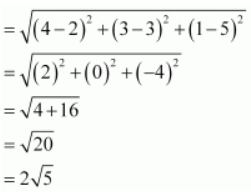
(i)  Distance between points (2, 3, 5) and (4, 3, 1)

chapter 12-Introduction to Three Dimensional Geometry Exercise 12.2

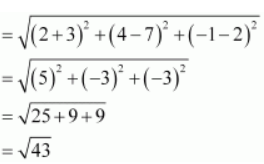
(ii) Distance between points (–3, 7, 2) and (2, 4, –1)

chapter 12-Introduction to Three Dimensional Geometry Exercise 12.2

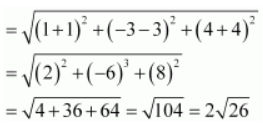
(iii) Distance between points (–1, 3, –4) and (1, –3, 4)

chapter 12-Introduction to Three Dimensional Geometry Exercise 12.2

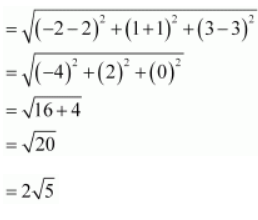
(iv) Distance between points (2, –1, 3) and (–2, 1, 3)

NCERT Solutions for Class 11 Maths Chapter 12 Introduction to Three Dimensional Geometry

Question 2. Show that the points (–2, 3, 5), (1, 2, 3) and (7, 0, –1) are collinear.

Solution :
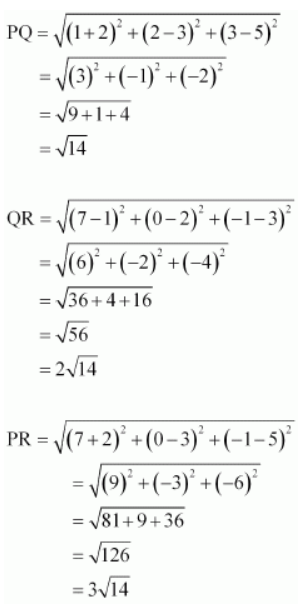
Let points (–2, 3, 5), (1, 2, 3), and (7, 0, –1) be denoted by P, Q, and R respectively.

Points P, Q, and R are collinear if they lie on a line.

NCERT Solutions for Class 11 Maths Chapter 12 Introduction to Three Dimensional Geometry

Here, PQ + QR NCERT Solutions for Class 11 Maths Chapter 12 Introduction to Three Dimensional Geometry = PR

Hence, points P(–2, 3, 5), Q(1, 2, 3), and R(7, 0, –1) are collinear.

Question 3. Verify the following:

(i) (0, 7, –10), (1, 6, –6) and (4, 9, –6) are the vertices of an isosceles triangle.

(ii) (0, 7, 10), (–1, 6, 6) and (–4, 9, 6) are the vertices of a right angled triangle.

(iii) (–1, 2, 1), (1, –2, 5), (4, –7, 8) and (2, –3, 4) are the vertices of a parallelogram.

Solution :
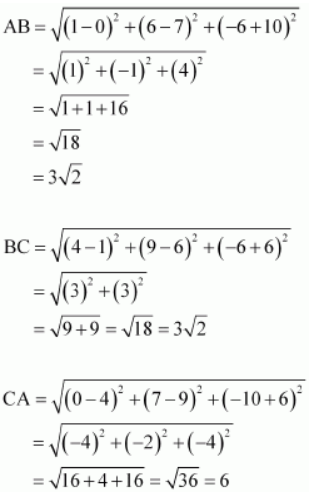
(i) Let points (0, 7, –10), (1, 6, –6), and (4, 9, –6) be denoted by A, B, and C respectively.

NCERT Solutions for Class 11 Maths Chapter 12

Here, AB = BC ≠ CA

Thus, the given points are the vertices of an isosceles triangle.

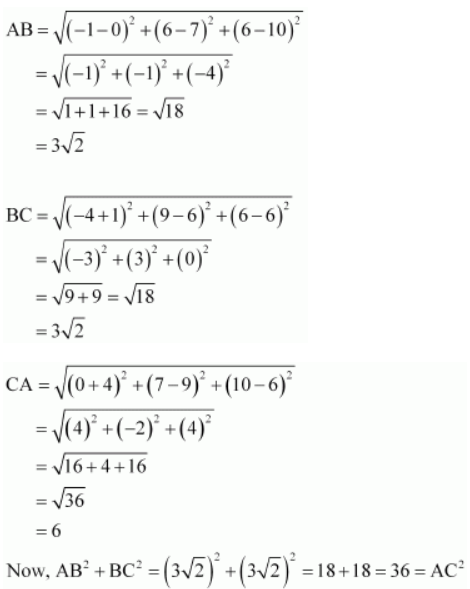
(ii) Let (0, 7, 10), (–1, 6, 6), and (–4, 9, 6) be denoted by A, B, and C respectively.

NCERT Solutions for Class 11 Maths Chapter 12 Introduction to Three Dimensional Geometry

Therefore, by Pythagoras theorem, ABC is a right triangle.

Hence, the given points are the vertices of a right-angled triangle.

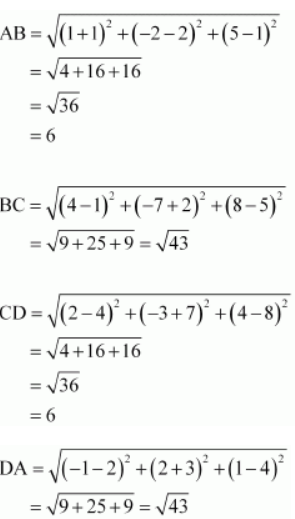
(iii) Let (–1, 2, 1), (1, –2, 5), (4, –7, 8), and (2, –3, 4) be denoted by A, B, C, and D respectively.

NCERT Solutions for Class 11 Maths Chapter 12 Introduction to Three Dimensional Geometry

Here, AB = CD = 6, BC = AD = 43

Hence, the opposite sides of quadrilateral ABCD, whose vertices are taken in order, are equal.

Therefore, ABCD is a parallelogram.

Hence, the given points are the vertices of a parallelogram.

Question 4. Find the equation of the set of points which are equidistant from the points (1, 2, 3) and (3, 2, –1).

Solution :
Let P (x,y, z) be the point that is equidistant from points A(1, 2, 3) and B(3, 2, –1).

Accordingly, PA = PB

NCERT Solutions for Class 11 Maths Chapter 12 Introduction to Three Dimensional Geometry

x 2 – 2 x + 1 + y 2 – 4 y + 4 + z 2 – 6 z + 9 = x 2 – 6 x + 9 + y 2 – 4 y + 4 + z 2 + 2 z + 1

⇒ –2 x 4y – 6 z + 14 = –6 x – 4 y + 2 z + 14

⇒ – 2 x – 6 z + 6 x – 2 z = 0

⇒ 4 x – 8 z = 0

x – 2 z = 0

Thus, the required equation is x – 2 z = 0.

Question 5. Find the equation of the set of points P, the sum of whose distances from A (4, 0, 0) and B (–4, 0, 0) is equal to 10.

Solution :
Let the coordinates of P be (x,y,z).

The coordinates of points A and B are (4, 0, 0) and (–4, 0, 0) respectively.

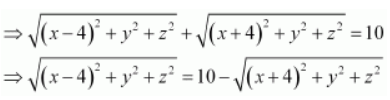
It is given that PA + PB = 10.

NCERT Solutions for Class 11 Maths

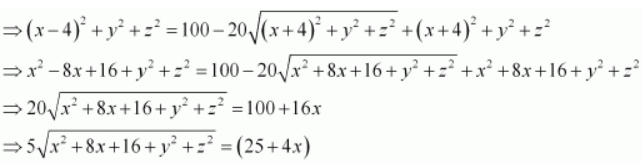
On squaring both sides, we obtain

NCERT Solutions for Class 11 Maths Chapter 12 Introduction to Three Dimensional Geometry

On squaring both sides again, we obtain

25 (x 2 + 8x + 16 +y 2 +z 2 ) = 625 + 16x 2 + 200x

⇒ 25x 2 + 200x + 400 + 25y 2 + 25z 2 = 625 + 16x 2 + 200x

⇒ 9x 2 + 25y 2 + 25z 2 – 225 = 0

Thus, the required equation is 9x 2 + 25y 2 + 25z 2 – 225 = 0.

Related Chapters

Free Learning Resources
Know about Physics Wallah
Physics Wallah is an Indian edtech platform that provides accessible & comprehensive learning experiences to students from Class 6th to postgraduate level. We also provide extensive NCERT solutions, sample paper, NEET, JEE Mains, BITSAT previous year papers & more such resources to students. Physics Wallah also caters to over 3.5 million registered students and over 78 lakh+ Youtube subscribers with 4.8 rating on its app.
We Stand Out because
We provide students with intensive courses with India’s qualified & experienced faculties & mentors. PW strives to make the learning experience comprehensive and accessible for students of all sections of society. We believe in empowering every single student who couldn't dream of a good career in engineering and medical field earlier.
Our Key Focus Areas
Physics Wallah's main focus is to make the learning experience as economical as possible for all students. With our affordable courses like Lakshya, Udaan and Arjuna and many others, we have been able to provide a platform for lakhs of aspirants. From providing Chemistry, Maths, Physics formula to giving e-books of eminent authors like RD Sharma, RS Aggarwal and Lakhmir Singh, PW focuses on every single student's need for preparation.
What Makes Us Different
Physics Wallah strives to develop a comprehensive pedagogical structure for students, where they get a state-of-the-art learning experience with study material and resources. Apart from catering students preparing for JEE Mains and NEET, PW also provides study material for each state board like Uttar Pradesh, Bihar, and others

Copyright © 2026 Physicswallah Limited All rights reserved.