NCERT Solutions For Class 11 Maths chapter-10 Straight Lines Exercise 10.3
NCERT Solutions for Class-11 Maths Chapter-10 Straight LInes
NCERT Solutions For Class 11 Maths Chapter-10 Straight LInes Exercise 10.3 prepared by expert of Physics Wallah score more with Physics Wallah NCERT Class 11 maths solutions. You can download and share NCERT Solutions for Class 11 Maths.
NCERT Solutions for Class-11 Maths Exercise 10.3
Question1. Reduce the following equations into slope-intercept form and find their slopes and the intercepts.
(i) x + 7y = 0,
(ii) 6x + 3y – 5 = 0,
(iii) y = 0.
Solution :
(i) Given: x +7y = 0
it can be writen as
⇒ y =- 1/7x + 0 ------(1)
Therefore, the above equation is of the form y = mx + c, where m =−(1 / 7)
(ii) Given: 6x + 3y – 5 = 0,
Given that, the equation is 6x+3y−5=0
Slope - intercept form is represented as y=mx+c
, where m is the slope and c is the y
intercept.
Now, the equation can be expressed as,
3y=−6x+5
y=−6/3x+5/3
=−2x+5/3
Therefore, the above equation is of the form y=mx+c
, where m=−2 and c=5/3.
(iii) Given: y = 0
Given that, the equation is y=0
Slope - intercept form is given by y=mx+c
, where m is the slope and c
is the y intercept.
Then, y=0 × x + 0
Therefore, the above equation is of the form y=mx+c
, where m=0 and c=0.
Question2. Reduce the following equations into intercept form and find their intercepts on the axis:
(i) 3x + 2y – 12 = 0,
(ii) 4x – 3y = 6,
(iii) 3y + 2 = 0.
Solution :
(i) Given: 3x + 2y – 12 = 0,
it can be writen as
3x + 2y = 12
3x/12 + 2y/12 = 1----------------- (1)
the equation is of the form x/a + y/b = 1 Where a = 4 and b = 6 .
Therefore equation (1) is in intercept from the intercepts on the x and y axes are 4 and 6
(ii) Given: 4x -3y = 6
Divided both side by 6

(iii) Given: 3y +2 = 0
iven that, the equation is 3y + 2 = 0
Rewrite the equation,
3y =−2
Divide both sides by −2
G⇒y(−2/3)=1
Now, equation is in the form x/a+y/b = 1
, where a=0 and b=−2/3
.
Therefore, the equation is in the intercept form, where the intercept on the y-axis is −23 and it has no intercept on the x-axis.
Question3. Reduce the following equations into normal form. Find their perpendicular distances from the origin and angle between perpendicular x-axis:
(i) x−√3y + 8=0,
(ii) y – 2 = 0,
(iii) x – y = 4.
Solution :
(i) Given: x−√3y + 8=0,

(ii)
Given that, the equation is y−2=0
This can be reduced as,
0.x+1.y=2
Divide both sides by 02+12−−−−−−√=1, we get
0.x+1.y=2
⇒xcos90∘+ysin90∘ = 2
This equation is in the normal form.
When comparing the equation with the normal form of equation of line
xcosω+ysinω = p
, we get ω = 90∘ and p=2
Therefore, the perpendicular distance of the line from the origin is 2
, while the angle between the perpendicular and the positive x-axis is 90∘.
(iii) Given: x−y=4
Ans.Given that, the equation is x−y=4
This can be reduced as 1.x+(−1)y=4
Divide both sides by

Question 4. Find the distance of the point (–1, 1) from the line 12 (x + 6) = 5(y – 2).
Solution :
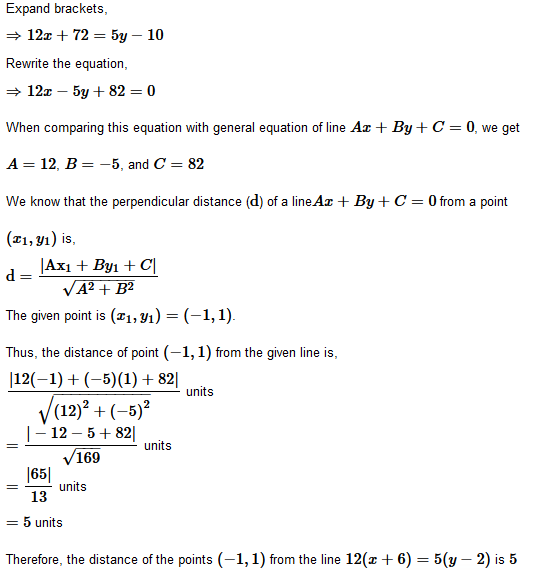
5. Find the points on the x-axis, whose distances from the line x/3 + y/4=1 are 4 units.
Solution :
Let can be write as 4x+3y−12=0
When comparing this equation with general equation of line Ax+By+C=0
, we get
A=4,B=3, and C=−12
Let (a,0)
be the point on the x-axis whose distance from the given line is 4
units.
We know that the perpendicular distance (d) of a line Ax+By+C=0 from a point

Question6. Find the distance between parallel lines
(i) 15x + 8y – 34 = 0 and 15x + 8y + 31 = 0
(ii) l (x + y) + p = 0 and l (x + y) – r = 0.
Solution :
(i) We know that the distance(d) between parallel lines Ax+By+C1=0 and
Ax+By+C2=0 is,

The given parallel lines are 15x+8y−34 = 0 and 15x+8y+31 = 0
Here, A= 15,B = 8,C1 = −34, and C2 =31
Thus, the distance between the parallel lines is,

Question7. Find equation of the line parallel to the line 3x − 4y + 2=0 and passing through the point (–2, 3).
Solution :Here, the equation of the given line is 3x−4y+2=0
Rewrite as,
y=3x/4 + 24
This can be write as,
y=34x + 12 , which is of the form y=mx+c
Now, slope of the given line = 34
It is known that parallel lines have the same slope.
Thus, slope of the other line is m=34
Now, the equation of the line which has a slope of 34
and passes through the points
(−2,3)
is,
(y−3)=3/4 {x−(−2)}
Cross multiply and expand brackets,
4y−12 = 3x+6
Rewrite as,
3x−4y+18=0
Therefore, the equation of the line parallel to the line 3x−4y+2=0
and passing
through the point (−2,3)
is 3x−4y+18=0.
Question8. Find equation of the line perpendicular to the line x – 7y + 5 = 0 and having x intercept 3.
Solution :
Given:The given equation of the line is x−7y+5=0
It can be write as,
y = 17x + 57 which is of the form y = mx + c
Now, Slope of the given line = 17
The slope of the line perpendicular to the line having a slope of 17 is,
m=−1/(1/7)=−7
The equation of the line with slope −7 and x-intercept 3 is,
y=m(x−d)
Substitute the values,
⇒y=−7(x−3)
Expand bracket,
⇒y = −7x + 21
⇒ 7x + y =21
Therefore, the equation of the line perpendicular to the line x−7y+5=0
and having x
intercept 3 is 7x+y=21.
through the point (−2,3) is 3x−4y+18=0.
Question9. Find angles between the lines √3x + y = 1 and x + √3y =1.
Solution :
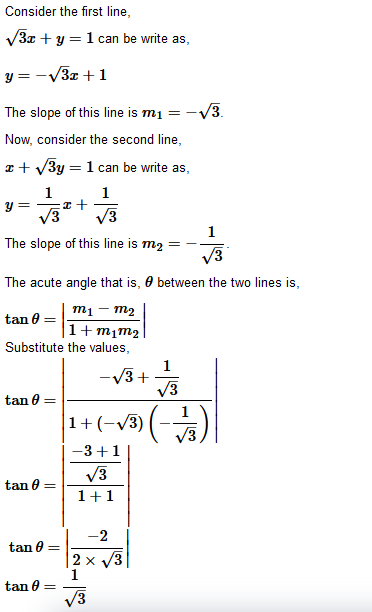
θ = 30∘
Thus, the angle between the lines √3x + y = 1
and x+√3y=1 is either 30∘
or
180∘−30∘=150∘
.
Question10. The line through the points (h, 3) and (4, 1) intersects the line 7x -9y-19 = 0 at right angle. Find the value of h.
Solution :
Slope of the line passing through the points (h, 3) and (4, 1) = 7x -9y-19 = 0
Also slope of the line 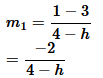 is 7x -9y-19 = 0
Since both lines are perpendicular to each other.


Question11. Prove that the line through the point (x1,y1) and parallel to the line Ax + By + C = 0 is A(x − x1) + B(y−y1)=0.
Solution :
Equation of the line parallel to the line Ax + By + C = 0 is …..(i)
Since line (i) passes through 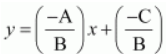 , therefore ….
 .(ii)
.(ii)
Subtracting eq. (ii) from eq. (i), we have

Question 12. Two lines passing through the point (2, 3 ) intersects each other at an angle of 60∘ If slope of one line is 2, find equation of the other line.
Solution :
Given: Given that the slope of the first line is 2
That is, m1 = 2
Assume that the slope of the other line is m2
The angle between the two lines is 60∘
.


Question13. Find the equation of the right bisector of the line segment joining the points (3, 4) and (-1, 2).
Solution :
The right bisector of a line segment bisects the line segment at an angle 90∘
The end-points of the line segment are given as A(3,4) and B(−1,2)
Now, mid-point of AB= 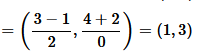
⇒ Slope of the required line is 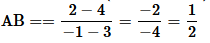
Therefore, the required line passes through point (1, 3) having slope -2 .
⇒ Equation of the required line 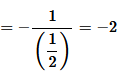
The equation of the line passing through (1,3) and having a slope of −2
is,
(y−3) = −2(x−1)
Expand bracket,
y−3 = −2x+2
2x+y = 5
Therefore, the equation of the right bisector of the line segment joining the points (3,4)
and (−1,2)
is 2x+y=5.
Question14. Find the coordinates of the foot of perpendicular from the point (–1, 3) to the line 3x – 4y – 16 = 0.
Solution :
Let Q be the foot of perpendicular drawn from Points (–1, 3) on the line 3x – 4y – 16 = 0.
Slope of the line joining (−1,3) and (a,b) is,
⇒ Equation of a line perpendicular to 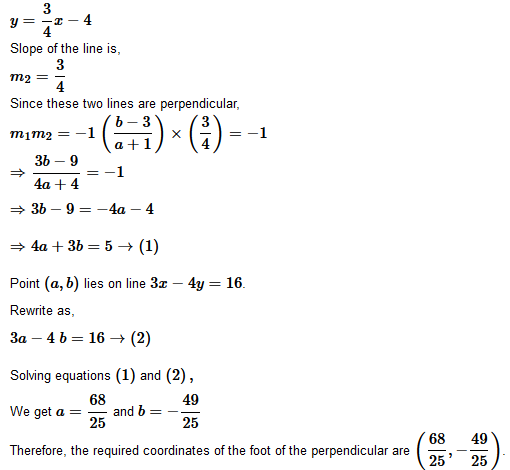
Question15. The perpendicular from the origin to the line y = mx + c meets it at the point (–1, 2). Find the values of m and c.
Solution :
Equation of the line PQ is y = mx + c
The given equation of line is y=mx+c
It is also given that the perpendicular from the origin meets the given line at (−1,2)
.
Then, the line joining the points (0,0) and (−1,2) is perpendicular to the given line.
Now, slope of the line joining (0,0) and (−1,2)= 2 / −1 = −2
The slope of the given line is m
∴m × −2 = −1
(The two lines are perpendicular )
⇒m = 1/2
Since points (−1,2) lies on the given line, it satisfies the equation y = mx + c
2 = m(−1) + c
⇒2 = 2 + 12(−1) + c
⇒ c= 2+1 / 2 = 5 / 2
Therefore, the values of m and c are 12 and 52 respectively.
Question 16. If p and q are the lengths of perpendiculars from the origin to the lines cosθ − sin θ = kyx 2cos θ and x sec θ + y cosec θ = k, respectively, prove that p2+4q2=k2.
Solution :
Length of perpendicular from origin to line is The equation of given lines are,
= xcosθ−ysinθ=kcos2θ→(1)
xsecθ+ycosecθ=k→(2)
And Length of perpendicular from origin to line (d) Ax+By+C=0 from a point (x1,x2)
is

= Compare equation (1)
to the general equation of line that is., Ax+By+C=0,
We get A = cosθ,B = −sinθ, and C = −kcos2θ
It is given that p is the length of the perpendicular from (0,0) to line (1).

Now, Compare equation (2)
to the general equation of line that is, Ax+By+C = 0
,
We get A = secθ, B = cosecθ
, and C = −k
It is given that q
is the length of the perpendicular from (0,0) to line (2).

Question17. In the triangle ABC with vertices A (2, 3), B (4, –1) and C (1, 2), find the equation and length of altitude from the vertex A.
Solution :
Slope of BC 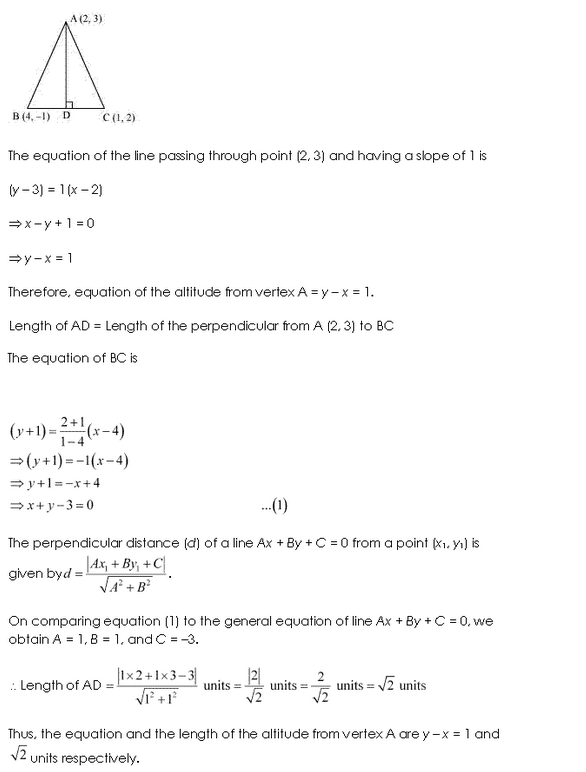
Question18. If p is the length of perpendicular from the origin to the line whose intercepts on the axes are a and b, then show that.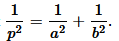
Solution :
Given: Line

Recent Concepts
- chapter-1 Set Miscellaneous
- chapter-2 Relations And Functions
- chapter-3 Trigonometric Functions Exercise 3.4
- chapter-3 Trigonometric Functions Miscellaneous
- chapter-4 Principle of Mathematical Induction
- chapter-5 Complex Number And Quadratic Equations Exercise 5.3
- chapter-5 Complex Number And Quadratic Equations Miscellaneous
- chapter-6 Linear Inequalities Exercise 6.1
- chapter-6 Linear Inequalities Exercise 6.2
- chapter-6 Linear Inequalities Exercise 6.3
- chapter-6 Linear Inequalities Miscellaneous
- chapter-7 Permutation And Combination Exercise 7.1
- chapter-7 Permutation And Combination Exercise 7.2
- chapter-7 Permutation And Combination Exercise 7.4
- chapter-7 Permutation And Combination Miscellaneous
- chapter-8 Binomial Theorem Exercise 8.1
- chapter-8 Binomial Theorem Exercise 8.2
- chapter-8 Binomial Theorem Miscellaneous
- chapter-9 Sequences And Series Exercise 9.1
- chapter-9 Sequences And Series Exercise 9.2