






Some Other Families

Share
Some Other Families
Families Of Angiosperms of Class 11
Family Ranunculaceae (Buttercup family)
Distinguishing features :
(1) Flowers are spirocyclic
(2) Thalamus elongated, carpels 1-, apocarpous.
(3) Fruit - Aggregate

Important plants :
(1) Aconitum napellus
(2) Delphinium ajacis (Larkspur)
(3) Ranunculus inuricatus (Butter cup)
(4) Nigella sativa (Kalonji)
Family Malvaceae
Inflorescence : Solitary axillary or terminal racemose or helicoid cyme.
Distinguishing features:
(1) Epicalyx (whorl of bracteoles) present except Sida & Abutilon.
(2) Corolla with twisted aestivation.
(3) Androecium indefinite, monoadelphous, filaments fuse to form staminal tube, epipetalous, anthers basifixed and monothecous.
(4) Gynoecium : Syncarpous, multilocular, axile placentation.
(5) Fruit is carcerulus or capsule.

Family Cucurbitaceae
F.F.Male flower  K(5) C(5) A(2)+(2)+1 G0.
Female flower K(5) C(5) A0 .
Important Plants :
(1) Cucumis melo (Kharbhuja)
(2) Cucurbita pepo (Kaddo)
(3) Citrulus vulgaris (Tarbooz)
(4) Luffa cylindrica (Sponge gourd)
Family Labiatae
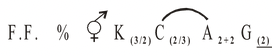
(1) Verticillaster inflorescence, flowers zygomorphic
(2) Calyx and Corolla bilabitae
(3) Androecium, mostly didynamous
(4) Bicarpellary, syncarpous, superior ovary
(5) Gynobasic style, stigma bifid, fruit carcerulus
Important Plants :
(1) Ocimum sanctum (Tulsi)
(2) Mentha piperita (Peppermint)
(3) Mentha arvensis (Podina
Important plants
(1) Hibiscus rosa sinensis (China rose).
(2) Hibiscus esculentus (Lady’s finger).
(3) Hibiscus cannabinus (Patsan)
(4) Hibiscus sabdariffa (Rosella).
(5) Gossypium sp. like herbaceum, barbedense, hirsutum, arboreum (cotton).
(6) Malva sylvestris (Khatmi)
(7) Althaea rosea (Holly-hock).
(8) Thespesia populnea (Umbrella or Portia tree).
Floral Formula
Floral formula is an expression summarizing the informations given in a floral diagram. It represents the informations given in a floral diagram in the form of an equation. Following symbols are used in constructing a floral formula:
 Male
Male
 Female
 Bisexual
 Actinomorphic
% Zygomorphic
Ep Epicalyx
K Calyx-free (polysepalous)
(K) Calyx-united (gamosepalous)
C Corolla-free (polypetalous)
(C) Corolla-united (gamopetalous)
CxCorolla-cruciform
P Perianth
A Androecium-free
(A) Androecium-united
 Epiphyllous
 Epipetalous
G Gynoecium-free
(G) Gynoecium-united
G Superior ovary
 Inferior ovary



