






Repair And Regeneration
Growth Repair Ageing & Death of Class 12
Wear and tear of cells and their replacement in the body is a regular and everyday phenomenon. e.g. RBC, skin cells, the mucosal cells of gut. Many animals can restore their accidently lost or damaged body parts. Cuts and wounds are soon healed up by localized proliferation andmigration of cells. The restoration takes place primarily by initiating the morphogenetic processes i.e. multiplication and differentiation of cells. These post-embryonic events are collectively called as repair and regeneration. Power of regeneration varies in different animal groups. Higher forms can reconstitute only small part of the body while lower forms can restore the whole body from a small fragment, others cannot do so at all. Accordingly, it is of two types
- Reparative regeneration
- Restorative regeneration
- Compensatory regeneration
Reparative regeneration : Localized cell movement for repair or healing of the lost part. Common in both invertebrates and vertebrates. e.g., formation of lost part of mammalian liver.

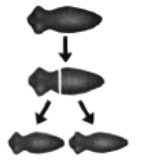
Fig. Regeneration in Hydra Fig. Regeneration in Planaria
Restorative regeneration:
Restoration of major part or the complete body; occurs in animals of simple body organisation hence common in invertebrates.
Hydra has totipotent interstitial cells (except basal disc and tentacles) hence any piece of its body (with interstitial cells) can regenerate complete body.
It is similar to the process of embryonic development.
In sponges, archaeocytes perform this function, but other cells can also do so by undergoing dedifferentiation.
Even differentiated cells retain their individuality and totipotency hence it dissociated, cells reassociate, and reorganize to form new individual by taking up their respective positions and functions.
Compensatory regeneration :
This is an intermediate kind of regeneration without undergoing dedifferentiation. In case of the loss of one kidney other one increases in size to compensate the function of lost one to some extent (compensatory hypertrophy).
Mechanism of Regeneration
Morgan (1908) identified it of two types :
- Morphollaxis
- Epimorphosis
Morphollaxis (morphallactic regeneration): By this process whole body is formed from small fragment; involves reorientation and reorganisation of the existing cells; since no new cells are formed concurrently, the regenerated individual is smaller in size which later grows to normal size (e.g. Hydra).
Epimorphosis (or epimorphic regeneration) : Occurs by the proliferation of new cells or tissues from the surface of wounds or cut parts. e.g., regeneration of limb, tail, etc., in salamander and lizard. It
involves dedifferentiation to form undifferentiated mass of tissue. It begins with the spreading of epidermis from the edges of the wound, it takes about two days to cover the wound. After next few days a conical bulge appears at this site as a mass of accumulated cells below epidermis which begins to proliferate actively. This is called as blastema or bud (callus in plant) which then redifferentiate to form the lost part controlled by neuronal and hormonal factors. Lower the grade of evolution greater is the power of regeneration. When the organisation becomes more complex the power of restorative regeneration is lost and only the power of reparative regeneration remains.
Factors Controlling Amphibian Limb Regeneration
Both in limb and tail the progenator of mesenchyme is the blastema formed by dedifferentiation, their division is controlled by nerve and wound epidermis.
Neurons release some trophic factors which may either act as stimulatory or as inhibitory factors in limb regeneration. These are:
- Glial growth factors (GGF)
- Fibroblast growth factors (FGF)
- Insulin like growth factor (IGF)
- Transferrin : An iron transport protein necessary for mitosis. GGF and FGF are small peptides with variety of roles like; patterning of growth and differentiation.
Autotomy
The cutting or breaking off its own body parts to save itself from the danger e.g., Lizards break off its tail, and the crabs do so with its leg, the sea cucumber (holothurians) throws off its entire visceral organ (evisceration).
Regeneration ability in different animal groups
- Protozoans : If Amoeba is cut into any number of parts, every part can become a full fledged amoeba if it contains nucleus.
- Porifera : Maximum regeneration power is present in sponges. If a sponge is broken into a number of pieces, each fragment grows into a complete sponge. Wilson studied regeneration in sponges.
- Coelenterata : Trembley (1744) discovered regeneration in animals for the first time in Hydra. He obtained a seven ‘headed’ Hydra through selective cutting and regeneration.
- Platyhelminthes : Planaria has high degree of regeneration.
- Aschelminthes : Power of regeneration is low in round worms. Reparative regeneration is present.
- Annelida : A good power regeneration present in Nereis and Earthworm but not in Leech.
- Arthropoda : Cray fish can regenerate lost appendages and eye. However regenerated parts do not exactly resemble the lost parts i.e., heteromorphosis.
- Mollusca : Gastropods can regenerate eye with eye stock. However, arm can regenerate in sepia, octopus and loligo.
- Echinodermata : Autotomy and regeneration are quite common.
- Chordata/Vertebrata : Ammocoete larva of petromyzon can regenerate the lost tail.Fishes can regenerate their fins.Salamander Newt and Axolotla larvae of Ambystoma would regenerate parts like limbs, tail, upper and lower jaw, external gills, intestine, retina and lens of eye. Tadpoles of frog and toad can regenerate theirlimb and tail.Reptiles Caudal autotomy is shown by lizards. AGEING (= GERONTOLOGY) Ageing is the unabated deterioration in the structure and function of the body cells, tissues and organ; first described by Huxley. There is gradual decline in metabolic activities, water content, average body weight and the power of regeneration.
- Gerontology : Study of various aspect of ageing.
- Father of Gerantology — Vladimir Korenchevsky.
Life Span
It is the period from birth to death, longer in women than man.
- Maximum life span : The maximum age reached by any member of a species.
- Average life span : The number of years lived by average members of the species
Life Expectancy
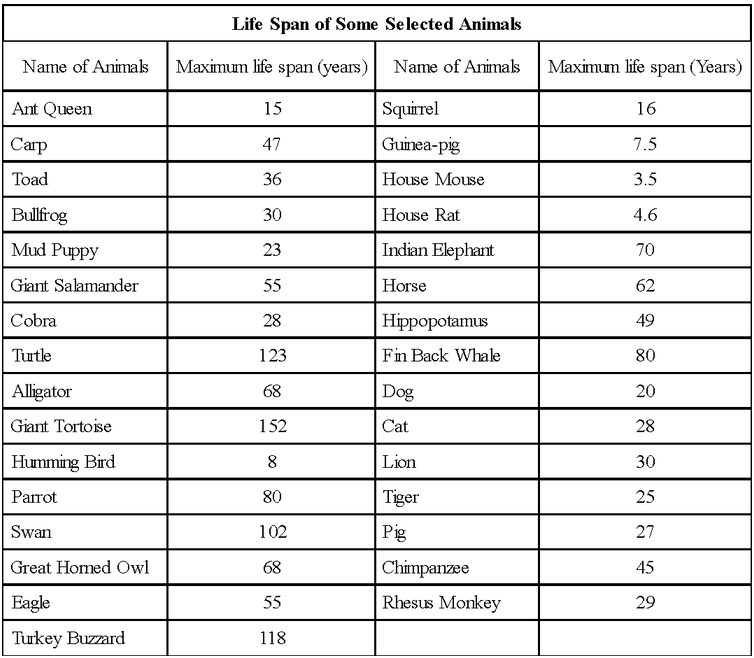
Life expectancy is the number of years one individual is expected to live, this is based upon the average life span. It is defined as the age at which half of the population still survives. Maximum life span is the characteristic of species while life expectancy is the characteristic of a population. In wild animals the maximum life span is difficult to estimate since they live in natural condition, face very high death rates due to diseases, infant mortality, rough weather, predators, competition etc. Hence reliable information is based upon reports from zoo. Following table depicts this :
Human
Maximum life span is about 121 years based upon a Japanese, Shirechiyo Izumi, who reached 120 years. Due to low rate of mortality the average life span and life expectancy has increased markedly. It is 56 years in India and 78 years in USA. Increase of life span is due to improved sanitation, medical facility, life style, discovery of antibiotics :



