






THE WATER-CYCLE OR HYDROLOGICAL CYCLE
Natural resource of Class 9
Water is the most abundant (60-90%) component of protoplasm. It acts as a habital for hydrophytes and many aquatic animals, a good ionizer, good solvent, temperature, buffer and perform transportation of materials. It also helps in digestion of organic compounds and in photosynthesis of plants.
Global water cycle:
Water evaporates from the hydrosphere (oceans, seas, rivers, lakes, etc.) with sun’s heat and form clouds. Rain may fall directly into the oceans or clouds blowing over the land also precipitate (rain, snow, hail, etc). Some water is soaked into the ground and some flows into rivers from where it gets into the seas. The ground water comes to the surface by springs and pumps. This water finally evaporates into the atmosphere and form clouds. This completes the global water cycle.
Biological water cycle:
It is the interchange of water between Abiotic and biotic components of environment e.g. the plants absorb water from water bodies and soil while loose most of the water by the process of transpiration, animals consume water from water bodies or the food ingested, while release water via the processes of respiration and excretion.

Water cycle
Water is used by terrestrial plants and animals for various life processes. Transpiration of water plays a role in determining the microclimate around them. Water being a universal solvent dissolves a large number of substances. These dissolved minerals are carried to rivers and then to the seas where these are used by the marine animals.
Nitrogen cycle:
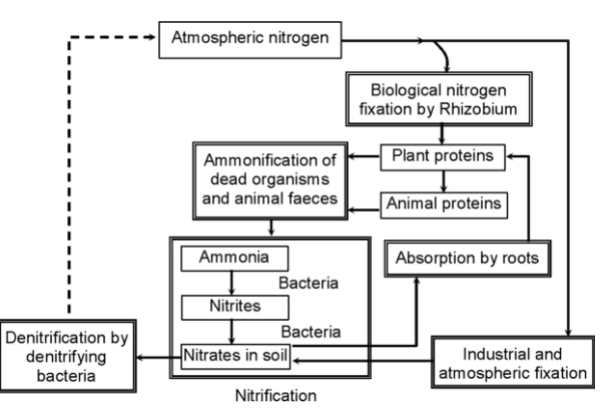
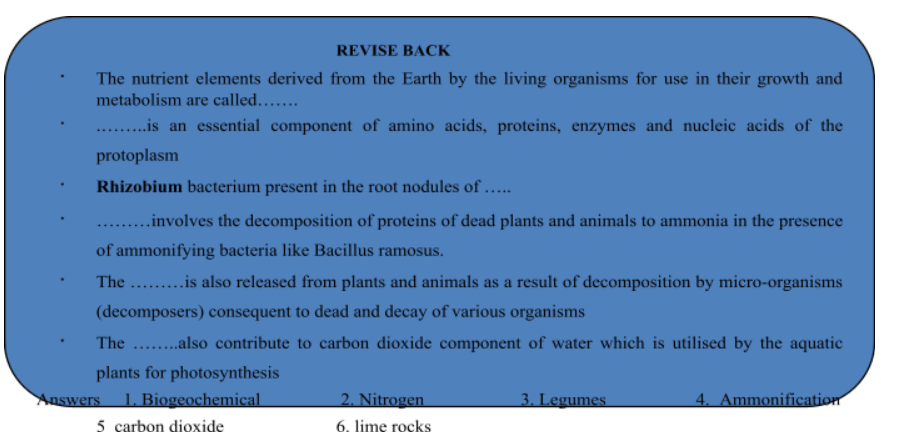
Nitrogen is an essential component of amino acids, proteins, enzymes and nucleic acids of the protoplasm. Reservoir pool of nitrogen is atmosphere which contains about 78.08% of nitrogen in gaseous state. But it cannot be used directly and is changed into nitrites and nitrates and then utilized.
Steps of nitrogen cycle are:
Nitrogen fixation: it involves the conversion of free diatomic nitrogen (N2) into nitrites and nitrates. It occurs in three ways:
- Atmospheric nitrogen fixation in the presence of photochemical and electrochemical reactions induced by thundering and lightening.
- Industrial nitrogen fixation in the industries at night temperature and high pressure.
- Biological nitrogen fixation in the presence of certain living organisms as
- Rhizobium bacterium in the root nodules of legumes.
- Azotobacter bacterium in the soil.
- Anabaena (blue green algae) in water in the paddy fields.
- Azospirillum bacterium in loose association with the roots of maize, sorghum, etc.
Ammonification: it involves the decomposition of proteins of dead plants and animals to ammonia in the presence of ammonifying bacteria like Bacillus ramosus.
Nitrification: it involves the oxidation of ammonia to nitrites (NO2) and nitrates (NO3) in the presence of nitrifying bacteria like Nitrosomonas (Ammonia to nitrite), Nitrobacter (Nitrite to nitrate), etc. plants absorb the nitrites and nitrates from the soil through their roots and convert them into organic compounds(e.g. proteins) of protoplasm by the process called nitrogen assimilation.
Denitrification: it involves reduction of ammonium compounds, nitrites and nitrates to molecular nitrogen in the presence of denitrifying bacteria like Thiobacillusdenitrificans.
CARBON CYCLE
Carbon is the basic constituent of all living beings. Its organic compounds play a major role in our life as carbohydrates, fats, proteins and nucleic acids. Food, fibers (cotton, jute), medicines, fertilizers and fuels, all contain compounds of carbon. The endoskeletons and exoskeletons of various animals are also formed from carbonate salts.
The main features of carbon cycle are as follows:
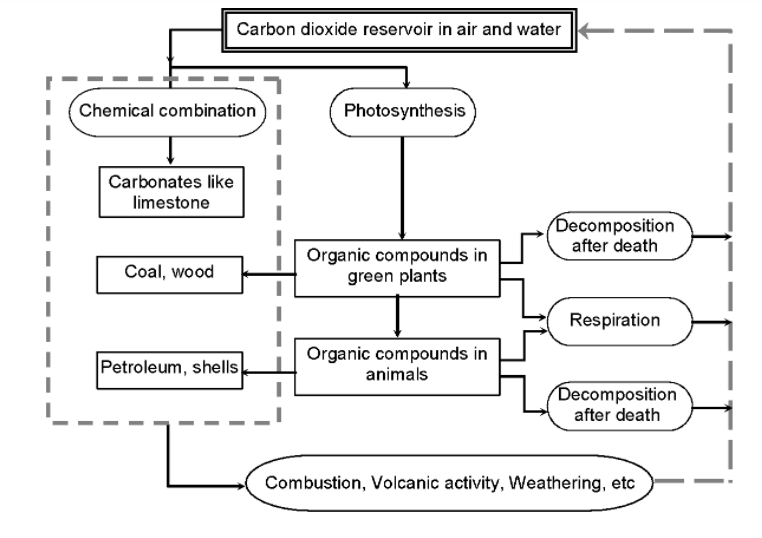
- Plants absorb carbon dioxide from the air and fix it in the form of glucose by way of photosynthesis. Therefore, plants are called producers.
- From plants (producers) it goes to animals (consumers) through food.
- By way of respiration, the biotic components (animals and plants) return carbon dioxide to the atmosphere.
- This carbon dioxide is also released from plants and animals as a result of decomposition by micro-organisms (decomposers) consequent to dead and decay of various organisms.
- The producers, consumers and decomposers may be converted into fossil fuel (peat coal, oil) or they may form the carbonate rocks.
- The lime rocks also contribute to carbon dioxide component of water which is utilised by the aquatic plants for photosynthesis.
- The atmospheric carbon dioxide may get dissolved in water and the aquatic producers use this carbon dioxide for photosynthesis and then return it by way of respiration.
- By the combustion of peat, coal, oil (fossil fuels) as also by volcanic activity, carbon dioxide is returned to the atmosphere.
- The combustion of producers and consumers also returns carbon dioxide to the atmosphere.
Carbon cycle
OXYGEN CYCLE
Oxygen is a very abundant element in our Earth. It is found in the elemental form in the atmosphere (21%). In combined form, it is found in the Earth’s crust as oxides of most metals and silicon, as carbonates, sulphates, nitrates and other minerals. It is also found in the air in the form of carbon dioxide.
The following are the steps of oxygen cycle:
- The animals and plants both take up oxygen for the oxidation of food.
- As a result of oxidation, carbon dioxide and water are formed. The resulting carbon dioxide is liberated to the atmosphere while the water becomes the part of general water content of the living matter as the source of hydrogen and oxygen.
- The oxygen remains in the organisms as a component of carbohydrates, proteins, amino acids, lipids, water etc. and after its death it goes back to the atmosphere.
- The oxygen is also utilised for the formation of ozone layer. The ozone layer forms a barrier in the atmosphere for the entry of UV-rays onto the soil surface.
- Plants do photosynthesis and utilise the carbon dioxide and water. As a result of photosynthesis hexose sugars are formed and oxygen is released which is again used in respiration.
-
Oxygen is also helpful in combustion. Without oxygen, complete combustion is not possible.
-
On being dissolved in water it is taken up by aquatic plants and animals for the purpose of their respiration.

Oxygen cycle



