






Class Aves
Classification of Animal Chordates of Class 11
Study of birds ornithology. Dr. Salim Ali is regarded “Bird man of India”.
Feather-clad, air-breathing, warm-blooded, oviparous, bipedal flying vertebrates.
Body divisible into four distinct regions : head, neck, trunk and tail. Jawed bones prolonged into a toothless beak or bill. Neck is long and flexible. Tail is short and stumpy.
Limbs are two pairs. Forelimbs are modified as wings for flying. Hindlimbs or legs are large, and variously adapted for walking, running, scratching, perching, food-capturing, swimming.
Exoskeleton is epidermal; feathers form a non-conducting body covering for warmth, scales on the legs, similar to those of reptiles; claws on the toes, and sheaths on the beaks.
Feathers are modified epidermal scales. Birds have scales on their legs (it indicates their reptilian ancestory)
Endoskeleton fully ossified. Long bones pneumatic.
Skin is dry and devoid of glands except the oil or preen gland or uropygeal gland at the root of tail.
Pectoral muscles of flight are well-developed.
Vertebral column short. Centra of vertebrae heterocoelous (saddle-shaped).
A synsacrum results by fusion of posterior thoracic, lumbar, sacral and anterior caudal vertebrae.
Tail vertebrae few, compressed laterally and the last 3 or 4 fused into a ploughshape bone, pygostyle.
Sternum large, usually with a vertical, mid-ventral keel for attachment of large flight muscles.
Both clavicles and single interclavicle fused to form a Y-shaped bone, called furcula or wishbone.
Pelvic girdle large, strong and fused with synasacrum throughout its length.
Skull is monocondylic.
Oesophagus frequently dilated into a crop for quick feeding and storage.
Heart completely 4-chambered. There is neither sinus venosus nor truncus arteriosus. Only right aortic (systemic) arch persists in adult. Renal portal system vestigeal.
Birds are the first vertebrates to have warm blood.
Respiration by compact, spongy, non-distensible lungs continuous with thin-walled avaxular air sacs.
Larynx without vocal cords. A sound box or syrinx, produces voice.
Kidneys metanephric. Urinary bladder absent. Birds are uricotelic.
Cerebrum, cerebellum and optic lobes greatly developed. Cranial nerves 12 pairs.
Olfactory organs poor. Middle ear contains a single ossicle. Eyes large and possess nictitating membrane, and a vascular pecten. Pecten is highly vascular, comb like structure hanging in utreous cavity from the region of blind spot. It provides nutrition to eye ball.
Male has a pair of abdominal testes. A copulatory organ absent except in ratitae, ducks, geese, etc. Female has a single functional left ovary and oviduct.
Fertilization internal. Females oviparous. Eggs large with much yolk and hard calcareous shell.
Extra-embryonic membranes present.
Parental care is well-marked.
Classification
- Extinct, archaic, Jurassic birds of Mesozoic Age about 155 million years ago.
- Wings primitive, with little power of flight.
- Tail long, tapering, lizard-like.
- Each hand bearing three unfused and clawed fingers. Skull with teeth in both jaws, embedded in sockets.
- Vertebrae amphicoelous.
- Tail with 18-20 free caudal vertebrae, without pygostyle.
- Sternum without a keel.
- Example : Archaeopteryx lithographica. (missing link between rephles & birds)
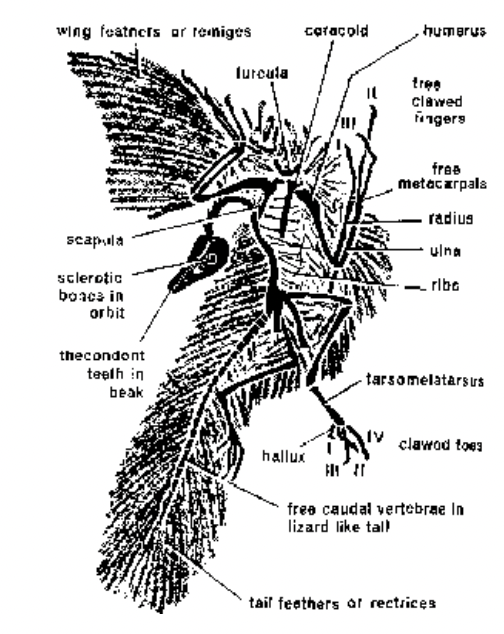
Fig. Archaeopteryx lithographica Fossil showing
skeleton and feathers. Berlin specimen
Sub-class II : Neornithes
(Gr., neos, modern+ ornithos, birds)
Modern as well as extinct post-Jurassic birds.
Wings usually well-developed and adapted for flight, with few exceptions.
Tail short and reduced.
Wing composed of 3 partly fused fingers without claws, teeth absent.
Vertebrae heterocoelous in living forms.
Few caudal vertebrae free. Rest fused into a pygostyle.
Sternum usually with a keel.
The sub-class is divisible into 4 super-orders:
Super-Order 1 : Odontognathae
(Gr., odontos, teeth)
Extinct, upper Cretaceous birds.
Jaws bear teeth, “so advantageous for catching fish.”
Brain of the avian type.
Example : Enaliornis, Ichthyornis
Super-Order 2 : Palaeognathae or Ratitae
(Gr., palaios old + gnathos jaw; L., ratis, raft)
Modern big-sized, flightless, running birds, without teeth.
Wings vestigial or rudimentary; feathers devoid of interlocking mechanism.
Oil gland is absent, except in Tinamus and Kiwi.
Sternal keel vestigial, absent or flat, raft-like.
Tail vertebrae free. Pygostyle small or absent.
Pectoral muscles poorly developed.
Syrinx is absent.
Male has a large and erectile penis; female has a clitoris.
Distribution is restricted.
The flightless birds or ratites are not represented in India, Europe & North America.
Example : True ostriches of Africa and western Asia, Darwin’s rhea (Pteroncemia pennata), Cassowaries of Australia, Kiwis (Apteryx) of New Zealand, Moas
(Dinornis maximus) of New Zealand. Giant Elephant-birds of Africa and Madagascar, Tinamou.
Super Order 3 : Impennae
Order 1 : Sphenisciformes
(Gr., spheniscus, wedge + form)
Modern, aquatic, flightless, with paddle-like wings or flippers.
Feet are webbed.
Examples : Penguins (Aptenodytes) of Southern Hemisphere.
Super Order 4 : Neognathae or Carinatae
(new jaw or L., carina, a keel)
Most modern, usually small-sized, flying birds.
Wings well-developed; feathers with interlocking mechanism.
Oil gland is present.
Sternum with a well-developed keel.
Pygostyle is present.
Pectoral muscles large.
Male has no copulatory organ.
Distributed all over the world.
Example : Common house crow (Corvus splendens), Golden-backed woodpecker (Dinopium benghalensis), Blue rock pigeon (Columbia livia), Green parrot (Psittacula krameri), Quail (Cotrunix coturnix), Koel (Eudynamis scolopaceous), Wild duck or mallard (Anas), White breasted kingfisher (Halcyon smyrnensis)



