Non Infectious / Non Communicable Diseases
Human Health And Diseases of Class 10
These diseases which remain confined to a person.They are neither present at birth nor spread from one person to another. The diseases are caused due to some specific factors. They may be caused due to improper functioning of an organ (shortsightedness, hypertension, arthritis), hormonal imbalance (diabetes, dwarfism), allergy, cancer, inadequate diet (anaemia, goitre), etc.
- These diseases are of following types:
- Deficiency diseases: Caused due to lack of some nutrient materials in our body like vitamins, minerals, protein etc.
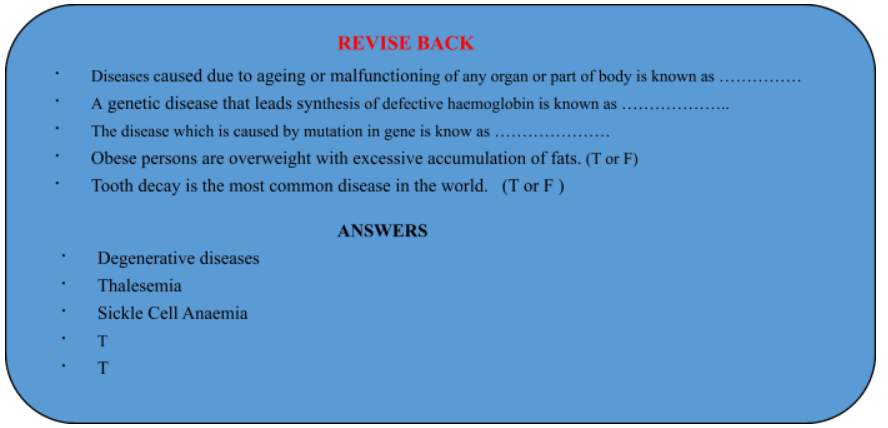
- Degenerative diseases: Caused due to ageing or malfunctioning of any organ or part of body.
- Allergies: Caused due to hypersensitivity of an organism to certain type of material like pollen grains, dust etc.
- Uncontrolled growth of cells : this can cause cancer and tumor.
- Mental disorders
- Occupational diseases
- Addiction : Caused due to excessive intake of drugs tobacco, alcohol etc.
NON COMMUNICABLE DISEASES |
||
|
Cause |
Name of Disease |
Symptoms |
|
1. Protein Energy (PEM) |
Marasmus (infants below 1 year) |
Shrivelled appearance, thinning of limbs, prominent ribs, retarded physical and mental growth, digestive disorder, repeated diarrhoea. |
|
2. Protein (PEM) |
Kwashiorkor |
Loss of appetite, stunted growth, bulging eyes, enlarged stomach, long thin and curved legs. |
|
3.Iron |
Anaemia |
Become pale, loose appetite, feels tired |
|
4.Vitamin B12 (Cyanocobalamine) |
Perirniciousanaemia |
Become pale, loose appetite, feels tired, reduced number of RBCs. |
|
5. Folic acid |
Macrocytic anaemia |
Become pale, loose appetite, feels tired, reduced growth of RBCs. |
|
6. Iodine |
Goitre |
Abnormal enlargment of thyriod swelling in the neck reduced thyriod function, retarded growth |
|
7. Vitamin A (calciferol) |
Xeropthalmia |
Night blindness dryness of cornea |
|
8. Vitamin D (calciferol) |
Rickets (children) osteomalacia (adults) |
Twisted, thin soft bent bones deformed ribs. |
|
9. Vitamin B1 (Thiamine) |
Beri−beri |
Muscular dystrophy, nervous disorder |
|
10. Vitamin B5 (Niacin) |
Pellagra |
4d syndrome (dermatitis, diarrhoea, dementia, death) |
|
11. Vitamin −C (Ascorbic acid) |
Scurvy |
Bleeding gums, loosening and falling of teeth, loose of weight |
|
12. Degeneration |
Heart attack, liver failure, kidney |
Hypertension, liver megaly etc. |
|
13. Hyper sensitivity |
Allergy |
Sneezing, coughing,, watering of eyes, asthma have fever |
|
14. Uncontrolled growth of cells |
Cancer and tumour |
Loss of weight, person becomes weak, can lead to death or destruction of affected organ |
GENETIC DISEASES:
Diseases that are transmitted from parents to offsprings are called hereditary or genetic diseases. Some genetic diseases are as follows:
(a) Haemophilia:It is a sex linked hereditary disease. The genes of the disease are found on sex chromosome −X. due to this disease blood clots very slow so patient can be die due to excess of haemorrhage. Due to presence of one normal X chromosomes, the disease is not developed in women generally. Women act as carrier only. While in man the recessive gene can be expressed, if present of a X−chromosome.
(b) Colourblindness: This is a sex linked hereditary disease, its genes are situated on X−chromosomes. In this disease also women are found as carrier generally and men as patients. A person suffering from colour blindness cannot differentiate between red and green colour.
(c) Thalesemia: It is a genetic disease that leads synthesis of defective haemoglobin. Blood of patient have to be changed frequently. Cause of this disease is a recessive gene.
(d) Sickle Cell Anaemia:Cause of this disease is a mutation in gene. In this disease shape of red blood cell becomes sickle like. A child with 50% sickle shaped red blood cells and 50% normal red blood cells can survive and remain anaemic.
HARMFUL EFFECTS OF OBESITY:
- It is a luxury nutritional disorder caused by great intake of food than the requirement of body.
- It is common in persons having higher intake of sweets, fried articles, fat rich food etc.
- Obese persons are overweight with excessive accumulation of fats.
- Movements are reduced. There is a risk of diabetes osteoarthritis, gall bladder stones, high bloodpressure and cardiac problems.
HARMFUL EFFECTS OF TOBACCO CHEWING:
- Regular contact of tobacco increases the possibility of mouth, tongue, throat or lung cancer.
- Nicotine of tobacco causes thickening of walls of arteries which can increase blood pressure and rate of heart beat.
- Carbon monoxide can destroy the blood cells.
- Rate of embryo development reduces if a pregnant woman uses tobacco.
HARMFUL EFFECTS OF DRUGS:
- Some drugs e.g. morphine, buprenorphine etc. are misused as intoxicants.
- These drugs can cause nightmares, lung and kidney infections, damage to brain and various unending physical and mental health problems.
- It can reduce learning and memory in young ones.
HARMFUL EFFECTS OF ALCOHOL:
- Liver converts excess of alcohol to acetaldehyde which is a poisonous substance.
- Alcohol reduces body coordination capacity and self control power of body.
- It decreases working capacity of person and increases possibilities of accidents.
- Alcohol causes fatty liver syndrome and affects synthesis of protein and carbohydrates.
- It causes economic loss and social reputation goes down.
SEXUAL EQUALITY:
- Human female produces only one type of eggs each having one X- chromosome.
- Male produces one sperm with X and one with Y chromosome.
- The sex of newly born child is solely determined by the type of sperm that fuses with the ovum. The fusion of sperm with ovum is purely determined by chance, so there are equal chances of birth of a male or a female baby. Thus it is the father who is biologically responsible for the sex of the child.
SOME IMPORTANT POINTS:
- World T.B. Day is on 24th March.
- BCG is a vaccine against T.B.
- Chloragenis a toxin produced by the cholera bacteria.
- Leprocy is also called Hansen’s disease after the name of its discoverer.
- 30th January is the Anti Leprocy Day.
- Tetanospasminis the toxin produced by Tetanus bacteria.
- Widal test is a very sensitive test for Typhoid.
- Degenerative diseases are also called as organic diseases.
- Tooth decay is the most common disease in the world.
- Rabies is 100% fatal disease.
- HIV virus is a ‘Retro virus’
- Test for AIDS infection can be performed three months after infection. This is called as ‘Window Period’
- In our country ELISA and Western Blot tests for AIDS are available.