






Growth Regulators
Plant Growth And Development of Class 11
Growth Regulators
The term hormone (Excitant-activator) was first used by Starling
Growth regulators are either growth promoters or growth inhibitors. Phytohormones or plant growth regulators are 1. Auxins 2. Gibberellins 3. Cytokinins 4. Abscisic acid and 5. Ethylene.
Auxins
Auxins are defined as an organic compound characterized by its capacity in low concentration to induce elongation in shoot cells and inhibition of elongation of root cells.
Darwin (1880) who found that light falling on the tip of a grass coleoptile, from one side causes some influence to be transmitted downward due to which the coleoptile curves towards the light. When the coleoptile tip is removed phototropic response does not occur.
Boysen-Jensen (1910-1913) found that when an excised coleoptile tip was replaced without or with gelatin inserted in between the two, phototropic curvature resulted as in normal coleoptile i.e., tropic stimulus passed over the incision. He further found that insertion of mica plate on shaded side prevents curvature following unilateral illumination of the tip. When the mica sheet was inserted on illuminated side curvature resulted in the usual way. It was concluded that a substance migrates down the dark side promoting curvature towards light.
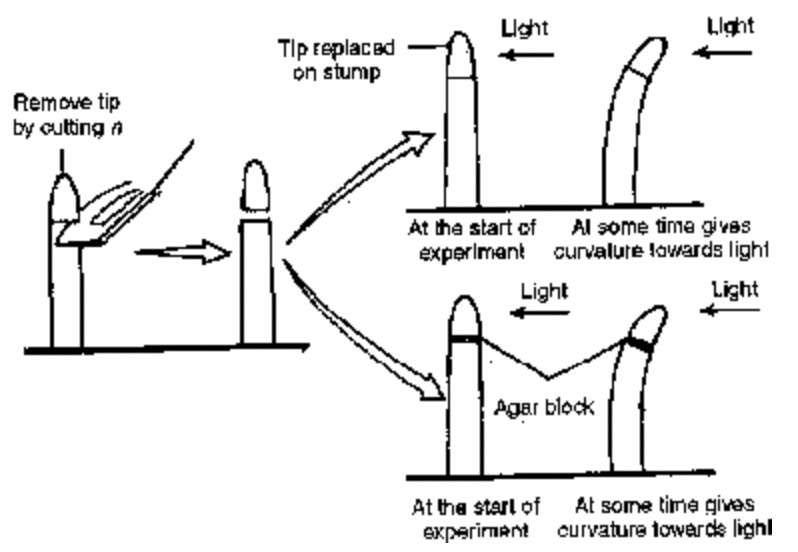
Fig. Boysen-Jensen Experiment
Went (1928) found that when an Avena coleoptile is decapitated its growth in length ceases. He further found that if we take tips and place them on an agar block for sometime and then placed on coleoptile stump, there is a curvature in coleoptile and this is proportional to the amount of auxin in agar.
The growth promoting substance was named by Went as auxin.
Kogl and Haagen Smith isolated three chemicals from human urine. They were named as auxina a, auxin b, and heteroauxin. Kogl et al (1934) found that heteroauxin is the real plant auxin and is chemically indole 3- acetic acid or IAA.
Indole 3- Acetic Acid is the universal natural auxin. It was discovered by Kogl et al (1934). Related chemicals are indole 3-acetaldehyde, indole 3-acetonitrile, phenyl acetic acid and 4-chloro indole acetic acid.
Synthetic Auxins : Many synthetic auxins are also being manufactured. The important ones are 2:4 D (2:4-dichlorophenoxy acetic acid), IBA (indole 3-butyric acid), NAA (naphthalene acetic acid).
Auxin Functions
Cell Enlargement
Cambial Activity : Degree of cambial activity is directly proportional to auxin concentration.
Cell Division : Auxin is known to promote division in the cells of vascular cambium.
Root Formation : Auxin promotes root initiation
Apical Dominance : Apical dominance is the phenomenon by which presence of apical bud does not allow the nearby lateral buds to grow.
Inhibition of Abscission : Auxin delays abscission of leaves and fruits. Its effect is through nonformation of abscission zone below a leaf or fruit.
Tropic Movements : Differential distribution of indole 3-acetic acid produces tropical plant responses like phototropism and geotropism.
Sex : Auxins have a feminising effect on some plants.
Seedless Fruits
Use of Auxins
Roots : IBA, IBA-alanine, NAA.
Parthenocarpy : IAA, IBA
Weedicides : Application of 2 : 4-D and 2 : 4 : 5-T removes broad leved weeds in cereal crops while dalapon kills grasses in broad leaved crops.
Flowering : NAA and 2, 4-D are often employed for inducing flowering in Litchi and Pineapple.
Prevention of Pre-Harvest Fruit Drop
Prevention of Lodging
Gibberellins
Gibberellins are weakly acidic growth hormones having gibbane ring structure which cause cell elongation of intact plants in general and increased internodal length of genetically dwarf plants, in particular.
Gibberellin Discovery
They are weakly acidic plant growth hormone which possess gibbane ring structure are able to bring about cell elongation of both leaves and stem.
- Kurosawa, 1926. He recorded bakane (foolish seedling) disease in Rice caused by a fungus Gibberella fujikoroi (Fusarium moniliforme). The infection caused increased growth in plants.
- Yabuta, 1935, Extracted the growth promoting substance and termed it gibberellin.
- Brian et al, 1955, Isolated GA3 (gibberellic acid)
About 100 gibberellins are known
Gibberellins are synthesized in plants in leaves of buds, developing embryos and root tip.
Gibberellin bioassay is performed through dwarf maize test and cereal endospesm test.
Gibberellin Functions
- Stem and Leaf Growth.
- Dwarf Shoots : Gibberellins specifically induce internodal growth in some genetically dwarf varieties of plants like Pea and Maize.
- Bolting : Gibberellins induce subapical meristem to develop faster. This cause elongation of reduced stem or bolting in case of resette plants like Henbane, Cabbage.
- Dormancy : Gibberellins overcome the natural dormancy of buds, tubers, seeds, etc.
- Seed Germination : During seed germination, especially of cereals, gibberellins stimulate the production of hydrolytic enzymes like amylases, lipases and proteases.
- Fruit Development : Along with auxin, gibberellins control fruit growth and development.
- Flowering : They promote flowering in long day plants.
- Sex Expression : Gibberellins promote the formation of male flowers
Gibberellin Uses
- Fruit Growth : Application of gibberellins increases the number of size of several fruits, e.g., Grape
- Parthenocarpy : Seedless pomaceous fruits can be produced by application of gibberellins to unpollinated flowers.
- Malt : Gibberellins increase the yield of malt from barley grains.
Cytokinins
Cytokinins are mildly basic growth hormones which are usually amino purine (occasionally Adenine) and promote cell division in plants.
Skoog and Miller (1954) discovered a substance (Kinetin) from DNA (obtained from Hering fish sperm), which increased cell division activity in tobacco pith culture. This substance was chemically found to be 6-furfuryl amino purine.
Later on such substances were also reported from coconut milk and yeast extract and such substances were named as cytokinins because of their property of inducing cytokinesis or cell division. These are also called phytokinins.
Examples of Cytokinins
Zeatin : Obtained from corn milk by Letham (1963)
Physiological effects
- Cell division : Cell division activity is enhanced by cytokinins (bioassay of cytokinins)
- Overcoming apical dominance : Cytokinins overcome apical dominance even in presence of apex.
- Induction of femaleness in plants
- Retards senescence : (Richmond-Land effect)
- Retards abscission
- Mobilization of food material : Is increased by application of cytokinins and this is the reason of release of apical dominance by cytokinins.
- Intergrity of membranes and retention of chlorophyll.
- Helps in opening of stomata.
Ethylene
They are gaseous plant hormone. Crocker (1930) reported presence of ethylene from plant organs and named it as gaseous hormone.
Burg (1962) established that ethylene is the only gaseous growth regulator.
Ethylene is more synthesized in nodal regions. Biosynthesis of ethylene occurs from methionine (a sulphur containing amino acid), which serves as a precursor of ethylene in all higher plant tissues.
Ethylene and fruit ripening : In most of the plants, there is a sharp rise in respiration rate near the end of the development of fruit, which sets in progress those changes, which are involved in ripening of fruit. This sharp rise in respiration is called ‘Climacteric rise’ or ‘Climacteric’ by Kidd and Went (1930). Ethylene is responsible for early climacteric or fruit ripening.
Ethylene increases transverse growth in the plant.
The commercial product for providing ethylene is ethaphone (2 chloroethyl phosphoric acid).
Ethylene functions : (a) Transverse growth, (b) Senescence, (c) Graviperception, (d) Flowering in pineapple.
Abscisic Acid (ABA)
(Stress hormone)
Carns and Addicott (1961-65) discovered 2 substances from cotton, i.e., Abscisin-I from old cotton bolls and Abscisin II from young cotton bolls, both of these are capable of inducing abscission of leaves.
Eagles and Wareing (1963) discovered another substance ‘Dormin’, capable of causing dormancy of seeds.
ABA is a naturally occuring growth inhibitor in plants.
- Abscission : ABA is an active substance inducing abscission of different plant parts.
- Seed germination : Seed germination is limited and hence induces dormancy of seeds and buds.
- Flowering : ABA inhibits flowering in long day plants.
- Maleness induced by GA is reversed by ABA.
- amulase synthesis induced by GA is inhibited by ABA.
- Cell division and cell elongation is delayed by ABA.
- As antitranspirant : ABA causes partial closure of stomata under drought and thus acts as antitranspirant (Hence also known as Stress hormone).
- Senescence : ABA induces senescence.



