






Drawbacks of Two Kingdom Classification
The Living World of Class 11
Drawbacks of Two Kingdom Classification
Higher organisms can easily be differentiated as plants and animals, but lower organisms can’t be easily placed either in the plant or animal kingdoms because these possess dual characteristics of both kingdoms. For example,
- Euglena resembles plants in having an autotrophic mode of nutrition as it contains chlorophyll pigment. However, like animals, it is a motile-bearing flagellum and lacks a cell wall.
- Sponges resemble plants in being fixed, having irregularly branched bodies. They have a holozoic mode of nutrition and excrete nitrogenous waste materials like animals.
The two-kingdom system takes unicellular and multicellular organisms together. Even unicellular organisms like bacteria were considered plants.
Unicellular plants (diatoms, dinoflagellates) and animals (protozoans) resemble each other in level of organization and reproduction by fission but placed in two separate kingdoms.
Table: Two Kingdom System of Classification

Fungi are included in the kingdom Plantae despite the fact they lack chlorophyll, and cellulosic cell walls and are either saprophytes or parasites, unlike typical plants.
Some of the organisms like viruses and lichens can’t be placed in either of these two kingdoms because of peculiar characteristics.
- Viruses lack protoplasm and exhibit characters of living organisms only inside a living cell.
- Lichens are peculiar in being association of an alga and a fungus having neither distinct plant nor animal characters.
It puts together eukaryotes with prokaryotes.
This system does not indicate the gradual evolution of early organisms into plants and animals.
Three kingdom system of classification
Ernst Haeckel (1866), a German zoologist suggested that a third kingdom, Protista be created to include those unicellular microorganisms that are typically neither plants nor animals. He included bacteria, algae, fungi, and protozoa under Protista.
Table : Three Kingdom System of Classification

Three kingdoms according to Haeckel are Protista, Plantae, and Animalia.
This solves the problem of assigning suitable kingdoms to the organisms which have similarities with both plants and animals. Drawback :
- Acellular and multicellular organisms are kept together in Protista.
- Bacteria and fungi have been grouped with unrelated organisms.
Four kingdom system of classification
Copeland (1956) suggested that all prokaryotes. i.e., bacteria, cyanobacteria, etc., be placed under kingdom Monera (= Mychota). According to Copeland, four kingdoms are Monera (= Mychota), Protista, Plantae, and Animalia.
Protists are single-celled eukaryotic organisms. Fungi continued to remain with plants.
The main drawback of this system is that fungi are not properly placed.
Table : Four Kingdom System of Classification
Five kingdom system of classification
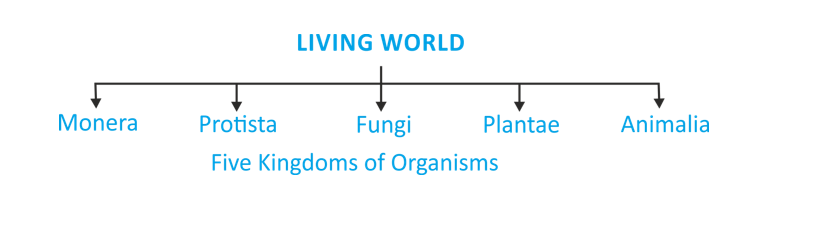
According to Robert H. Whittaker (1969), an American ecologist, non-chlorophyllous heterotrophic plants to be classified under kingdom Fungi. Five kingdoms in which the living world is divided are Monera, Protista, Fungi, Plantae/Metaphyta (Plantae) and Animalia/Metazoa (Animals).

Five Kingdoms of Organisms
The classification is based mainly on following three main criteria :
- Complexity of cell structure : prokaryotic or eukaryotic
- Complexity of cellular organization : unicellular to multicellular
- Mode of nutrition : autotrophic or heterotrophic.
- Other criteria include life style and the phylogenetic relationships.
Evolution is reflected through an increase in the complexity of the cells, as well as in the organism. The mode of nutrition also diverged in the multicellular kingdom viz Plantae, Fungi, and Animalia. The ecological role of these three multicellular kingdoms was also established as producers, decomposers, and consumers, respectively.
The organisms, according to the Five Kingdom System, are re-distributed into additional three kingdoms while retaining the two kingdoms - Plantae and Animalia. All multicellular, mobile and heterotrophic organisms were included in the kingdom Plantae. Some of the unicellular algae and protozoans were taken out from plant and animal kingdoms and were included in a separate kingdom Protista. All bacteria and multicellular blue green algae with prokaryotic cells were transferred from kingdom plantae to a new Kingdom Monera.

Five kingdoms showing increasing complexity during evolution
In the Five Kingdom classification, it is thought that the Monera has given rise to the Protista, which gave rise to the remaining three kingdoms of multicellular organisms, viz. Fungi, Plantae and Animalia.
Significance of five kingdom classification
This system seems more natural and indicates the gradual evolution of early organisms into plants and animals.
Kingdom Animalia has become more homogenous with the exclusion of protozoa.
Kingdom Plantae has become more coherent after the exclusion of bacteria, fungi, and some unicellular algal forms.
The creation of the kingdom Monera from prokaryotes is fully justified.
Some organisms like Euglena showing the mixotrophic mode of nutrition could be placed either in the plant or animal kingdom easily. The creation of the kingdom Protista including all unicellular eukaryotes, irrespective of the mode of nutrition, has resolved this problem.
The fungi, included as sub-division of division Thallophyta of two-kingdom classification is raised to the rank of a kingdom as they differ morphologically and physiologically from plants with whom they are grouped in old two-kingdom classification.
Five kingdom classification is undoubtedly better than two kingdom classification, resolving many problems, faced in old systems of classification. However, this system is also not perfect. Still it has some drawbacks as briefly discussed below:
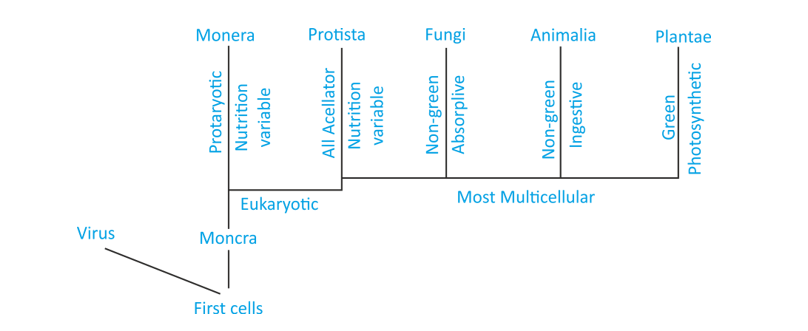
Phylogenetic relationship of five kingdom
Demerits :
- Kingdoms Monera and Protista still retain heterogeneity, as both heterotroph and autotroph organisms with or without cell walls are included in both these kingdoms. The slime molds are quite different from the other protists with which they have been combined.
- Multicellular green algae can’t be phylogenetically separated from unicellular algae and, thus unicellular algae-like Chlamydomonas have placed in the kingdom Plantae rather than Protista.
- Placing algae in three kingdoms seems to be unrealistic.
- Viruses do not find any place.
Copeland (1956) created the group of Mychota for prokaryotes. It was called Monera by Dougherty and Allen (1960).
Algae are spread over three kingdoms-Monera (Cyanobacteria). Protista and Plantae.
Dougherty (1957) distinguished prokaryotes and eukaryotes.
Related Topics



