






General Chemical Properties Of The Alkyl Halides For Class 12
Alkyl and Aryl Halides of Class 12
Carbon halogen bond in alkyl halide is polar owing to partial positive charge on carbon and partial negative charge on halogen. Due to the positive charge on carbon, any nucleophile can attack the molecule and if it is a stronger nucleophile than halide, it can substitute halide. So nucleophilic substitution reactions are the most common reactions of alkyl halides.
(I) Preparation of Organometallic compounds
R − X  RMgX
RMgX
(Grignard reagent)
R − X  R − Li + LiX
(Organo lithium compound)
Mechanism:
R − X + Li  [R − X]− + Li+
[R − X]− R∙ + X−
R∙ + Li R − Li
The extra electron in free radical anion occupies an antibonding molecular orbitals.
It must be noted that the reactivity of alkyl halides to form organometallic compounds increases from alkyl fluorides to alkyl iodies. Infact alkyl fluorides do not respond to the reaction and alkyl chloride and aryl halides give considerable yield only if THF (Tetrahydrofuran) is used as a solvent. Further, more the stability of free radical, more will be reactivity of alkyl halide to form organo metallic compound.
Alkyl organometallic compounds are good sources of carbanions (as carbon is more electronegative than the metals) and are very useful in organic synthesis.
(II) Reduction of alkyl halides
R − X 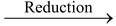 R − H
R − H
The reagents used for reduction of alkyl halide to alkane are Zn and CH3COOH, Zn and HCl, Zn and NaOH, Zn − Cu couple and alcohol, aluminium amalgam and alcohol etc.
(III) Wurtz reaction
---2R − X + Na ether R − R
Details about this reaction had already been discussed during preparation of alkanes.
(IV) Dehydrohalogenation of alkyl halides
R − X 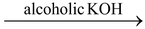 Alkene

Details of this reaction had been discussed during preparation of “alkenes”.
A very important reaction of alkyl halides i.e. Aliphatic nucleophilic substitution is dealt as a separately heading.



