






Conduction of Impulse

Share
Conduction of Impulse
Nervous System of Class 11
As neuron is a long, branched cell it requires to transmit the imulse from its point of generation to the axon terminals in order to produce effects in the body parts.
In myelinated and non-myelinated nerves the impulse is transmitted differently.
In non-myelinated axons
The impulse moves along the axon as local effect by altering the permeability of the neighbouring Na+ – channels and affecting every next channels in succession moving the effect ahead from axon hillock to the axon terminal.
This is called stepwise or local circuit theory of transmission and is comparatively a slower conduction, generally found in invertebrates.
In myelinated axon As the axon is insulated, the impulse generated at axon hillock can affect the Na+ channel only at the node of Ranvier where the axolemma is exposed, which means Na+ can cross the membrane only at these sites. Thus, effect moves forward from one node of Ranvier to the other in only few steps, called as jumping or saltatory transmission. It is comparatively a faster conduction found mostly in vertebrates.
Velocity of transmission of impulses is directly proportional to
- Degree of myelination — advantage to vertebrates.
- Temperature — advantage to homoeotherms, as the body temperature is constant and also higher than poikilotherms.
- Diameter of axon — advantage to sea squids whose axon diameter is about 1500µ so axon of sea squid is termed as giant axon while in vertebrate axon the maximum diameter is 25 – 35µ.
The average velocity of conduction in frog is about 20 – 25 m/sec. while in mammals it is about 100 – 200 m/sec.
The fastest impulse in some nerves of human being is upto 532 Kmph.
Synapse
It is the joint of two neurons — between the axon of one neuron and the dendron of another neuron.
Axon is termed as pre synaptic terminal while, dendron as post-synaptic terminal.
Synapse are of following two types:
Chemical Synapse Electrical Synapse
- Most common type – Uncommon type
- No direct contact between two terminals – Direct contact between both terminals
- Synaptic cleft (10 - 20 nm gap) of two – Synaptic cleft absent or may be a gap of terminals present between the membrane only 0.2 nm
- Terminal buttons (secretory vesicles or synaptic – Terminal buttons absent knob) present (diameter of 50 nm) at the end of telodendria
- Transmission of impulse mediated by chemical – Transmission of impulse in electrical manner called neurotransmitters without neurotransmitter The advantage of chemical synapse over electrical synapse is that the nature of neurotransmitter can be different with different kinds of responses either excitatory or inhibitory.
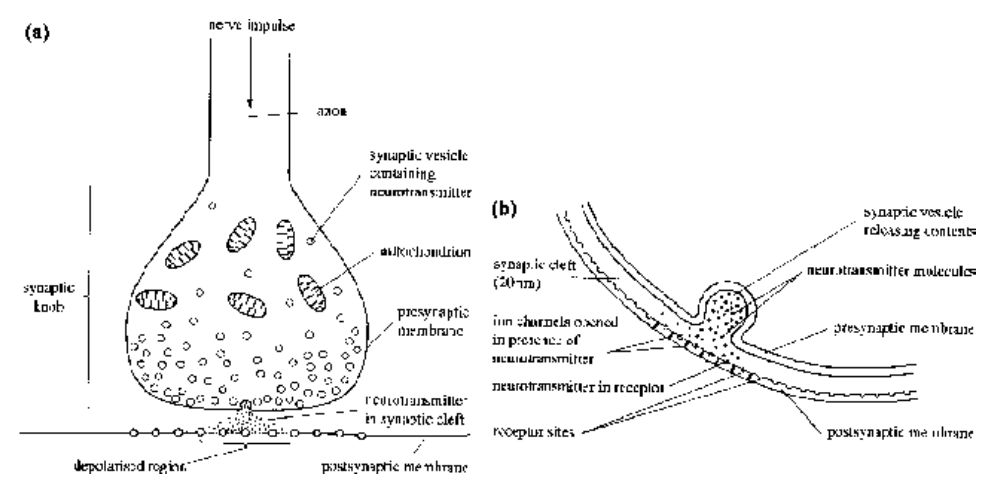
Fig.Structure of a synapse
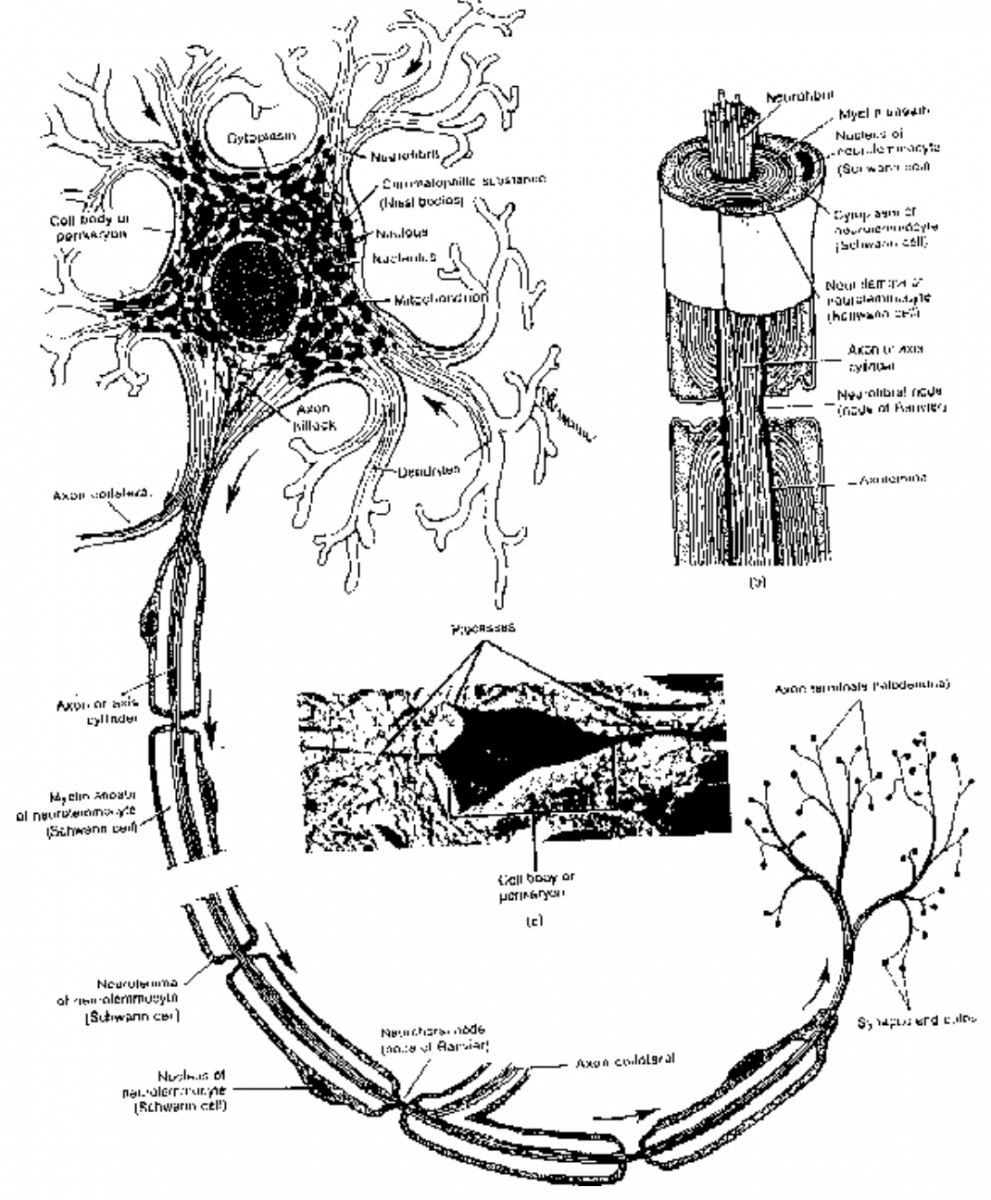
Neurotransmitters
In one synaptic knob about 10,000 molecules of neurotransmitter may be present. More than 30 types of biogenic amines (derivative of amino acids) and over 60 types of neuropeptides have been identified so far to have this role. Acetylcholine is excitatory for nerve and general muscle, while inhibitory for cardiac muscle. Sympathin, histamine, noradrenaline (adrenaline) are excitatory for all muscles and nerves. Serotonin, dopamine and GABA (-amino-butyric acid) are inhibitory for all.



