






Central Theme of This Theory
Theories of Evolution of Class 12
Central theme of this theory :
- Continous change in environment
- Use and disuse of organs.
- Inheritance of acquired characters.
Continuous changes in the environment directly affect organism’s structure and function.
Due to more use some organs increase in size while those not in use become reduced.
Changes acquired by organism, are inherited in their offsprings and many such changes make them different from their ancestors to be regarded as a new species.
Lamarck cited the examples of present day giraffe and snake.
Ancestors of present day Giraffe were, short grazing animals like common deer. Successive change of grassland into desert forced them to depend on bushes and tall trees. Constant raising of neck and fore limb resulted in their elongation.
Lizard like ancestors of snakes had limbs to pass through narrow passage in thick bushes, their limbs became obstacles hence being not used, it started degenerating and finally disappeared and body became thin and cylindrical.
Criticism
Darlington commented “Lamarck’s theory is an evergreen superstition”
Examples against the theory:
Muscles of arms and shoulders in blacksmiths, circumcison of foreskin of penis in jews and muslims, piercing of ear-lobe in Indian women, shaving of beard in man for many generations brought no change in their subsequent generations.
Weismann’s (1812 - 56) experiment of cutting tail of mice for many generations came as big blow to Lamarckism.
He later gave “ Theory of continuity of Germplasm ” (1892) stating that every organism consists of two components: (1) Somatoplasm (2) Germplasm
Changes only in the germplasm are inheritable.
Neo-Lamarckism
It is modified form of Lamarckism to remove its shortcomings. Lamarckism was later supported and redefined by many
- Mc Dougall (1938) : found that time taken for training the mice was reducing gradually through generations. This agrees with Lamarck’s idea that acquired learning is passed to the offspring.
- Kammerer (1924) : kept a species of salamander in black and yellow boxes separately. This affected the skin colour pattern in their offsprings.
- Sumner (1910): Rats reared at warmer temperature had long tail and pinna, which continued in their offsprings.
- Tower (1952) : found inheritable changes in all stages of potato beetle if subjected to varied temperature, humidity and other conditions. He also found the change at nucleic acid level due to effect of radiation.
- Guyer and Smith (1954) : Proved that the antibodies and hormones act as carrier of the somatic characters to the germplasm.
Darwinism
Theory of Charles Darwin (1809 – 1882): about evolution marks the beginning of an era in understanding of evolution. At the age of 22 he lead the expedition tour on H.M.S.Beagle (1831), studied variety of flora and fauna from different parts of globe, but found Galapagos Island most interesting, a “living laboratory of evolution”. Earlier a believer of “theory of special creation”, Darwin propounded Natural Selection as basis of evolution - and all organisms including man have arisen as modified descendants.
He was influenced by the ideas of -
- T.R. Malthus (1799) _ An Essay on Population
- Charles Lyell (1832) _ Principles of Geology
- Herbert Spencer (1856) _ Idea of Survival of fittest
A.R. Wallace (1823-1913) : a contemporary naturalist from Dutch East Indies had made similar studies in Malay Archipelago (Indonesia) and sent his paper - “ Tendency of varieties to depart indefinitely from original type “ to Darwin for comment who had also written a similar article by that time, hence they published (1858) this article jointly as “Origin of Species”
Later with the help of Lyell and Hooker Darwin published (1859) his complete book “Origin of New Species by Natural Selection” : “The Preservation of Races in the Struggle for Life”.
Main theme
- Enormous fertility
- Struggle for existence
- Variation and heredity
- Survival of fittest
- Origin of species by Natural selection
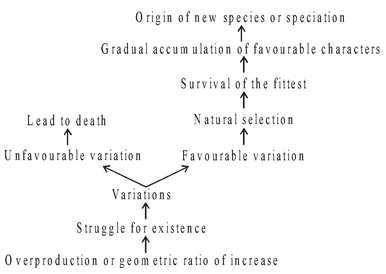
- Enormous fertility : All organisms have enormous capacity to reproduce; Oyster lays a million egg; salmon - 2.5 crore eggs ; 1 pair elephant (slowest breader) 2 crore in 750 years. The no increases geometrically, but the nature controls itself by
- Struggle for existence : High number of individuals lead to struggle for food, shelter, reproduction — both interspecific (prey - predator ; host - parasite) and intraspecific, struggle with nature includes flood, famine, cyclone, earth quake to take heavy toll of life. Thus constancy of population is maintained.
- Variation (Adaptation): makes the organism able to succeed all the above struggles; which makes one different from its parent or kin. These changes are inheritable and accumulate in the population.
- Survival of the fittest : The term first used by Herbert Spencer (1856) means those individual which undergo suitable variation as per existing condition only survive (selected) while others do not (rejected)
- The changes which make them fit to survive was termed as “Natural Selection” by Darwin. This is the basis for formation of new species. Hence, he believed evolution as a slow gradual and long time process.



